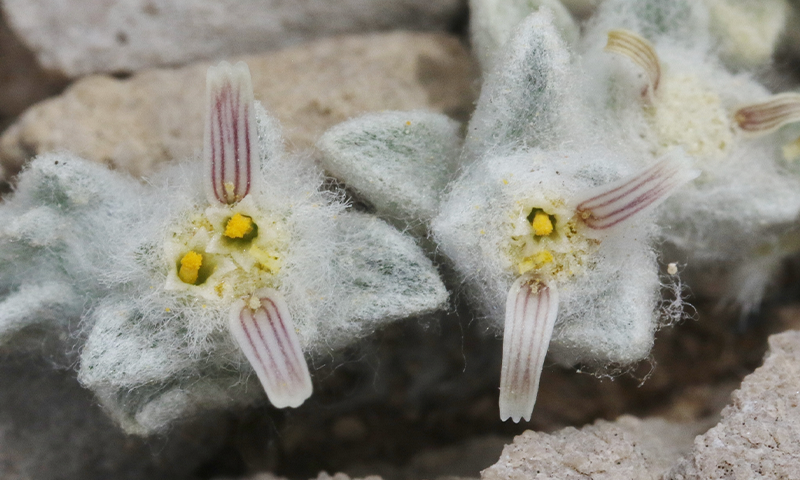
At first glance, these little star-shaped plants look anything but intimidating. They sprout butter-yellow flowers and downy fuzz and, measuring just a few centimeters across, they are so discreet that they belong to a class of plants botanists affectionately call “belly plants”—those that are best observed while lying on the ground. Yet researchers recently dubbed this new-to-science species the Woolly Devil (Ovicula biradiata), so-called because of its hairy appearance, its characteristic ray florets, which resemble devil horns, and the proximity of some populations of the plants to a secluded trail through the Chihuahuan desert known as the Devil’s Den.
Co-authors of the first Woolly Devil study, published in February, say there’s reason to believe these fuzzy flowers could possess healing capabilities. When researcher Keily Peralta of the California Academy of Sciences studied the downy plant under an electron microscope, she found that it sported specific glands, similar to those found in other sunflowers of the Helenieae tribe, that suggest it may produce compounds with medicinal value.
Big Bend National Park volunteer Debra Manley first came across a few specimens of the Woolly Devil in the gravel on March 2, 2024, while hunting for rare plant populations. She snapped some photos and later uploaded them to community science app iNaturalist, which spurred a scientific frenzy. An international community of botanists soon descended on the Chihuahuan Desert to get to know the diminutive flower.
It turns out, the plant is a type of sunflower that is entirely new to science, even though the region where it was discovered has been subject to countless botanical surveys over the past century.
These fuzzy flowers could possess healing capabilities.
Though certain differences in the Woolly Devil’s genetics and appearance—its small size, fuzzy foliage, annual habit, and ray floret coloring—justified the creation of a whole new genus, it was almost immediately clear that this flower was a member of the daisy-and-sunflower family (Asteraceae). Asteraceae encompasses tens of thousands of plant species who all share a common flower head shape, known as a “capitulum.” These distinctive bodies look, on the surface, like a single flower, but are actually composed of several individual florets, clumped together on the same stem-like structure.
Ultimately, researchers hope that the discovery of this diminutive plant underscores the importance of preserving plant biodiversity and spurs further studies on lesser-known or overlooked species.
“There’s so much about this plant’s life history, chemistry, conservation, and therapeutic uses that could go unknown without more research,” said study lead Isaac Lichter-Marck, a post-doctoral researcher at the California Academy of Sciences. “It’s rare for people to recognize that the vast majority of our medicines today come from plants—and that they can hold a huge amount of potential for future medicines.” 
Lead photo by James Bailey