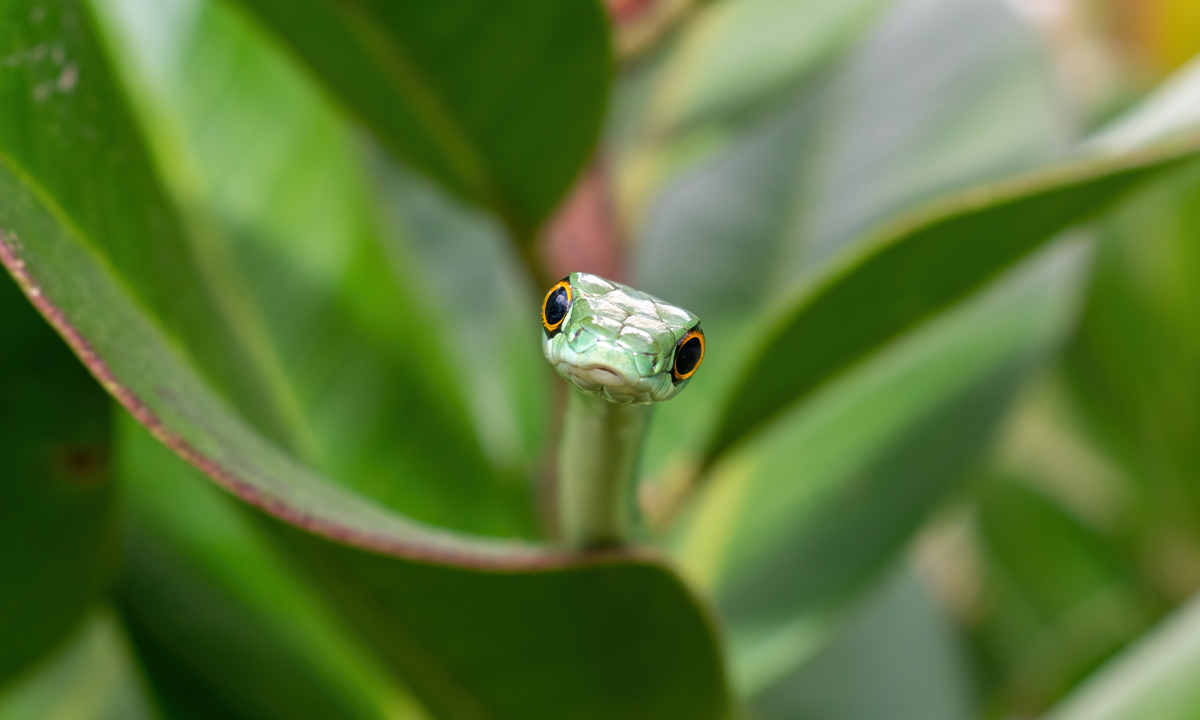
Snakes are scary!
Or are they? Of the roughly 4,000 snake species in the world, no more than 15 percent are venomous. And unless you live in tropical wilds, your chance of getting bitten by a snake is way lower than your chance of getting run over by a car. Yet we give passing cars a benefit of the doubt that’s rarely offered to passing snakes.
In a recent study published in Anthrozoös, research psychologists from Canada and the United States studied how children become indoctrinated to the idea that snakes are nightmare fuel. In particular, they wanted to understand how urban children view snakes compared to other animals. “Childhood is a critical time for shaping someone’s attitudes and behaviors toward animals,” said study author Jeff Loucks at Oregon State University in a press release.
Read more: “Giant Pythons Once Roamed Prehistoric Taiwan”
The researchers studied middle-class kids living in or near Regina, Saskatchewan. A sample of 48 5-year-olds looked through photos of snakes in nonthreatening poses with their parents. From videos of the sessions, the researchers noted negative language about snakes, hypothesizing that the parents’ perspective would shape their children’s. Then, in randomized treatment groups, the kids either heard a researcher read a story objectifying a snake as “it” or a story using he/she for the snake. Finally, using drawings, the kids were tasked with indicating similarity between a snake, a human, and various other animals.
During the picture-book session, nearly half of the parents (46 percent) said something negative about snakes—from “He might bite you” to “Baby snakes, yuck!” The children who heard more negative language were less likely to equate the snake with a human. Children who heard the researcher’s story with the snake objectified as an “it” were also less likely to equate snakes with humans. In both cases, however, the kids readily equated the snake with other animals.
But if the kids didn’t see the picture book or hear the story about a snake, they no longer grouped snakes with other animals. It’s like the unique body forms of snakes naturally set them apart from a human perspective. And so, perspective may be powerful when it comes to the conservation of animals threatened by public attitudes. “(A) brief education about the biological nature of snakes can (at least temporarily) alter children’s conceptualization of snakes,” according to the study authors.
Or as Loucks put it, “Some exposure to snakes and learning about their biological needs can act as an inoculation against negative attitudes toward snakes, which can help to engender care and respect for these animals.” 
Enjoying Nautilus? Subscribe to our free newsletter.
Lead image: Craig Cordier / Shutterstock