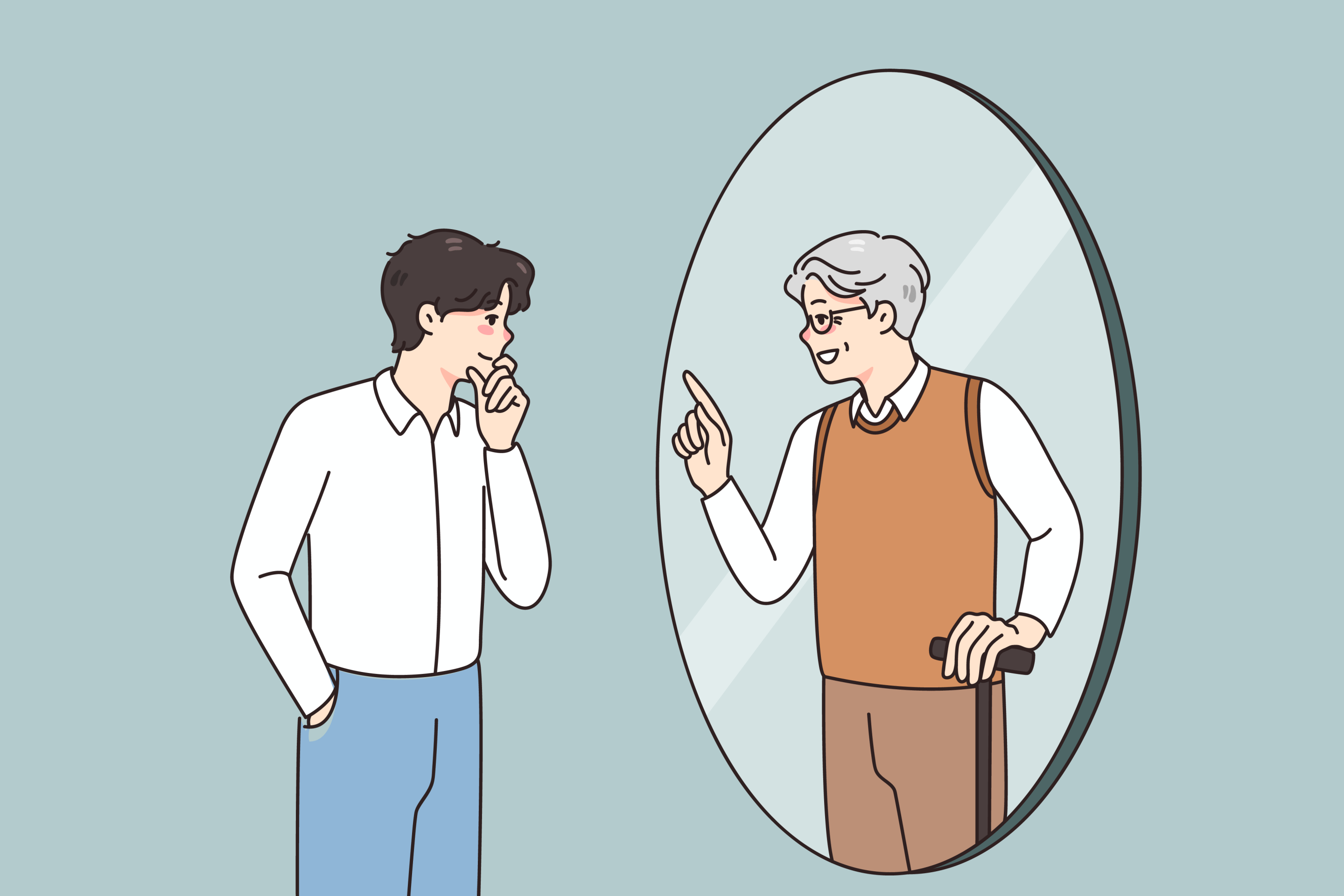
It’s long been assumed that happiness across the lifespan shows a distinct “U” shape. When we’re young, and in relatively good health, we have high levels of happiness. In mid-life, happiness slumps as people grapple with the demands of adulthood and responsibilities of family life. As those responsibilities lessen with age, and as people gain more wisdom and perspective, their levels of happiness rise again. Decades of research had borne this out. U-shaped happiness curves seemed to be integral to the human experience. One study even reported that the pattern held in nonhuman primates in captivity, including chimpanzees and orangutans.
But new research points out that most of the popular studies in humans (and in fact, even the nonhuman primate study) were done in well-resourced countries and regions, such as the United States and Europe. Lifetime happiness assumptions, it turns out, might have a WEIRD problem. That term was coined in 2010 by social scientists to describe a bias found in many studies of human behavior, which have historically recruited participants primarily from Western, educated, industrialized, rich, and democratic populations—abbreviated as WEIRD.
Evolutionary anthropologist Michael Gurven had noticed in his observations of small-scale societies in Bolivia, which depend heavily on farming and foraging, that happiness seemed to continue declining in older adults as they aged. In WEIRD countries and population samples, people are often able to retire and take on work that requires fewer physical demands when they reach old age. But when your working life revolves around physical labor, as in small-scale farming and foraging societies, hardships are more likely to increase as health deteriorates, he theorized.
In a recent study, published in Science Advances, Gurven put his intuitions to the test. He and his colleagues assessed happiness in more than 9,000 people from numerous different small-scale subsistence societies and forest foraging communities living in more than 20 low-income countries across Latin America, Asia, and Africa.
Lifetime happiness assumptions, it turns out, might have a WEIRD problem.
“What we found was that there was a lot more variability than is acknowledged in the literature,” says Gurven, a professor at the University of California, Santa Barbara. Happiness levels in these populations rarely followed a U-shaped curve. In most cases well-being stayed the same or declined from ages 45 to 70, but in some cases they found no age-related trends in happiness at all, or even inverted U shapes.
The findings have implications not just for subsistence and horticultural communities in low-income countries, but also for wealthy countries in which lifespans are lengthening faster than healthspans and the social safety net is threatened, he says.
Gurven and his colleagues used a variety of methods to collect their data. They conducted on-the-ground surveys with the subsistence societies, asking participants to rate their overall life satisfaction, happiness, and fulfillment on a numbered scale. For forest foraging societies, they pulled numbers from existing databases that measure life satisfaction. For the Tsimane, an Indigenous group in the Amazon, they relied on a database of data on depression as a proxy for well-being.
In his analysis of forest foragers in low-income countries in particular, Gurven found that age explained less than 5 percent of the variation in well-being. Disruptive high-stake events like crop failure, as well as illness, tended to have a greater impact on life happiness than age. Crop failures are likely less of a concern among older people living in wealthy industrialized places, where most people do not grow their own food or depend on farming for income. Further, at least one meta-analysis showed that correlations between health and happiness in old age are much lower in high-income countries than in low-income ones, where illness could make it more difficult to maintain a livelihood.
The findings also showed that a person’s ability to be a productive and valuable member of society had a greater impact on happiness in lower-income and subsistence societies, especially among older adults—the idea being that when one is not providing value to the community, one’s social capital is weakened, compromising the social safety net on which they depend. “Zooming out, those things matter a lot more than just age,” Gurven says. 
Lead image: klyaksun / Shutterstock