The power of platforms like Facebook and Google has escaped the control of the optimistic technocrats at their helm. And it is wreaking havoc in ways that we lab rats have only just begun to understand. At least, that’s the case Netflix’s new documentary The Social Dilemma, directed by Jeff Orlowski, makes. Through interviews with repentant tech leaders, we learn how websites that began as ostensibly innocent attempts to bring people closer together have since mutated into sophisticated, self-teaching attention-harvesting machines that are getting better and better at keeping us glued to our devices.
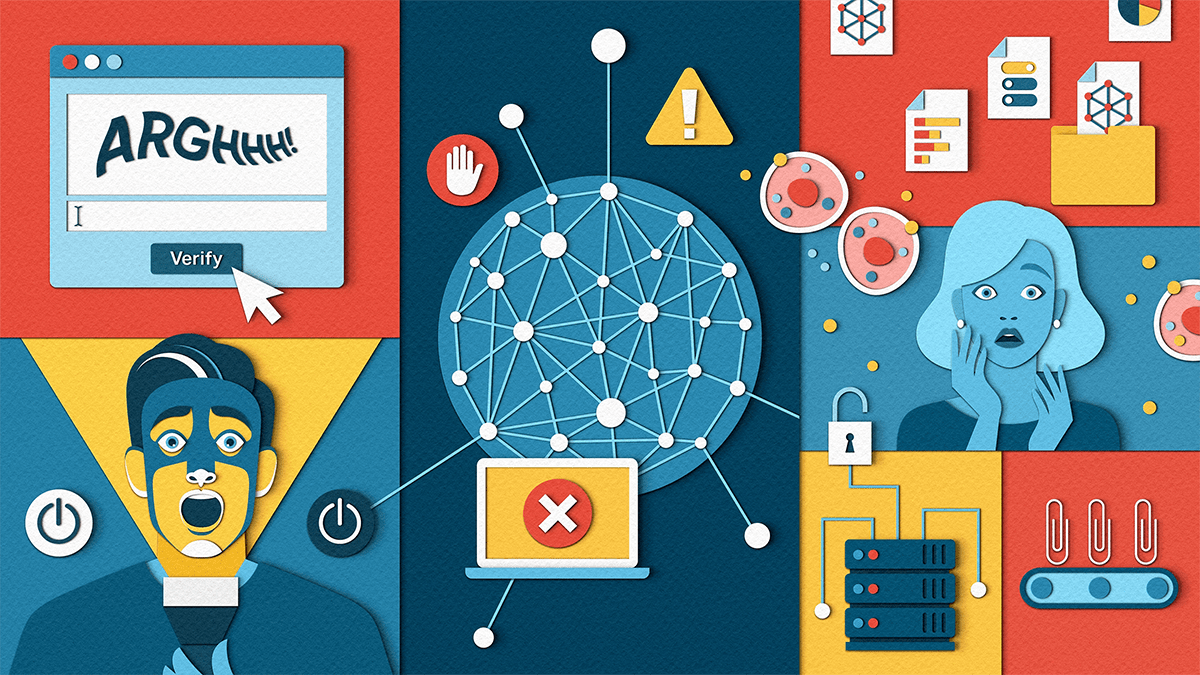
The nefarious algorithms at work, hilariously personified in the film by actor Vincent Kartheiser, analyze our online activity to build a detailed model of our preferences. They then use these to spoon-feed us personalized content and cleverly timed notifications, all in service of selling valuable ad space.
Whether we’ve truly been “checkmated” as a species seems more of an open question than the film acknowledges.
The film dramatizes the runaway consequences of this profit strategy—ranging from mental health issues to ideological radicalization—with periodic vignettes of a fictional family struggling to navigate their digital landscape. There’s a young girl (played by Sophia Hammons) dealing with “Snapchat dysmorphia,” for example, while her older brother (played by Skyler Gisondo), feeling alienated in his real-world social life, is dragged down a fringe YouTube rabbit-hole that ends with his arrest at a protest. While the dramatization is sometimes heavy-handed, it gets its message across: Social media can indeed harm mental health, radicalize vulnerable users, and disrupt a society’s ability to agree on basic facts.
Journalists and watchdogs have been pointing out these issues for years, but the film’s value isn’t its novelty—it’s that it’s a polished and cohesive synthesis of various threads of the conversation. Plus, the rhetorical punch is arguably more powerful coming from the people who helped create the problem, like Justin Rosenstein, co-inventor of Facebook’s “like” button, and Tim Kendall, former president of Pinterest.
The film treads carefully, perhaps too carefully, in its treatment of the political implications of its argument. For example, it declines to acknowledge that fake news is disproportionately shared by people who are older and more conservative, and the dramatized vignettes about polarization feature a vague movement called the “extreme center.” The film’s creators may have decided not to risk alienating right-leaning viewers, which is understandable. But these large tech companies’ numerous political conflicts of interest—say, Facebook’s reliance on rightwing populism for engagement, or its clear financial incentive to help elect politicians who won’t raise its taxes or break it apart—could have been an interesting topic for discussion.
Also, there’s an unnecessary touch of “social media is changing our brains!” alarmism. The fact is that just about everything changes our brains. As science blogger Neuroskeptic pointed out, “The brain’s job is to respond to things. Its activity is change. Brain activity is ever-changing and, for that reason, changes are almost always reversible.” Many changes certainly are for the worse, like an increase in depressive symptoms or the development of an addiction, but to treat social media-induced brain change as a bad thing in and of itself is unproductive.
In general, though, the film’s treatment of the psychology and neuroscience of the attention-extraction economy is compelling. One section highlights the stark mismatch between the prehistoric social environments our brains evolved to handle and the much larger and more gamified social environments we face now. “We curate our lives around this perceived sense of perfection because we get rewarded in these short-term signals—hearts, likes, thumbs-up,” says former Facebook executive Chamath Palihapitiya. “And we conflate that with value and we conflate it with truth.” The film mostly covers this mismatch with reference to adolescent mental health, but it’s also worth considering how it can distort our sense of right and wrong.
One of the most intriguing debates surrounding social media is how much agency we should expect of ourselves. Can’t we just choose to put down our phones once in a while? Or has this technology hooked us so deeply that our only chance of salvation is government regulation?
The film strongly endorses the latter stance. At one point, Tristan Harris, a former design ethicist at Google who has been called “the closest thing Silicon Valley has to a conscience,” claimed that social media, with all the “addiction, polarization, radicalization, outrageification, and vanityification” it inflicts on us, represents “checkmate on humanity.”
Research on willpower suggests that systemic changes are indeed better than effortful self-restraint at helping us avoid temptation and behave more intentionally. Plus, the argument that we should deal with the dangers of social media on our own can come across as cruelly individualistic tech-apologia. But whether we’ve truly been “checkmated” as a species seems more of an open question than the film acknowledges.
Either way, if there’s one thing that The Social Dilemma does extremely well, it’s to force us to confront the possibility that we have far less control over our behavior than we like to think. Now keep scrolling.
Scott Koenig is a doctoral student in neuroscience at CUNY, where he studies morality, emotion, and psychopathy. Follow him on Twitter @scotttkoenig.