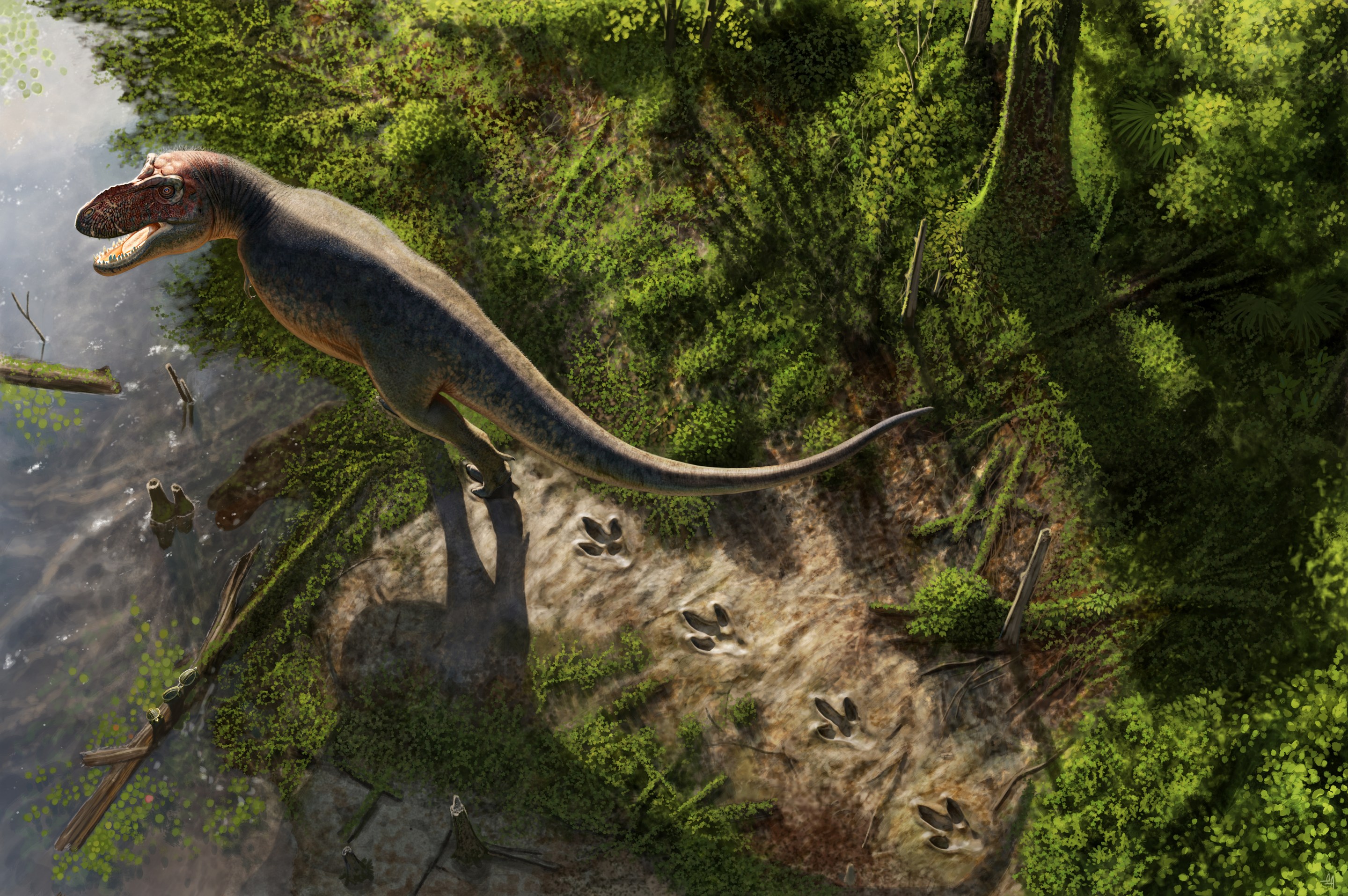
Dinosaur footprints that remain preserved over millions of years are incredibly rare, and trackways—several footprints in sequence—even more so. Now archaeologists have discovered what they believe to be the first trackway left by an adult T. rex, in the Hell Creek Formation of southwestern North Dakota, a site that dates back 66 million years.
The trackway stretches about 23 feet and consists of four individual footprints left behind as the dinosaur walked along: left, right, left, right. The prints measure up to 3.3 feet in length and show a stride length of around 13 feet. (In paleontology, a stride is two paces, or left foot to left foot.)
What’s surprising about the trackway is that it’s made up of mounds of sandstone (technically termed internal molds inside concretions), rather than holes in the ground.
Essentially, a Tyrannosaurus rex plodded along in the mud, leaving four deep depressions. Sand eventually washed in and filled these holes, which turned to rock with the help of a calcium carbonate “glue” provided by groundwater, which affected the sand but not the surrounding mud. Over millions of years of erosion, the softer side sediment got taken away, leaving the solid rock casts of the original footprints.
Based on the prints, researchers estimate that the T. rex wasn’t in a hurry, traveling along at around 3.5 to 4.5 miles-per-hour, roughly the same speed as a brisk walk for a person. Also notable is the narrow “pace angulation” of the trackway, with the footprints finding that the dinosaur walked almost in a straight line, with little swaying to the left or right.
“Bones tell us an enormous amount about these animals, but footprints capture a moment of behavior,” Tyler Lyson, senior curator of vertebrate paleontology at the Denver Museum of Nature and Science, said in a statement. “With a trackway, we can actually follow an animal as it moved across the landscape. That is incredibly rare for T. rex.”
The size and the narrow shape of the three toes on these prints make an adult T. rex the most likely dinosaur to have left its mark here, the researchers say, while the number of T. rex fossils in the surrounding area make it likely that it was the only predator of its size roaming around this particular part of the world.
Three of the footprints are due to be airlifted out of the area and displayed at the Denver Museum of Nature and Science—if that happens to be within walking distance for you. 
Enjoying Nautilus? Subscribe to our free newsletter.
Lead Image: Andrey Atuchin