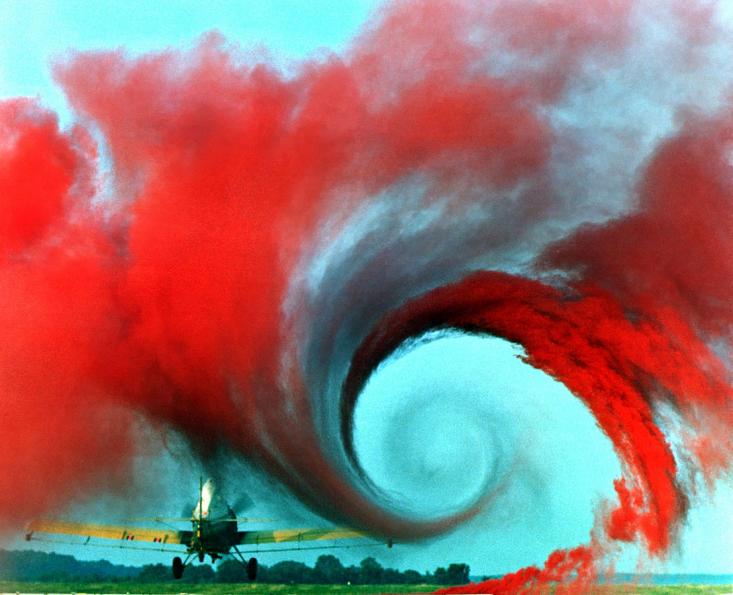
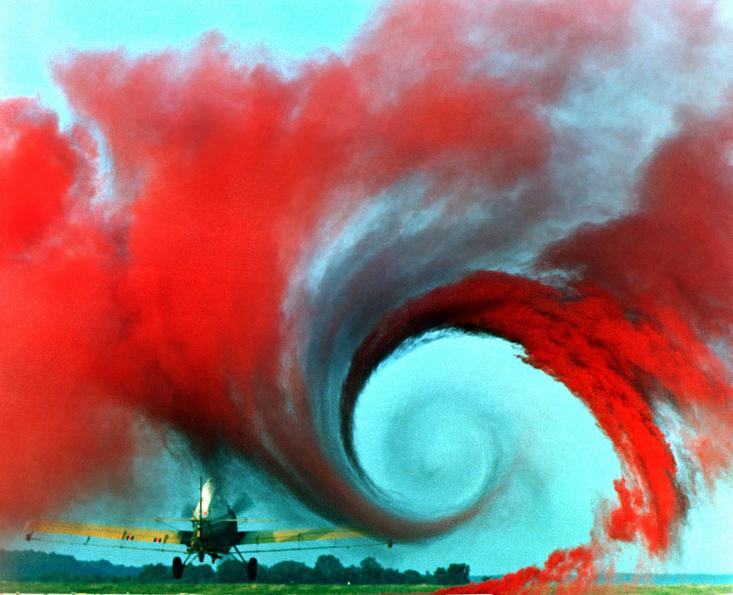
In many of the times we encounter turbulence in our lives, it is preceded by a calmly worded warning from above. “Uh, folks, we may hit a few bumps,” a pilot announces over the plane’s PA system—or something to that effect. The pilot’s unpretentious, unbothered tone is reassuring, and we generally ride out the unwanted roller-coaster without incident. But what’s happening inside the cockpit—are pilots as calm as they sound? Are they worried about turbulence?
To find out, we talked to Ed Bagden, a pilot at Republic Airlines, and asked him some questions that Nautilus readers submitted via Twitter. Here are some of his responses, lightly edited for length:
Miriam Kramer: How much of a commercial flight is actually done with a computer vs. manual operation?
Ed Bagden: On a vast majority of flights, the aircraft is manually flown through takeoff and initial climb, at which point the autopilot is selected on. The autopilot depends on pilot input and monitoring to provide control inputs to the aircraft. Having the aircraft maintain altitude and course without constant pilot input helps reduce workload and fatigue. The autopilot is often used during descent and arrival, but the pilot will turn the autopilot off and manually perform the landing.
The technology exists for aircraft to auto-land under the careful supervision of the flight crew, but this capability is only available to certain aircraft on select runways with specific certification for the pilots. In nearly all cases, it is preferable to land the aircraft manually, as there is still great value in having a well-trained pilot at the controls.
Blair Hickman: Can turbulence actually bring down a plane?
EB: Aircraft are designed and engineered with enormous safety margins and procedures for nearly all conceivable situations. We have specific airspeeds to fly when penetrating rough air that ensure the structural integrity of the aircraft cannot be compromised. As a result, it is impossible for turbulence to take an airplane down.
Maggie Chok: Is there any other experience you can liken to sitting in a cockpit in the sky? Or is that kind of aesthetic and sensory satisfaction only available to those with wings?
EB: As pilots we often say that we have “the best office view in the world.” While it is a unique experience that is hard to replicate, you need not be an airline pilot to experience it yourself!
I would recommend that you find a nearby airport that offers discovery flights; for a small fee, an instructor will take you up in a small airplane where you can experience the same things that we do as airline pilots, not the least of which are the views. I’d venture to say that the experience is even more breathtaking and visceral in a small aircraft than in an airliner.
Stephanie Drimmer: Does an airplane’s low-oxygen environment have an actual physiological effect on passengers? If so, are pilots/captains similarly affected?
The cabin is typically pressurized to an equivalent altitude of 6,000–8,000 feet above sea level. Just as a person acclimated to living at sea level may experience altitude sickness when visiting a high elevation city, passengers may experience headache, nausea, fatigue, lack of appetite, and dehydration. As pilots, we are constantly working at altitude, and over time our bodies become acclimated to the conditions.
Francie Diep: Are there any health problems pilots encounter more often than other people?
EB: The most significant health risk that pilots are exposed to through their occupation is cosmic ionizing radiation. The atmosphere absorbs much of this radiation before it reaches the surface, but at high altitudes, especially near the Earth’s poles, the level of radiation exposure is significantly higher.
On airlines that often fly polar routes, the pilots wear a badge that monitors radiation exposure; the pilots turn them in periodically for laboratory analysis to ensure that safe levels of exposure are not exceeded.
Patricia González: Are you ever been afraid of flying, if only for a few seconds?
EB: I have had a passion for aviation since childhood, and I have always found excitement around airplanes. Pilot training emphasizes worst-case scenarios, and we are expected to have expert knowledge of the aircraft we fly. We are constantly evaluated on our knowledge and skills, and I have absolute confidence in myself, the other crewmembers, the support staff, and airplane. If I had any doubt in the safety of what I do for a living, it would be unthinkable to continue doing it.
Ross Rozanski: What’s the scariest thing a student pilot has ever done in your plane?
EB: It is important to allow a student to make mistakes, learning to make decisions while recovering from their errors on their own. But it is the instructor’s responsibility to know when to intervene.
A particular incident comes to mind when my student in a Cessna 172 touched down with the right wheel brake completely locked! In flight training there is a fundamental rule that if the instructor says “my controls,” the student will release the controls and say “your controls.” In this situation, the student quickly relinquished control and the airplane was righted.
David Manly: My nephew asks: Where does the pee go?
EB: Into a tank, where it is emptied by the ground crew in between flights.
Rose Eveleth is Nautilus’ special media manager.