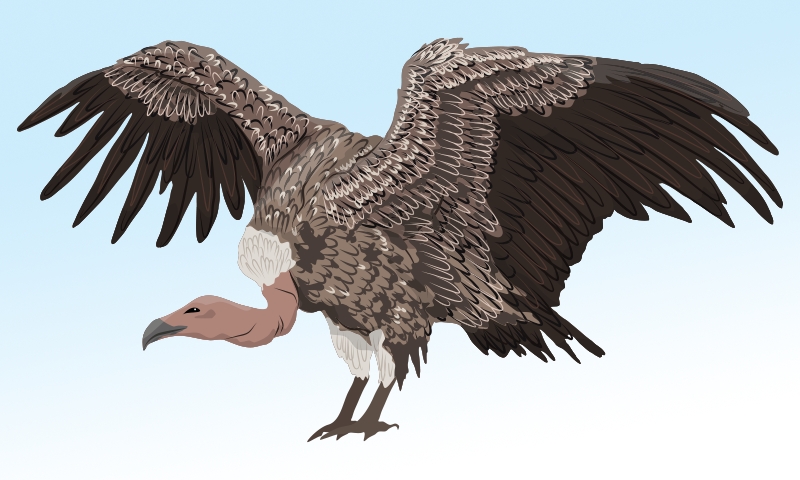
Vultures, hyenas, and other scavengers tend to have less than stellar reputations. Because they are attracted to the smells of decaying flesh they are often associated with death. If you see vultures circling, you can probably assume that some creature is nearing its end or has just departed. And they’re freeloaders: They don’t work for their lunch as much as the hunters of the animal kingdom do, they just steal the spoils. So, while scavengers are essential to a functioning planet, helping to clean up nature’s messes and to protect against the spread of disease, they also tend to inspire disgust.
It might come as a surprise, then, to learn that early humans may have relied heavily on scavenging, even after they had the tools to hunt. This is the finding of a sweeping study by a team of Spanish paleontologists, archaeologists, and ecologists, who reviewed theoretical work as well as experimental observations in the field of carrion ecology. Their finding upends conventional wisdom on the subject, which held that for early human ancestors, the risks of eating already dead animals would have outweighed the benefits. The study was published in the Journal of Human Evolution.
"When large terrestrial and marine mammals die, they provide tons of easily accessible food, enabling many scavenger species to coexist and feed at the same time," said Ana Mateos, a researcher in paleophysiology and human ecology at the Centro Nacional de Investigación sobre la Evolución Humana in Spain and the lead author of the study, in a statement.
Earlier scholars thought scavenging was too unpredictable, and already-dead animals too scarce, for it to be a frequent approach to finding food for ancient humans. And the risks—of attack from a lingering predator or of catching a disease from the rotting meat—would have been too great.
But the new research suggests that carrion may have been a more dependable resource than previously thought, especially when plant food sources were scarce. The scientists also suggest that humans are, in fact, well adapted to scavenge: They have defenses that could protect against disease from carrion, such as a particularly acidic stomach to help kill off potential pathogens. And when humans learned to use fire to cook, that would have added another layer of protection. They also had the language and social skills to coordinate with one another to find carrion in the wild and bring it back home for dinner.
Evidence of early human meat-eating has been surfacing since the 1960s, when archaeologists began finding stone tools and butchered animal bones dating from more than 2 million years ago at numerous African sites. That set off a debate among scholars about where the meat came from: whether our ancestors scavenged or hunted, or both, and when each practice might have evolved.
Until now, the consensus had generally been that as soon as humans began to hunt, they abandoned carrion as a source of meat. That line of thinking, which posited that humans evolved in a straight line from scavenger to hunter to farmer, may have partly developed because scavengers have historically been seen as marginal or primitive creatures. But this view of scavengers has more recently been debunked.
The new work suggests that scavenging persisted among humans long after hunting emerged. So while it has long been argued that “eating meat made us human,” says Mateos, an equally true statement might be that “scavenging made us human.” 
Lead image: AnnstasAg / Shutterstock