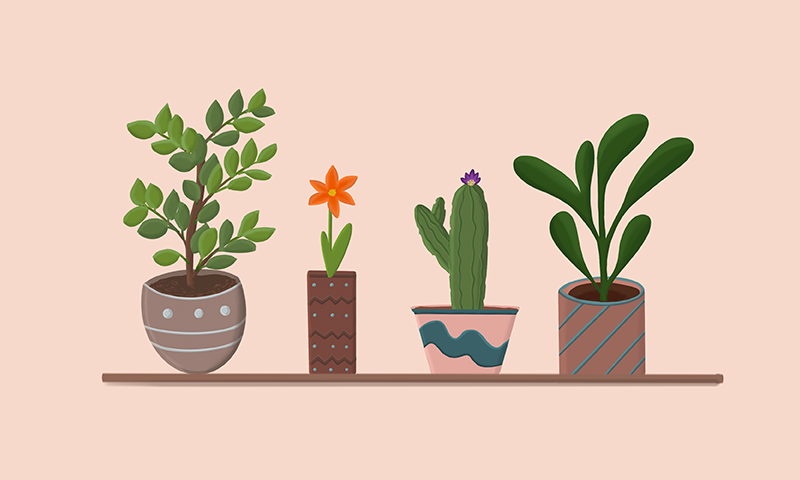
People have adorned their homes with greenery for millennia—in China, for example, people may have brought plants indoors more than 3,000 years ago. But houseplants became especially popular amid the rapid surge of industrialization in the mid-19th century in Europe and the United States, when people might have been craving a bit of nature in their cramped living spaces in polluted cities.
The COVID-19 pandemic ushered in another escapist houseplant frenzy, and this living decor remains exceedingly popular. Research has suggested that houseplants boost our mental health by, for instance, easing stress and depressive symptoms. They’ve also been linked with improved cognition on cognitive tasks, and less frequent sick leave among workers. Natural materials like wood have also been found to enhance mental and physical well-being.
But what dose of indoor greenery is ideal to reap the most benefits? The methods used in previous studies aren’t uniform enough to offer a clear answer, according to a new paper published in the journal Sustainable Cities and Society. For example, some papers only analyze the impacts of nature versus no nature in a room, or subjective amounts of plants.
Read more: “What Plants Are Saying About Us”
For a more precise measurement, researchers from Stanford University created a software called the Nature View Potential tool. This calculates how much nature people can glimpse in a specific indoor space. “The tool is calculating how many of those rays that are coming from your eyes are seeing natural elements,” said study author Eva Bianchi, who recently received her Ph.D. in civil engineering at Stanford University, in a statement.
The team combined this tool with 3-D modeling software to create realistic-looking virtual office environments with different levels of plants, wood, and window nature views. They recruited 412 participants from a crowdsourcing platform and randomly assigned them to these digital rooms. After completing a survey that assessed various measures of well-being, the subjects did some tricky tasks in these leafy environs, including counting down from 1,022 to zero in increments of 13. To make things even more stressful, Bianchi told participants their scores were below average—and that they weren’t getting paid (they were, in fact, paid for their time at the conclusion of the study).
Ultimately, a 20 percent dose of nature “had the strongest response in restoration and sense of belonging for participants,” according to the statement. Yet the room with the highest dose in the paper—60 percent—appeared to intensify stress the most. “I wasn’t expecting this at all,” Bianchi said in the statement. This outcome “was contradictory to prior work.”
The paper also indicated that those who reported an elevated connection to nature got more out of its presence indoors than those who didn’t. But this work has limitations, primarily that the experience was purely digital rather than in real life.
Going forward, the Nature View Potential tool could help designers envision healthy indoor spaces, including schools and offices, the authors say—giving our spaces just the right amount of flora for us to thrive. 
Enjoying Nautilus? Subscribe to our free newsletter.
Lead image: Reytschl / Pixabay