Mark Urban was not in the Arctic to study ice. He was looking for fish—tracing their travels from lake to stream and back again, as they navigate their changing world. But at all hours, in the field and in his campsite, he could hear it. Plink, plonk, plink. Pebbles subsumed in ice thousands of years ago being released from previously frozen lake banks, dropping into the water below.
Urban, an environmental ecologist and director of the Center of Biological Risk at the University of Connecticut, was conducting his experiments with colleagues at I-Minus Lake, in far northern Alaska. The lake is surrounded by permafrost that is now rapidly warming and melting, releasing its material to the unfrozen world around it. “All day and all night, you hear that melting of the ancient ice,” Urban says.
You see the land just disintegrate—almost before your eyes.
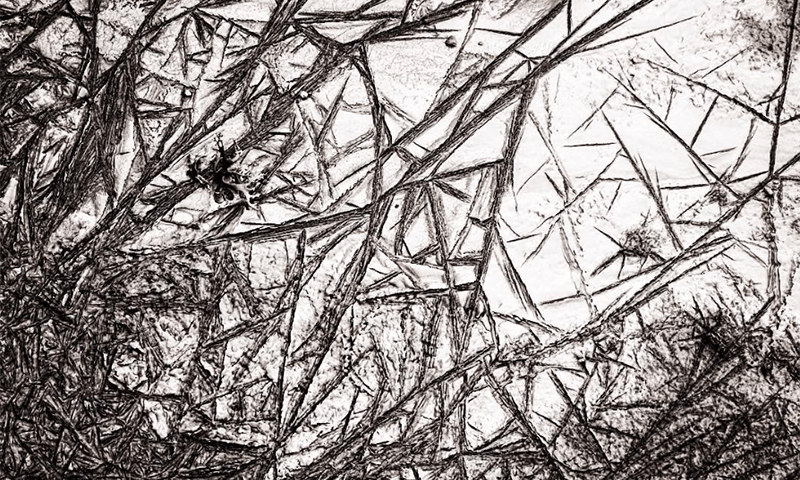
One morning he woke up to see the mesolithic mud that had melted the day before refrozen and was inspired to take this photo, which spans an area of about a couple of feet. The image, to him, captures a moment in time when “the Arctic is warming faster than anywhere else in the world,” he says. “We’re seeing the landscape change before our eyes.” Each warm season, the area is losing 20 to 30 feet of its permafrost: frozen soil, rocks, and ice that have been encased for 10,000 years.
Urban started traveling to this same field site more than a decade ago. “The Arctic is a really special place, built upon permafrost,” he says. “That’s what gives it its special properties, that’s why it looks the way it does and has this beautiful, stark landscape.”
With a scientist’s eye, he notes of climate change that, “we’re seeing it in the biology of species, we’re seeing it in the changes in weather patterns, we’re seeing it in the patterns of flow in the rivers. But to see the land just disintegrate—almost before your eyes—I think is one of those images that really strikes you and says, yes, this is really happening. And it’s happening quickly.”
But the image doesn’t relay the sounds. During fieldwork there, he says, “every once in a while, you’ll pause and hear that noise.” Plink. Plonk. Plink. “And you think, oh, what is that? Oh, it’s the melting of the permafrost.” Plonk. “It’s a somber soundtrack for watching the world fall apart.” 
Lead image courtesy of Mark C. Urban