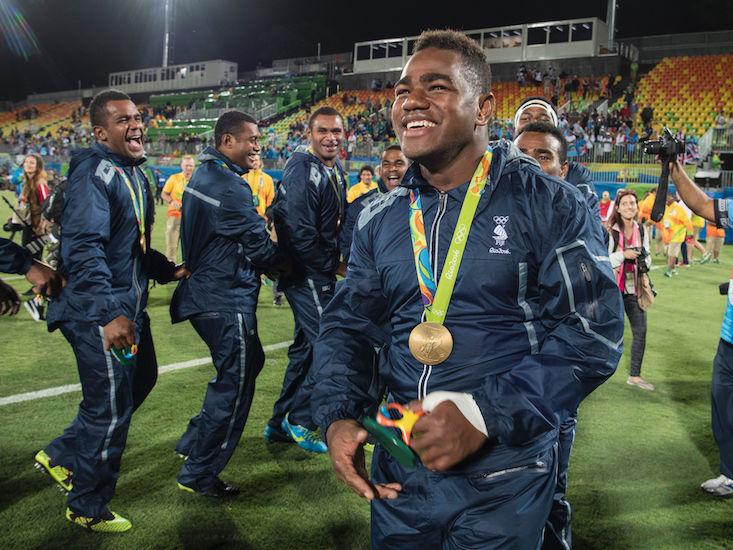
Over the first week of the Rio Olympics, an ancient narrative played out in the men’s rugby sevens tournament. Rising through a field of 12, the Fiji national team dispatched powerhouses New Zealand and Great Britain on its way to a gold medal, the first of any kind for the small South Pacific nation. Having defeated its former colonial ruler in the final match, an unexpected champion was crowned and this made a lot of people happy; in the Olympics, at least, people tend to cheer for an underdog.
While it’s hard to imagine that everybody wasn’t thrilled by Fiji’s win, a recent article in the Journal of Experimental Social Psychology suggests otherwise. The article’s authors, Serena Does from the University of California, Los Angeles, and Avital Mentovich from the University of Essex, found that sporting events can be a window on attitudes toward social power. People who favor the idea of social dominance—an unequal distribution of power among social groups (such as nationality, race, or class)—tend to root for established powerhouses (top dogs) as opposed to establishment-challenging underdogs, at least when it comes to international sports competitions.
“The Fiji-Great Britain match is indeed a great example of the type of intergroup competitions we describe in the article,” says Does. “Based on the findings in our article, we would expect that people who are more pro-egalitarian (lower on social dominance orientation) would be more likely to root for Fiji, and people who are more pro-hierarchy (higher on social dominance orientation) would be more likely to root for Great Britain.” In other words, the defeat of Great Britain by Fiji not only scored one for the underdog, it represented a goal for social equality.
To reach this conclusion, Does and Mentovich used a measure called social dominance orientation, assessed using a 16-item scale. Subjects rank their positive or negative feelings, from one (very negative) to seven (very positive), toward 16 statements—a mix of, “It’s probably a good thing that certain groups are at the top and other groups are at the bottom” and, “All groups should be given an equal chance in life.”
Tuning in to the Olympics can boost nationalism (and smugness) across the globe.
Humans have a tendency to form groups, and those groups often fight and end up relatively advantaged or disadvantaged. Social dominance orientation is the extent to which a person approves of this inequality. Unsurprisingly, this orientation is positively associated with support for nationalism, racism, sexism, economic conservatism, and cultural elitism. In contrast, traits such as empathy and tolerance are negatively correlated with social dominance orientation.
A person’s degree of social dominance orientation can be indicative of how they participate in society. For example, previous research has shown that people who favor the idea of social dominance are likely to serve in a police force, which maintains strict hierarchies, as opposed to being a public defender and seeking to reduce inequalities.
For their article, Does and Mentovich carried out a series of three studies, each of which asked at least 100 Americans on the Internet to fill out a survey about an international sports competition. They also collected basic demographic information and measured the social dominance orientation of those who participated (with the aforementioned 16-item scale). The participants were given a list of matchups between countries, either as part of the World Cup or a particular set of Olympic events, and asked whom they wanted to win each of them. In some cases, they were given information about the economic power and previous athletic successes of the countries involved in their matchups, setting up a hierarchy with advantaged and disadvantaged countries.
Each study found that, regardless of the sport being played, social dominance orientation “was associated with a greater preference for top dogs rather than underdogs, an effect that was mediated by beliefs about intergroup competitions as being opportunities to maintain hierarchy rather than promote equality between countries.” This held true even after taking into account a participant’s personal ties to certain countries (be it family or fandom) and their views on the skill of each competitor. In addition, Does and Mentovich reported, social dominance orientation and “top dog preference were positively associated regardless of the hierarchy domain—i.e., countries’ economic power versus athletic achievement.”
The article by Does and Mentovich lends further support to the finding, from 2013, that tuning in to the Olympics can boost nationalism (and smugness) across the globe. Even so, underdogs such as the Fiji national rugby team will continue to pull out unexpected wins and topple the sport kings. Perhaps these victories, running counter to the ideals of social dominance, can instead unite people, drawing out empathy and tolerance to promote international equality.
Chris Drudge is a science writer from Canada. Follow him on Twitter @RosinCerate.