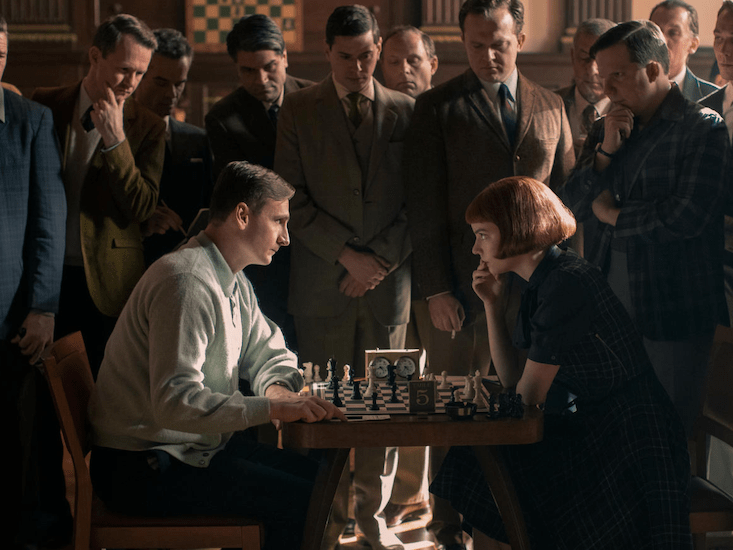
In the Netflix show The Queen’s Gambit, based on a novel by Walter Tevis, a burly custodian in an orphanage basement, hunched over a chess board, intrigues a nine-year-old girl named Beth Harmon, who sees him playing, under a dim light, against himself. This Mr. Shaibel can tell Beth’s a bit desperate to understand what he’s doing, and begrudgingly agrees to teach her to play. At night, high on the tranquilizers the staff administers to orphans—this is the early 1960s—she practices tactics in bed, staring up at a chess board that she hallucinates on the ceiling. Beth advances rapidly in skill, until Mr. Shaibel, who plays in a club, can no longer reserve how impressed he is at her abilities. He invites a fellow chess player, who heads the local high school chess group, to meet Beth, and recruit her. She ends up playing the boys in the club simultaneously, including last year’s champion. A crowd of students forms as she bests each one.
As I watched Beth dreamily focus on her imaginary chess board, simulating alternative possibilities, I thought about how that must be shaping her brain, particularly the part dedicated to planning and decision-making, the frontal cortex. Compared to other regions, it’s uniquely malleable, or plastic. Stanford behavioral endocrinologist Robert Sapolsky calls it “the brain’s hotspot for plasticity.” Our brains are changing, forming new neural connections and severing others all the time, of course. But at a young age the brain’s plasticity is much more pronounced. This is something that Tom Vanderbilt discussed in his Nautilus feature, “Learning Chess at 40,” in which he reports what it was like taking up the game with his four-year-old daughter. Neil Charness, a psychologist who has studied cognition through chess for years, told Vanderbilt, “If you’re talking about two novices, your daughter would probably pick things up about twice as fast as you could.” In that way it’s like learning a language—children can assimilate the game’s complex rules and action much more intuitively and quickly than an adult.
Mastering chess appears to have long-lasting effects on the brain.
This means that chess offers a unique opportunity. It could perhaps be the ultimate window through which we might see how our mental powers shift during our lives. This is because the moves of professional chess players in games, going back over a century, are recorded, and so researchers can objectively analyze the quality of players’ moves over their career, inferring cognitive rise and decline. And that’s exactly what a recent study, published in the Proceedings of the National Academy of Sciences, did.
An international group of researchers, located in France, Germany, and The Netherlands, evaluated professional players’ move-by-move performance in more than 24,000 games relative to the optimal move a chess engine suggested for each respective move. (These don’t include “book moves,” the intensively studied game-beginning and game-ending moves, since players routinely deploy them from memory.) The chess engine, an open-source program called STOCKFISH 8, has an estimated Elo-rating exceeding 3,200 points—Elo being the now-universal player-ranking system. The chess-move database includes the moves of current world champion, 29-year-old Magnus Carlsen, who has maintained his title since winning it all in 2013, and as of this year, has an Elo-rating of 2,872.
“This provides a precise and comparable measurement of individual performance for the same individual at different ages over long periods of time, exploiting the advantage of a strictly comparable task and a comparison with an identical performance benchmark,” the researchers write. “Repeated observations for the same individuals allow disentangling age patterns from idiosyncratic variation and analyzing how age patterns change over time and across birth cohorts.”
The result is a “hump-shaped profile of performance” over people’s life times. Over the last century or so, chess players, the study shows, have been getting better as well as younger. This parallels the so-called Flynn effect in intelligence, or a notable rise in raw cognitive scores. “Performance increased steadily over the course of the twentieth century,” the researchers write, “but the data also reveal a steepening of the performance increase during the 1990s.”
This echoes Charness: “The record of the youngest age to achieve grandmaster status keeps getting beat.” And it’s no wonder, given the digitization of chess play and knowledge. Aspiring grandmasters can game against anyone, human or machine, at any time, and benefit from software that offers sophisticated feedback, absorbed by the malleable young brain.
Mastering chess appears to have long-lasting effects on the brain. A 2018 study concluded, after analyzing the brains of almost 30 high-level professional chess players, that “long-term cognitive activities, such as chess, may systematically influence the [white matter] properties of early memory, attention, and visual pathways.”
Watching The Queen’s Gambit, it’s as if drugs conferred Beth that advantage pre-computer. Her psychedelic practice sessions offered their own form of immersive and responsive feedback. Mr. Shaibel’s surprise at being beaten so readily by a child reminded me of Vanderbilt’s own reflection on playing against his daughter. Inexperienced in so many ordinary ways, she was still able to show up an adult who spent some effort trying to learn the royal game. “She was Deep Blue,” Vanderbilt wrote, “and I was the human race, being slowly outmoded.”
Brian Gallagher is an associate editor at Nautilus. Follow him on Twitter @bsgallagher.
Lead image: Screengrab via YouTube / Netflix