Once you’re called a “genius,” what’s left? Super genius? No, getting called a “genius” is the final accolade, the last laudatory label for anyone. At least that’s how several members of Mensa, an organization of those who’ve scored in the 98th percentile on an IQ test, see it. “I don’t look at myself as a genius,” LaRae Bakerink, a business consultant and a Mensa member, said. “I think that’s because I see things other people have done, things they have created, discovered, or invented, and I look at those people in awe, because that’s not a capability I have.”
Yet the notion of genius as a capability a person can possess has come under attack recently in several ways. Megan Garber, writing in The Atlantic, criticized the excuses of bad behavior that so-called geniuses—specifically men—enjoy. “Genius, a means to godliness and its best evidence, cannot be argued with,” she writes. “Genius cannot be reasoned with. Genius is the answer and the question. It will be heard. It will be respected.” Not if Garber can help it. “The genius-bias is a strong one,” she writes, but not one we must submit to.
Genius, as a noun, has always been a sort of illusion.
Whether genius is partly genetic is hard to say; intelligence has a hereditary component, but its link to genius is hazy, as Hans Eysenck points out in his new book, Intelligence: A New Look. “There is no case of a genius having a genius father—the best we can do is Mozart, whose father was a reasonably good musician, and Bach, who had several musically gifted relatives in his family, none of genius rank,” he writes. “For the great majority, father and mother were ordinary folk, without any special gifts or achievements…” Moreover, these parents very rarely provided the sort of promising environments one might expect future geniuses to require. Genius seems to strike without warning.
Earlier this month, Yuval Sharon, artistic director of The Industry in Los Angeles, whose experimental operas have won widespread acclaim, shared his anxiety about winning a 2017 MacArthur Fellowship, notoriously called the “Genius Grant.” In an essay titled “Genius as Circumstance” in the Los Angeles Review of Books, Sharon writes, “Moments, ideas, a single poem in a collection—a work of genius, no matter how individually wrought—is never the product of a single individual. We should stop thinking of genius as an attribute and instead start to think of it as a condition, a circumstance.” As a theater director, Sharon writes, “my work consists entirely of creating the conditions for genius to flow.” He defines genius as “the oxygen that those in a shared space breathe in and are transformed by; it allows them to reach their full potential. In this way, ‘genius’ returns to its original Latin meaning of an ‘attendant spirit.’”
Jazz artist Vijay Iyer, another MacArthur fellow, is also uncomfortable with the conventional meaning of genius. In a Nautilus interview with Kevin Berger, Iyer says the label “genius” narrows our understanding of art and artists, and by extension, science and scientists. “The ‘G word’ is often used to shut down conversation or inquiry into a particular artist, into his or her community and connection to others,” Iyer says. “No music happens in a vacuum. Anybody who has the privilege of making music for others got there through the help of others. Even real singular talents, and I’ve known many, are nurtured and brought into a community. So I always try to understand the term relationally, understand artists in the historical, social, and political context in which they were living and working.”
Both Sharon and Iyer echo the work of Hungarian-American psychologist Mihaly Csikszentmihalyi. “The location of genius is not in any particular individual’s mind, but in a virtual space, or system, where an individual interacts with a cultural domain and with a social field,” he wrote in his 2015 book, The Systems Model of Creativity. He suggests that genius, as a noun, has always been a sort of illusion. “In popular usage, ‘genius’ is sometimes used as a noun that stands by itself, yet in reality it appears always with a modifier: musical genius, mathematical genius, scientific genius, and so forth,” he wrote. “Genius cannot show itself except when garbed in a concrete symbolic form.”
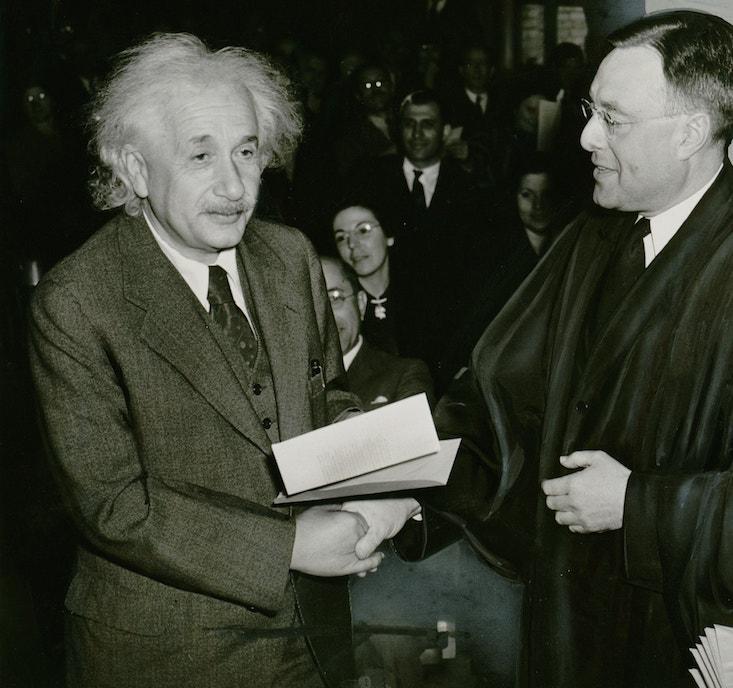
David Krakauer, a complexity theorist and president of the Santa Fe Institute, seems to agree. In an interview with Steve Paulson for Nautilus, he said, “I have my own favorite explanation for what genius is. If intelligence is making hard problems easy, genius is making problems go away!” For Krakauer, genius is more of an adjective that applies to solutions rather than scientists. “Genius just changes the rules of the game,” he said, referring to Albert Einstein’s theory of general relativity, and how it superseded Isaac Newton’s view, which couldn’t account for “very large masses and very large velocities.” General relativity didn’t just make our understanding of physics “better, or easier, or more efficient,” as a merely intelligent solution might, Krakauer said; it instead changed “the nature of the representation of the problem [of gravity] so completely that you get the kind of vertigo of unfamiliarity,” which is his litmus test of genius: “When you change the rules, you make a lot of people uncomfortable, and it looks a little crazy.”
Brian Gallagher is the editor of Facts So Romantic, the Nautilus blog. Follow him on Twitter @brianga11agher.
WATCH: The meaning of genius.