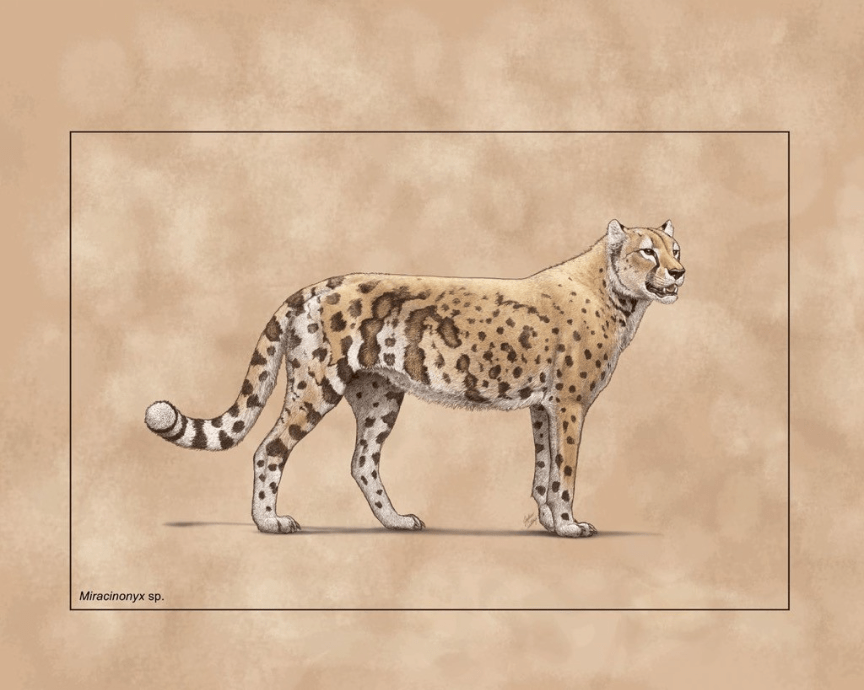
From about 2.5 million years ago to 16,000 years ago, a big cat roamed the open grasslands of North America. Its fossils show a streamlined body, long legs, and large nostrils, suggesting an animal that adapted to a life of chasing prey across the savanna like an African cheetah. Now, however, the “American cheetah” (Miracinonyx trumani) may need to be called something else. That’s because a study published today in the journal Current Biology found that it wasn’t what it appeared to be.
“It’s very hard to imagine a prehistoric species we’ve never seen without comparing it to something we know,” said first author Molly Cassatt-Johnstone, a graduate student at the University of California, Santa Cruz, in a press release.
Read more: “How the Fastest Land Animal in North America Got Its Need for Speed”
Cheetahs feed on fast, agile prey like gazelles and impalas, which they catch via incredible sprinting speeds of up to 70 miles per hour. Thus, the need for huge nose openings that allow for quick intake of oxygen. The co-occurrence of specimens of M. trumani with American pronghorn antelopes corroborated the hypothesis that these animals hunted like cheetahs.
In the first paleogenomic analysis of M. trumani, Cassatt-Johnstone and her coauthors collected data from four radiocarbon-dated fossils, one from Wyoming and the others from the Yukon Territory in Canada. The Canada specimens proved about 30,000 years old and expanded the species range into the Arctic steppe tundra, where it competed for food with gray wolves, short-faced bears, and scimitar cats. But, with no fast-running hooved prey in the Arctic, American cheetahs were feeding mostly on fish during the entire 8,000 years represented by the specimens.
In other words, compared to modern cheetahs, these “American cheetahs” were flexible carnivores who could adapt their feeding strategy depending on what prey was available. “From generalist grassland predators in temperate regions to specialized exploiters of aquatic resources in Arctic environments,” wrote the study authors, “M. trumani occupied a unique predatory niche that has no single modern analog.”
Furthermore, a family tree based on comparative DNA showed the American cheetahs to be more closely related to American pumas (Puma concolor) than to African cheetahs (Acinonyx jubatus). A sister species to pumas, M. trumani diverged from a common ancestor about 2.6 million years ago, according to the study findings.
Now the researchers just need to start working on a new nickname. 
Enjoying Nautilus? Subscribe to our free newsletter.
Lead Image: Julius Csotonyi