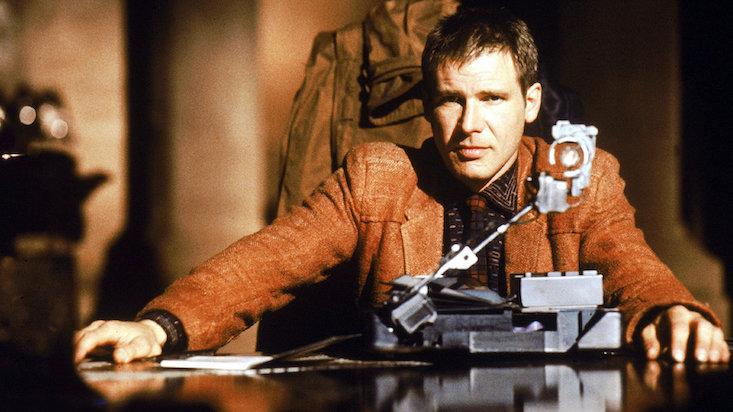
Is Rick Deckard a replicant, an advanced bioengineered being? The jury concerning the character in 1982’s Blade Runner is still out. Harrison Ford, who plays Deckard in the film, thinks he’s human. Ridley Scott, the film’s director, is adamant that he’s not.* Hampton Fancher, the screenwriter for the original film and the sequel, Blade Runner 2049, prefers the ambiguity: “I like asking the question,” he’s said, “but I think it’s nonsense to answer it.”
At the center of the question is a fictional test designed to distinguish between replicants and humans, called the Voight-Kampff test. It elicits emotions in the test subject that replicants supposedly can’t have, then monitors physiological responses, like pupillary motion and reaction time. But could such a test really distinguish between humans and replicants? Nautilus caught up with Chris Frith, Emeritus Professor of the Wellcome Centre for Neuroimaging at University College London to find out. He’s spent his career studying the neuroscience of consciousness and emotion, specifically its conscious and unconscious processes, and says he’s been influenced by Philip K. Dick’s stories, particularly Do Androids Dream of Electric Sheep?, which Blade Runner is based on.
Is there any science behind the Voight-Kampff test?
Yes. There’s a database of pictures, the International Affective Picture System, that includes emotionally disturbing pictures of people in road accidents, things like that, and an equivalent set of neutral pictures. You can measure whether somebody has an emotional response to a picture by the speed with which they perceive it, and by the size or the magnitude of the various responses you get. You’ll get an enlarged pupil, increased sweating, increased heart rate, and so on. Even patients who have some sort of brain damage will still show an emotional response to pictures of people that they are unable to remember, like their spouses.
Could the Voight-Kampff test be tricked?
Perhaps. It’s a bit reminiscent of the polygraph test, used in criminal investigations. If you are just asking people questions and seeing whether they’re anxious, then all sorts of normal people will feel very anxious, as they’re being asked questions by an intimidating lawyer or policeman. Whereas the psychopathic criminal doesn’t get these responses.
Are there tests that get around that loophole?
There’s a different kind of test you can do, sometimes called the Guilty Knowledge Test. The investigators happen to know that whoever was at the scene of the crime must’ve seen some particular item, which other people who were not at the scene of the crime will not have seen. You could present them with a picture of the item, and the person saying, “I’ve never seen that before,” would show an emotional response. That’s sometimes used, and seems more plausible than the usual, more general, lie-detection procedure.
What would a modern day Voight-Kampff test include?
Some people, and I’m a bit suspicious of this, would start using brain imaging, which wasn’t around when Philip K. Dick was writing his book. You can put people in an MRI scanner, and you can show them fearful pictures. Not only should they become aroused, but a particular bit of the brain, the amygdala, should light up. That would be part of the next generation of the Voight-Kampff Empathy Test, but the key question that we haven’t got around to is, Would this detect replicants? That all depends on your opinion about robots and replicants, and what they can do.
Do you think replicants are philosophical zombies?
I don’t see why they should be philosophical zombies—creatures identical to us but not conscious—because I believe that, if you know how the brain works, you could, in principle, build something like it, using silicon, or whatever we have in those future times that will do the same thing. At least in our universe, being conscious means being able to do things that you wouldn’t otherwise be able to do. But it’s turned out to be extremely difficult to discover what these things are.
What makes it hard for a replicant to pose as human?
One problem is culture. The human mind is strongly influenced by culture, maybe more than we realize, and the human brain is, in a sense, just a tool that we use. Our whole upbringing is somehow integrated by our brains into the way we think and the way we behave. This is sort of hinted at in 2001: A Space Odyssey when it’s clear that HAL, the ship’s AI, has been through a childhood stage, which is then removed by the astronauts, as it were, to disable him. How would you actually, in real life, provide all this information? It’s beginning to happen. Today a robot can access vast amounts of information very quickly. But I’m not convinced that that’s the same thing as what is being brought up in the movies.
Is having an upbringing essential to consciousness?
I once had a very strange conversation with a Lacanian psychoanalyst, the sort of person I don’t normally interact with. We were talking about whether machines could be conscious. He got very cross and said, “No, of course they can’t,” and I said, “Why not?” He said, “Because they don’t have a mother.” This is almost what I’m beginning to think might be an interesting point.
Why do you like Do Androids Dream of Electric Sheep?
I was always very impressed by Philip K. Dick, and to some extent influenced by him. One of the themes that he constantly brings up is that our view of reality is to some extent an illusion, and there’s always something hidden behind it. In Blade Runner, the illusion has to do with discovering that certain people are replicants, who didn’t realize that this was the case. Including, perhaps, Deckard himself, although that’s very ambiguous.
What draws you to studying illusions?
I was involved in studying schizophrenia. One of the major symptoms are what we consider hallucinations and delusions. There is always this worry that perhaps they’re seeing a reality which we are not seeing. As a psychologist, I am very interested in the question of how we know whether we are seeing reality or not. Everything we know about the world is based, to some extent, on these very crude sensations, so we always have to be epistemically vigilant. Don’t believe what you see.
Victor Gomes is an editorial intern at Nautilus.
Lead image: Universo Produção / Flickr
* Correction: This post originally stated Harrison Ford believed Deckard to be a replicant, and that Ridley Scott believe him to be human. The opposite in both cases is true.