As we head into the heat of summer in temperate regions of the world, many organisms are coming out of winter dormancy to become active again. Then there are those organisms that live year-round in freezing conditions and endure subzero temperatures, such as inhabitants of glaciers. A recent study in the journal Current Biology uncovered the metabolic secrets of how tiny snow flies endure such cold.
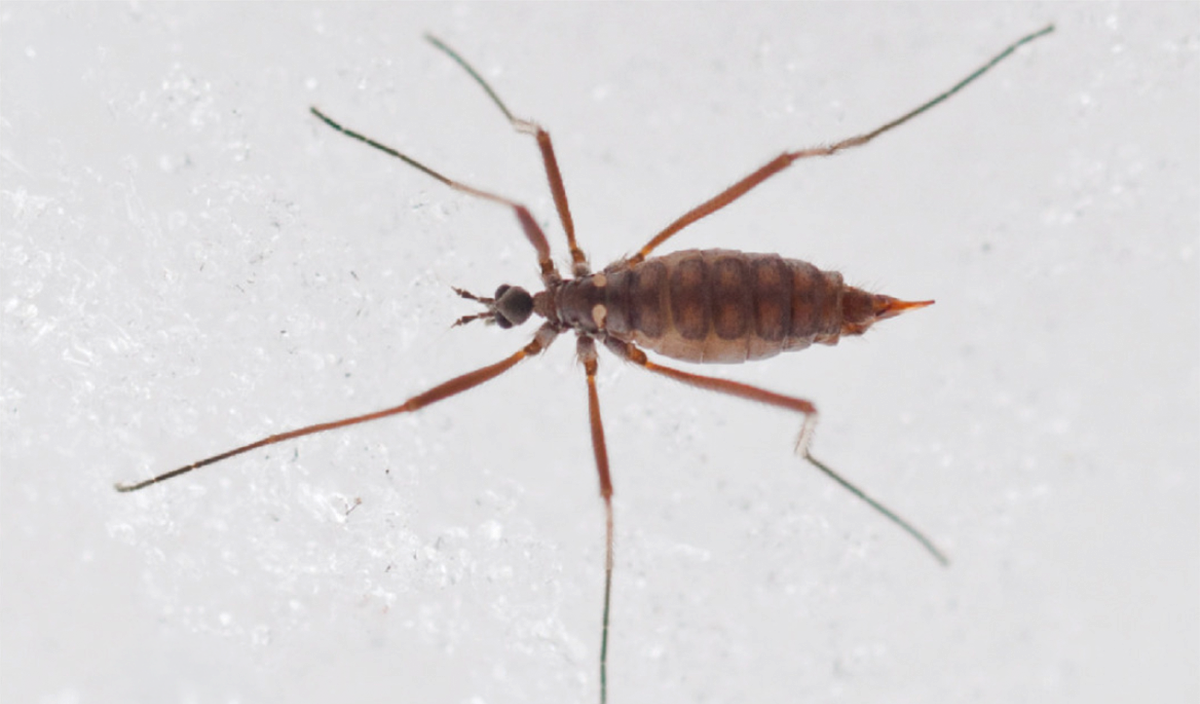
Snow flies lack wings and can be seen roaming over snow and ice at temperatures of zero degrees Celsius to negative 6 degrees Celsius to lay eggs. In fact, in the lab, snow flies will choose sub-freezing temperatures over warmth. Their behavior is extraordinary, given that they’re “cold-blooded” ectotherms, like other insects, whose body temperatures scale with outside temperatures.
“They have a mind-boggling ability to adapt to extremes,” explained lead study author Marco Gallio, a molecular biologist at Northwestern University, in a press release. “They really push the limit of what’s possible.”
Gallio and his co-authors from universities in Sweden, China, and the United States sequenced the genome of the snow fly Chionea alexandriana, which lives in mountains as far north as Alberta and British Columbia. Some of the genes that showed up are known to play a role in burning stored fat in larger animals. Polar bears, for example, use such genes to generate heat to keep warm during hibernation.
Read more: “The Secret Life of the North Pole”
Other genes that showed up weren’t in databases of known genomes, leaving the researchers scratching their heads. “It’s very rare for an active gene, which makes a protein, to not have a match,” said Gallio. It turns out those genes were manufacturing antifreeze proteins, molecules that bind ice crystals and halt their growth, and are comparable to antifreeze molecules known from Arctic fish.
Just to make sure they had identified the right cold-tolerance genes, the study authors engineered one of the antifreeze genes into fruit flies and then stuck them in a freezer (there’s a reason the research didn’t use humans). The engineered fruit flies had better survival in the freezer than non-engineered fruit flies.
Curiously, the body temperatures of snow flies remained a couple of degrees warmer than their environments when ambient temperature was gradually lowered to below freezing, exposing their capacity to generate body heat. Snow flies don’t appear to shiver to make heat, but instead may be generating heat at a cellular level.
Snow flies are also likely more tolerant of cold pain, according to the study. A sensory protein that would normally help detect dangerous cold conditions has been recrafted in snow flies to be less responsive. “It turns out that a specific irritant receptor is 30 times less sensitive in snow flies than in mosquitoes and fruit flies,” said Gallio.
All of which is to say that, despite their size, a snow fly can handle the cold with the resilience of a mighty polar bear. 
Enjoying Nautilus? Subscribe to our free newsletter.
Lead image: Capek, M., et al. Current Biology (2026).