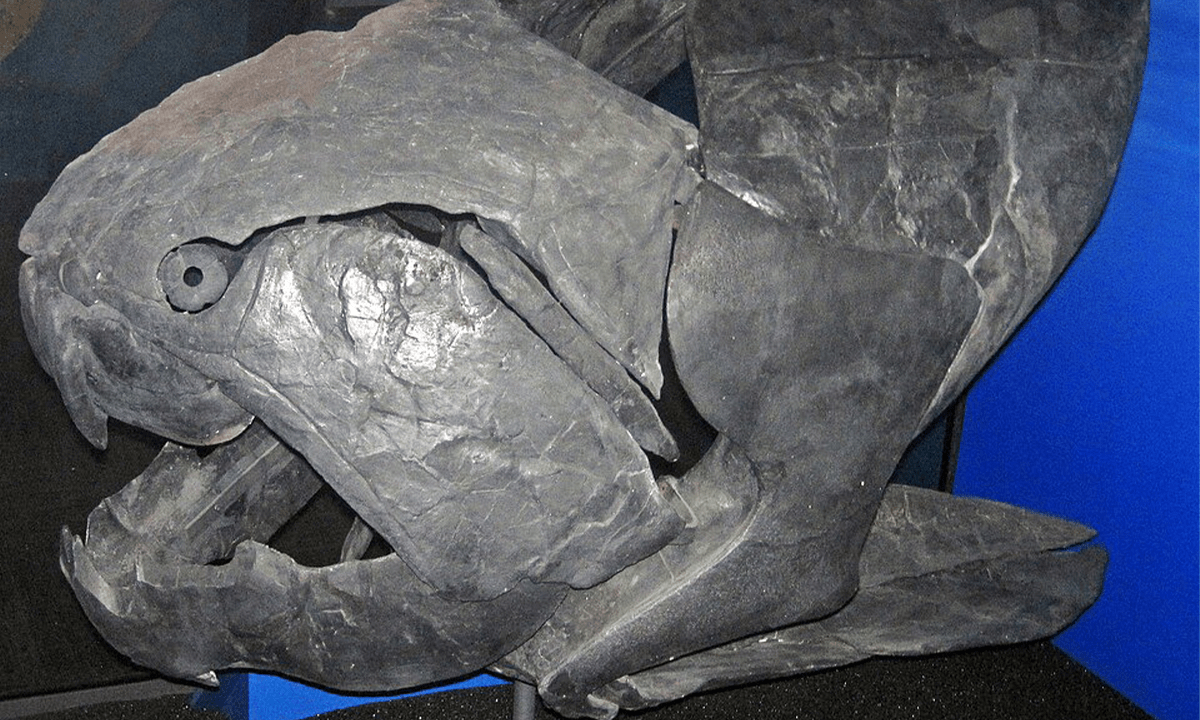
Some 360 million years ago, a terrible and strange sea monster named the Dunkleosteus patrolled shallow seas around the world, terrorizing its neighbors with its formidable razor-like jaws. The early fish was covered in armor, stretched 14 feet from head to tail, and could chomp enormous chunks of meat from its prey. Now an international team of scientists has published a detailed study of the fearsome apex predator revealing that it also had a really weird feature: Dunkleosteus technically had no teeth.
The fish has fascinated and perplexed amateurs and scientists alike since the first fossil was unearthed in the 1860s. One of the largest of the arthrodires—an extinct group of armored, shark-like fishes—Dunkleosteus gets its name from vertebrate paleontologist David Dunkle, who studied it in the 1950s. Despite all of the attention it has gotten over the decades, details about the fish’s anatomy and lifestyle have remained mysterious.
“The last major work examining the jaw anatomy of Dunkleosteus in detail was published in 1932, when arthrodire anatomy was still poorly understood,” said Russell Engelman, a graduate student in biology at Cleveland’s Case Western Reserve and lead author of the new study, in a statement. “Most of the work at that time focused on just figuring out how the bones fit back together.”
The team of researchers examined specimens from the Cleveland Museum of Natural History, which has the best collection of Dunkleosteus in the world, and compared them to other members of the arthrodire family. While the fish likely lived all over the planet in the Devonian period, known as the age of fishes and lasting from 420 to 359 million years ago, conditions were ripe in Cleveland for a mountain of remains to accumulate in the ancient seafloor, now preserved in a layer of black shale. The scientists focused on five near complete skeletons of juvenile and adult Dunkleosteus terrelli—the largest and most well studied of the Dunkleosteus genus—which had been preserved in a flattened state, using 3-D modeling to bring them to life.
When they took a closer look at the fish skulls, the scientists uncovered a wealth of surprises. Most arthrodires have teeth. But in place of teeth, this oddball sea monster had razor sharp bony plates that it used to slice flesh and crush bones. It also had shark-like jaw muscles, they discovered, and a more cartilage-heavy skull than they thought. Given what they learned, the scientists say they will have to re-evaluate how much force the Dunkleosteus had in its bite.
Read more: “The Fish That Took a Century to Name”
Previous research suggested the fish might have used suction to capture its prey, but most fish that are suction feeders have specific kinds of teeth that serve to hold the prey in the mouth, and Dunkleosteus lacks these, the scientists found. Instead, they have tusk-like, bladed mouth structures that are more similar to those of so-called “ram” feeders—such as herring, gar, and water snakes—as well as to those of land mammals like hyenas and wild cats that dismember and chop up their prey. These kinds of jaws allow them to cut through tougher tissues like skin and break prey items down into bite-sized pieces.
The findings help scientists understand the Dunkleosteus’s place in evolutionary history: Its unusual cleaver-like jaws allowed it to take enormous bites of flesh out of its prey, an adaptation it evolved so that it could hunt down bigger and bigger fish for dinner.
Despite its lack of teeth, this frightening fish was all bite. 
Enjoying Nautilus? Subscribe to our free newsletter.
Lead image: James St. John / Wikimedia Commons