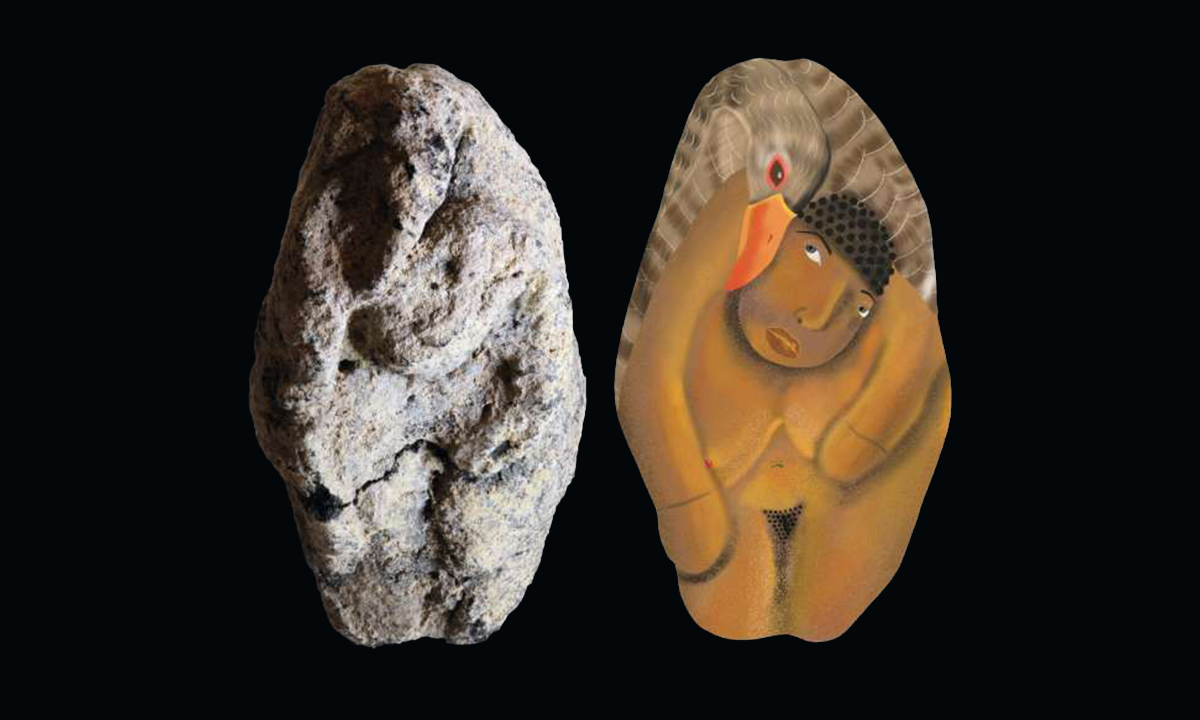
This 12,000-year-old clay figurine invites you to contemplate a tender embrace between a woman and a goose. It’s the oldest piece yet discovered to illustrate an interaction between a human and an animal, and it enriches our understanding of the earliest human settlements.
This figurine was found at a Natufian village in what’s now northern Israel. The Natufian culture existed between around 15,000 to 11,500 years ago, and it offers one of the best-documented examples of humanity’s transition from nomadic lifestyles to settled communities, just before the rise of agriculture.
Researchers haven’t discovered many objects from around this time period depicting interactions between humans and animals, and most findings have been from what’s now Europe. But these artifacts illuminate a crucial insight: How humans saw themselves in relation to both their environment and other species.
Now, the recently unearthed figurine “offers a rare window into the symbolic and spiritual world of early sedentary peoples in Southwest Asia,” according to a statement. This discovery was recently reported in the journal Proceedings of the National Academy of Sciences.
The figurine “captures a transformative moment,” said Leore Grosman, an archaeologist at the Hebrew University of Jerusalem in Israel, in the statement. “It bridges the world of mobile hunter gatherers and that of the first settled communities, showing how imagination and symbolic thinking began to shape human culture.”
Read more: “Beer Domesticated Man”
This object is only about 1.4 inches tall, and seems to be constructed from local clay that was heated at roughly 750 degrees Fahrenheit—suggesting that this community was adept at manipulating fire. According to chemical and microscopic analyses, the object has traces of red pigment, or ocher, and a fingerprint potentially made by an adult or young adult female artisan. The figurine also exhibits sophisticated artistic techniques for the time, such as “manipulating clay volume and light to create perspective,” that caught on more widely in the subsequent Early Neolithic period, the paper notes.
While Natufian people ate geese at the time, this piece of art seems to portray the animal as alive, and symbolizing far more than food. The researchers suggest that the figurine represents a mythological encounter, hinting at the belief that all living and nonliving things possess souls and are inextricably linked. As further evidence, the object was found in a stone structure alongside burials and ceremonial deposits, and the site was also found to be decorated with goose feathers and bones.
Ultimately, the type of “symbolic” vocabulary communicated with the figurine “later blossomed in Neolithic cults and figurative traditions across Southwest Asia,” the statement noted. This following age was marked by the birth of large-scale farming—cascading into the sedentary lifestyles we lead today. 
Enjoying Nautilus? Subscribe to our free newsletter.
Lead image: Laurent Davin