Skip to Content
Advertisement
Math

Time Trial: See If You Can Clock These Time-Warped GIFs

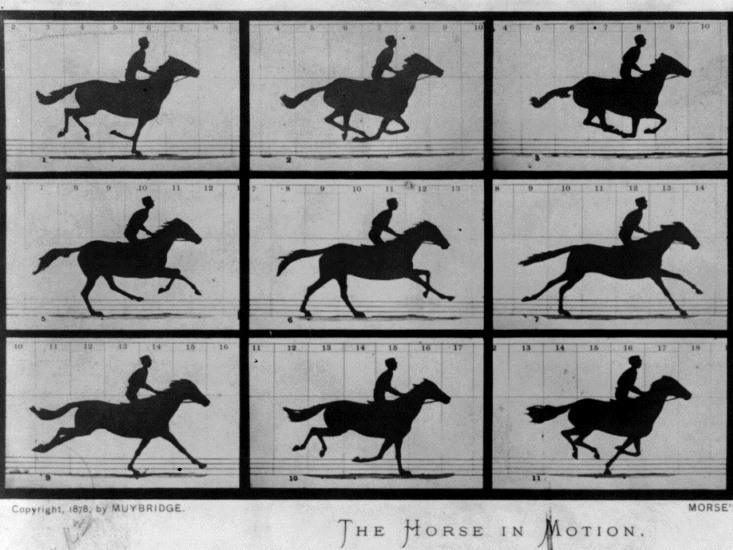
Muybridge The Horse in Motion

When Eadweard Muybridge captured the movement of a galloping horse in individual frames in 1878, he managed to settle a long-running debate over how that animal runs—specifically, whether there was any moment when it had all four feet off the ground. His pioneering stop-motion photographs showed how slowing the world down provided a powerful way to study it better. 

Featured Video

Photography has since then advanced dramatically, with high-speed cameras able to slow down fast-moving things to a fraction of their original speeds. Meanwhile, time-lapse cameras give us a new understanding of some of the slowest processes in nature by speeding them up to scales we can appreciate. Long gone are the days when a cat lapped too quickly to see, or starfish scuttled too slowly for the eye to detect. 

So how fast does a cat’s tongue actually move? And how slowly do starfish really crawl? Take our quiz, full of sped-up and slowed-down animations, to see how well you know the world moving all around you.

Advertisement

Advertisement

Stay in touch

Sign up for our free newsletter

More from Math

Explore Math

Ancient Math Hidden in Oldest Known Floral Pottery

Bowls from the Halafian culture of Mesopotamia suggest people used art to enumerate their rapidly changing world

December 15, 2025

When Monsters Came for Mathematics

Adam Kucharski’s 3 greatest revelations while writing <i>Proof: The Art and Science of Certainty</i>

June 13, 2025

The Mathematical Mysteries of Fireflies

What blinking bugs reveal about synchrony in the universe

May 2, 2025

When Work Is Play

Patchen Barss on his 3 greatest revelations while writing <i>The Impossible Man: Roger Penrose and the Cost of Genius</i>.

November 25, 2024

Why Physics Is Unreasonably Good at Creating New Math

The secret sauce is the real world.

September 3, 2024

The Elegant Math of Machine Learning

Anil Ananthaswamy’s 3 greatest revelations while writing <i>Why Machines Learn.</i>

July 23, 2024