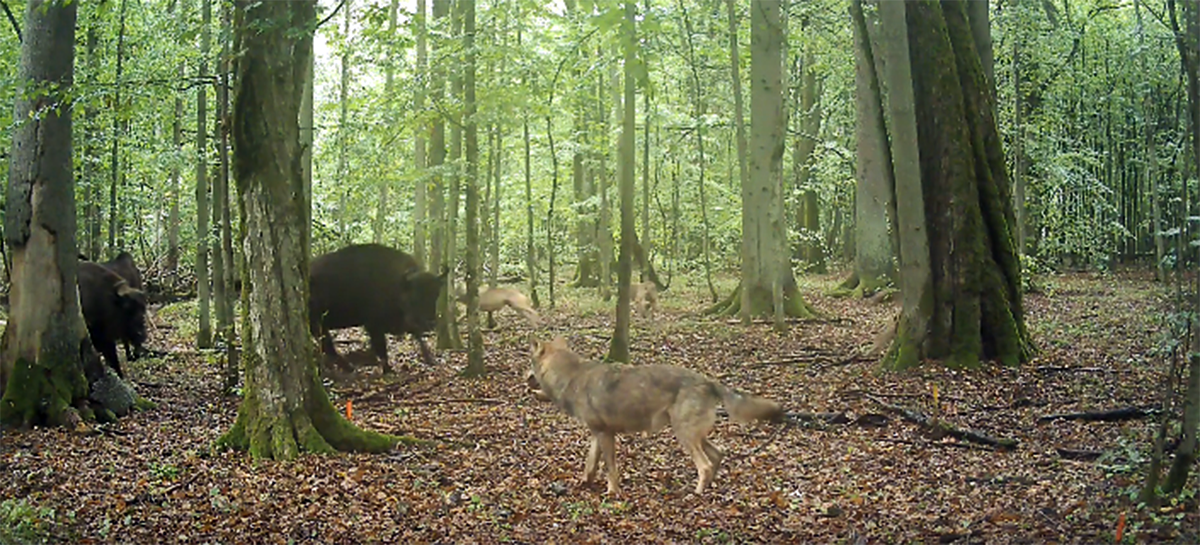
A bison calf narrowly avoided a pack of ravenous wolves, and the whole brouhaha was captured in a video recently published in Ecology and Evolution. Shot in 2025 on a trail camera placed in a forest in Poland, the video was somewhat surprising because European bison haven’t typically been considered prey animals. In fact, thanks to their massive size, they’re called the “kings of the forest.”
Like other herding animals, bison congregate in large groups to reduce the risks of predation. Of course, the “strength in numbers” axiom cuts both ways, and larger wolf packs have been more successful in bringing down the mighty beasts. Per a 2014 study of wolves hunting North American bison, it takes a pack of around nine to 13 wolves for a successful bison hunt. (For comparison, an elk can be felled by a nimble two-wolf team.)
European wolf packs tend to be smaller, and the camera trap filmed seven as they attacked the herd of bison. They focused their efforts on the smallest member, a newborn calf that was inadvertently left alone by adults chasing off the predators. The wolves seized on the calf’s neck to drag it away, but were again rebuffed. As the alarmed calf fled, it was grabbed a second time, and two adults lowered their horns to fend off the attack while the others closed ranks to protect the calf. The wolves, outnumbered and outmaneuvered, surrendered.
Read more: “Do Bison Belong in Spain?”
According to the researchers, the video shows that the bison’s designation as a non-prey animal should be revisited. The European bison were hunted to the brink of extinction by the early 20th century, before captive breeding and reintroduction plans brought them back. Since the 2010s, they’ve been part of a successful rewilding campaign across Europe, beefing up their population numbers to a much healthier “not threatened” designation. While there haven’t been reports of wolves successfully preying on them, they’re obviously making attempts to do so.
But you know what they say—you come at the king, you best not miss. 
Enjoying Nautilus? Subscribe to our free newsletter.
Lead image: Mammal Research Institute, Polish Academy of Sciences