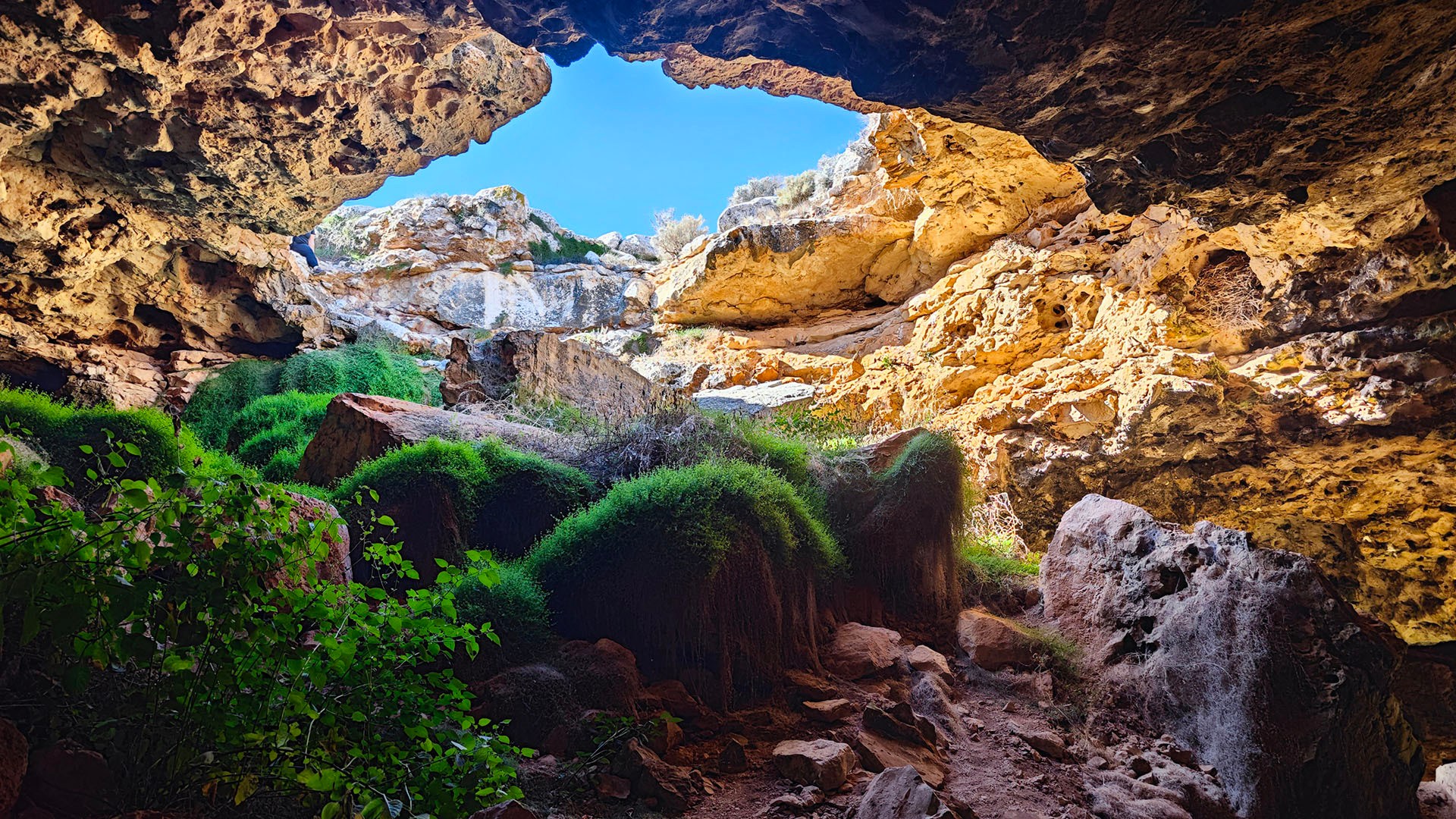
You might think by the year 2026 there wouldn’t be any major geological formations left to discover, but you’d be wrong. According to a new study published in Communications Earth & Environment, a vast network of caves in southern Australia has surface features that have been hiding in plain sight.
Geologists from Curtin University made the discovery after investigating a series of shallow trenches on the Nullarbor Plain, a sprawling crescent-shaped desert bordered by the Great Victoria Desert to the north and the Great Australian Bight to the south. The cave system beneath is also great, but the nondescript trenches—some of which stretch for over 10 miles—weren’t known to be associated with the underground network until now.
“From the surface, these features can look remarkably like shallow valleys or drainage channels, but our evidence shows they have a very different origin,” study author Matej Lipar explained in a statement. “By combining mapping, geophysical surveys, cave records, and sediment analysis, we found these trenches are linked to deep cave systems beneath the Nullarbor Plain.”
The trenches, it turns out, are the remnants of the cave openings. Over millions of years, many of these openings collapsed, partially filling in the caves and leaving long, wide depressions in the surface. “Because the landscape is so vast, it appears to be a flat, endless plain,” Lipar said. “But when we created exaggerated digital models of the terrain, the trenches became much easier to see and identify.”
The Nullarbor Plain is also the world’s largest exposure of limestone bedrock, and while it’s been open to the elements for 14 million years, there haven’t been a lot of elements to weather its features—no glaciers, no rivers, and not a lot of rain. According to the team, this unique characteristic of the Nullarbor trenches make them an ideal template for identifying cave systems that might be hiding on other planets.
“Cave systems aren’t always obvious from the surface, but the dry and stable landscape of the Nullarbor is excellent for removing a lot of ‘noise’ to allow us to recognize subtle landscape characteristics,” study co-author Milo Barham said. “This gives us a useful set of indicators for identifying hidden cave systems elsewhere—including on other planets such as Mars.”
Martian spelunking anyone? 
Enjoying Nautilus? Subscribe to our free newsletter.
Lead Image: Matej Lipar