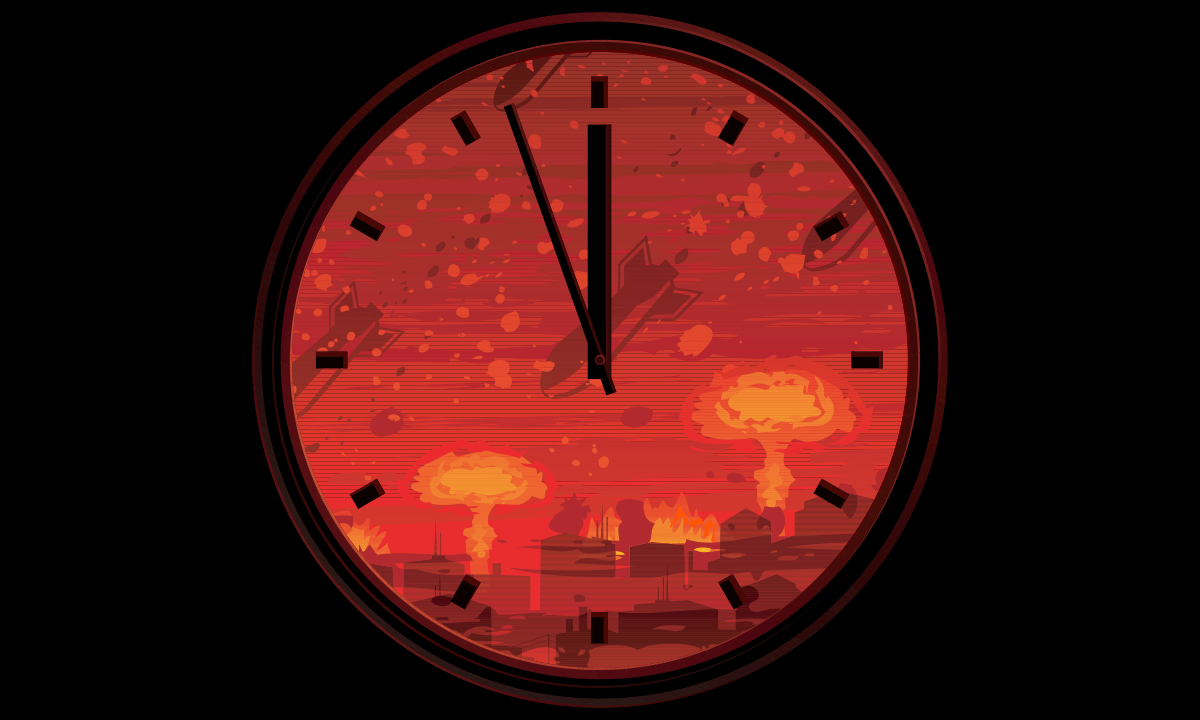
The Doomsday Clock now reads 85 seconds to midnight. The end of the world is closer than ever, it seems—if the metaphorical timer is to be believed. Managed by the Bulletin of Atomic Scientists with input from experts and Nobel Laureates, the clock was created in 1947 in response to the nuclear menace of the Cold War. But it now takes into account not only threats from nuclear arsenals, but rogue artificial intelligence and global biological calamities such as climate change and pandemics. The clock is reset every year, and has moved progressively closer to midnight since 2017.
It’s perhaps no huge surprise then that almost a third of people in the United States now expect the world to end during their lifetimes. This was one finding of a recent study published in the Journal of Personality and Social Psychology. The team of researchers drew on surveys of 3,400 people in Canada and the U.S. They also found that how people think about the causes of impending apocalypse shape their willingness to act to forestall it. Those who thought human hubris was to blame were willing to take extreme measures. Those who thought supernatural forces were at the root of it were not.
Apocalyptic thinking has a long history, so I reached out to Matthew Gabriele, professor of medieval studies in the Department of Religion and Culture at Virginia Tech, to find out what he makes of the new findings. Gabriele, who wasn’t involved in the new study, has published widely for both academic and popular audiences on religion, violence, nostalgia, and apocalypse—in the medieval world and the modern one. His Oxford University Press book Between Prophecy and Apocalypse came out in early 2024.
I talked with Gabriele about how views of the apocalypse have changed over time, what has historically determined whether doomsday prophecies drive constructive reform or violence, what Effective Altruism has in common with apocalyptic thinking, and what lessons if any we might draw from medieval cathedrals.
A recent study found that almost a third of people in the U.S. and Canada believe the world will end during their lifetimes. That seems like a striking figure, but is it surprising? Has a belief that the end is near been relatively consistent in Western culture across time?
People have always thought the end was coming. Can we put historically confident numbers on how many? That’s a little bit more problematic. But there’s certainly textual evidence, artistic evidence, and other cultural artifacts that show that end-of-the-world thinking has been around for a long time, and that’s true across different monotheistic religious traditions, such as Christianity and Islam.
The authors suggest that today, the belief in impending apocalypse is an unexpected point of agreement at a time of great polarization in the U.S., across a wide variety of disparate groups—from preachers to atomic scientists to UFO cults to artificial intelligence engineers. Has belief in the apocalypse been a unifying force historically?
My work is primarily focused on the European Middle Ages, so pre-modernity, and I’d say that during periods in which we see clear textual or artistic evidence of a concern about the end of the world, that did tend to cut across social class. There was an older strand of scholarship that said this was just a lower-class thing. The peasants were worried about these religious doomsday ideas, but the elites, they knew better. And that’s just absolutely not true.
How has the definition of apocalypse changed over time?
The problem of definition has troubled scholars of apocalypse for a long time as well. The term apocalypse comes from the Greek apokálypsis, which translates as revelation, an unveiling of a truth. So it’s not necessarily about disaster, or catastrophe, but certainly in the 20th and 21st century, it’s taken on that meaning.
But what Americans and Canadians in the 21st century consider the end of the world is probably not the same as what anybody in the past would’ve considered the end of the world, before the threat of nuclear annihilation, climate calamity, and global pandemics became a possibility.
Since the beginning of the 20th century, the function of mass media has been that we’re all consuming basically similar news information, in different ways. Everybody is aware right now of the war in Iran. Everybody’s aware of the potential for a nuclear bomb. Everybody’s aware of the sci-fi fantasy threats of zombies or aliens that inhabit American popular culture and the world. But everybody’s probably thinking about the apocalypse in quite different ways. If you asked an atomic scientist what the end of the world looks like, they’re going to say something different than an evangelical pastor.
It seems as though apocalyptic thinking attributed to supernatural forces has led to really diverse outcomes historically—from reform movements to violence to colonial projects to state conservatism. What determines whether society will head in one direction versus another?
That’s a great question and I don't have a great answer. My initial thought would be that Protestant Christian traditions, especially ones driven by Calvinists, who believe in predestination, would have a very limited understanding of how they can impact the course of sacred time. So in their case, apocalyptic thinking might lead to inaction: There’s nothing you can do. But in Catholic or Orthodox traditions, there’s an opposite understanding of things: Humans have more agency. They might not be able to change God’s plan for the world, but they could influence it subtly in some ways, making conditions right on this Earth so that the end of the world might be held off for a time. They might think that supporting a divinely anointed king, or leading a reform movement that would create a more moral and just world, could delay the end. So my feeling is that it would really depend on the particular community.
Read more: “Dr. Doom on the Hottest Summer (So Far)”
When did the idea that humans could create apocalypse themselves first arise? Was it with the origins of nuclear warfare, or did it happen earlier than that?
Yeah, in the 1940s and 1950s, the world became preoccupied not just with Hiroshima or Nagasaki, but the arms race of the early Cold War—the possibility that we could have a nuclear war triggered between the U.S. and Soviet Union that could annihilate not just those countries, but life on Earth. Before that time, death on that scale was almost impossible. The exception was the flu epidemic that killed millions across the world in 1918. That led to end-of-the-world speculation. But the plague is an old idea that goes back to ancient Egypt. It’s talked about in the book of Revelation, and it’s talked about within other traditions as well.
Concern about the end of the world has always been with us. But the change from belief that something theological would drive it, to the possibility of human-made destruction, is absolutely new. That shift seems to have excited more speculation because there’s just more ways that it could happen. The Doomsday Clock, for instance, is super close to midnight right now. But that’s a purely secularist kind of participation in end-of-world thinking. Trying to time the end in this way had traditionally been a theological speculation.
Is there any danger in secular progressives or environmentalists adopting the language of apocalypse around climate change? And does history tell us anything about that kind of danger?
This is one thing that the study could potentially be useful for, because it’s kind of measuring generalities. What does the language of the end of the world want people to do? If there’s a way of thinking about the end of the world in a specific register that gets a certain group of people motivated to do something, then this could be very helpful for kind of political communication: to highlight the importance of climate change and highlight the importance of nuclear disarmament. But the findings are a little counterintuitive. The study found that people who think supernatural apocalypse is a good thing are somehow more motivated to act to solve social problems. This is something that I’d want to understand further.
Are there any groups today that are using apocalyptic language in constructive ways to solve global challenges?
I can’t think of anything positive. Christian nationalists have been using apocalyptic language for a long time. You see that now with the Iran war. There’s a sense that the conquest of Persia, as they call it, will lead to Armageddon coming about and the end of the world and the last judgment. But as far as secular progressive groups go, it seems to me that they’ve shied away from that language. Like there isn’t the urgency that we saw in the early part of the 21st century. I don’t know if that’s just a political change because Trump won the election in the United States, and politics shifted to the right also in Europe, but there seems to have been a retreat from apocalyptic language. I don’t know if that’s because they weren’t getting the reaction they needed.
You often hear about the medieval cathedral as evidence that people could build a future even when they were expecting the world to end. What do you think about this notion, and is there an equivalent today?
The vast majority of people in the past weren’t necessarily worried about when the end was coming. They knew it was coming, and it was possible it would come soon, but most of them had the attitude that you gotta just get on with your life. If you’re a peasant, for example, which was the vast majority of Europe during the Middle Ages, you were more worried about whether your crops were going to succeed or fail. That’s the thing that you cared about. If you were a petty lord, you were worried about whether your serfs were going to bring in enough corn or grain for you to be able to live comfortably. The investment in things like a cathedral for the glory of God was just part of everyday life.
It reminds me a little bit of the Effective Altruism movement that became focused on protecting against existential threats to humanity, such as rogue AI, pandemics, or nuclear war. They weren’t predicting the end necessarily, just taking a long-term view of what needs to be done to protect the future of humanity.
It’s a similar form of thinking: You prioritize the things that are important to you. Maybe the world is going to end, maybe it’s going to not, but you just have to do what you can along the way. 
Enjoying Nautilus? Subscribe to our free newsletter.
Lead image: Taily / Shutterstock