A fear of spiders, or arachnophobia, seems quite common around the world. Last year, a team of researchers published a global database showing the pervasiveness of arachnophobic sentiments in media based on their investigation of a decade of online newspaper coverage from over 80 countries. These fears remain even though less than 0.5 percent of spider species can actually harm humans through their venom, and most of these species live far from humans anyway.
But there are some exceptions—and my home country, the Philippines, is one of them.
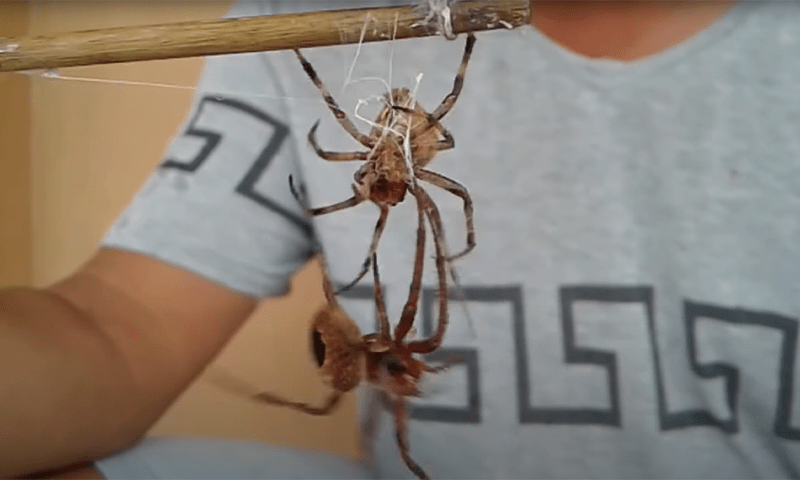
One of the authors of the study, entomologist Aimee Lynn Barrion-Dupo, is also from the Philippines. In an interview, she explained that unlike most countries where spiders were depicted as sources of venom and harm, in the Philippines spiders figured in news reportage mostly as pets or as participants in the popular pastime of laro ng gagamba (literally “game of spiders”). The game involves catching spiders, taking care of them, and making them fight other spiders.
Could it be that this game desensitized us to spiders?
When I was a child growing up in Laguna province in the Philippines, I played it with other kids in my neighborhood. My father taught at the University of the Philippines Los Baños, located on Mount Makiling. Those of us who grew up on its slopes would look for the fiercest, strongest, and most unique spiders and house them in medicine bottles or matchboxes, and feed them ants, grasshoppers, and other insects—until it was time to play. We would place our spiders on the opposite ends of a stick of walis tingting, a kind of broom. We’d nudge our spiders to walk toward one another and fight. The winner of the wrestling match was decided sometimes within seconds or at most a few minutes. It ended when one of the spiders was killed or incapacitated, or when a spider either fell off the stick or tried to run away more than once.
Could it be that this game desensitized us to spiders, making us less fearful of them in contrast to many other parts of the world? This question interests me not just because of nostalgia for the spiders of my childhood but as an anthropologist who today explores human entanglements with other species. I’m fascinated by how we perceive and live with other creatures, including animals we pit against each other and play with—from cockfighting in Bali to bullfighting in Spain to cricket fighting in China.
When it comes to widespread fears surrounding spiders, a closer look reveals a more complicated picture of human responses and interactions with these creatures. The arachnologist David Wise, for instance, surveyed folktales from North America to Africa that cast spiders in a positive light, leading him to conclude that not all societies are arachnophobic.
In the Philippines, a handful of scholarly accounts of laro ng gagamba depict people’s close relationships with spiders. One example comes from an ethnographic account by cultural anthropologist Ty Matejowsky, who researched spider wrestling in the Pangasinan province in northern Luzon in the early 2000s. He recounts how boys and young men collect, train, and play with spiders, often for money.
Fascinatingly, the researchers also recorded various substances people fed to the spiders to prepare for a fight. The list included various vitamins and supplements, dextrose, coconut water or meat, duck egg soup, Jujube plum fruit (Ziziphus jujuba), milk, honey, energy drinks, and even human breast milk. The gamers usually placed these substances on cotton balls and left them in the boxes where the spiders were kept.
These details show that, more than just a game, spider wrestling in the Philippines involves care and intimacy between humans and spiders. Matejowsky describes it as an “attachment … that approaches what some feel for more conventional pets.” Barrion-Dupo sees the spider game as offering children “first steps in science and natural history,” ultimately contributing to an appreciation not just for spiders but for the environment at large.
However, the research by Barrion-Dupo and her colleagues also shows the game has a potentially detrimental impact on the populations of various spider species. Gamers usually extract mature reproductive females from the wild; female spiders, as it turns out, are more ferocious than their male counterparts. The researchers call for policies to restrict the game to prevent species decline.
As far as I know, spiders are not often included in animal rights discourses in the Philippines. Even without active intervention, however, the game already seems to be declining in popularity.
When I recently returned to the neighborhood where I grew up, I was told that none of the kids ventured into the forests like my friends and I used to. The advent of electronic gadgets and digital technologies has meant that children today, whether they live in urban neighborhoods or mountainous communities, are far more likely to be familiar with Spider-Man than the spiders that share their environments. 
This work first appeared on SAPIENS under a CC BY-ND 4.0 license. Read the original here.
Lead image: Screen grab via YouTube: Prime Aquatics / YouTube