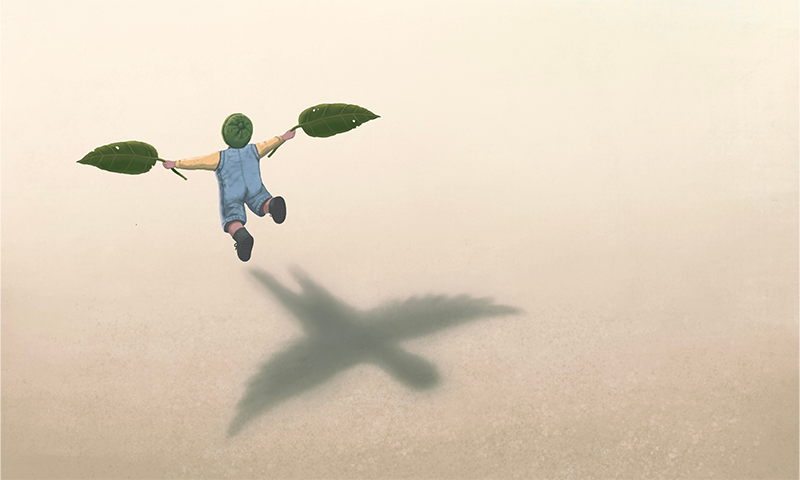
When a kid imitates a cat, or pretends to fly a rocket ship through space, they’re doing something that’s pretty complex: acting as though one thing is actually something else. Learning to pretend is a critical skill and an important stage in a child’s development.
But new research suggests that pretend play comes in many distinct varieties that emerge at different ages. Elena Hoicka, a professor of education at the University of Bristol, divided play types into 18 different categories—such as pretending one object is another and having an imaginary friend—and then surveyed about 900 parents of kids aged 4 months to just under 4 years old (47 months) about when they noticed their kids engaging in these behaviors.
By 15 months, half of kids will pretend with their own bodies: to sleep, or sneeze, or be an animal.
Hoicka wanted to know, do certain kinds of play emerge as we learn specific skills, such as representation, language, cultural knowledge, and socialization? Earlier theorists had suggested that children’s play may reflect their increasing ability to manipulate symbols, for instance. First, they might represent situations that are closely aligned with reality—such as pretending to sleep. Then they could move on to ones that treat inanimate objects as animate—pretending that a doll is sleeping. Older children would be able to make more abstract representations, such as imagining one object is another—a frisbee as a spaceship zooming through the cosmos. But most investigations of these hypotheses had been done in the lab, which can be cumbersome, and typically only addressed a fraction of the variety of play types.
Hoicka says her study was meant, in part, to provide a look at how children play in a natural environment, and to gather large-scale data on a comprehensive number of play types for the first time. Her analysis found that, by 13 months, half of kids will pretend with empty objects; by 15 months, they will pretend with their own bodies: to sleep, or sneeze, or be an animal. By 17 months, they move onto object substitution—the frisbee as a spaceship.
More complex pretend play, the kind that relies on advanced language skills, tends to start later. By the age of 2, she found, most kids will make up elaborate stories with characters and drama, and by the age of 3, they will begin to engage in complete make believe, inventing things that do not exist in the real world, such as Pegasus men who can fly. Hoicka also found that children may begin pretending as early as 4 months, whereas earlier studies suggested pretending does not begin until 8 months of age.
Hoicka began the play-age project nine years ago, before she had her own children and watched them start to pretend. “I can categorize what they’re doing as they go,” she says. Hoicka’s 2-year-old likes pretending with dolls, for example, and her 5-year-old makes up real-world scenarios, like inventing a pretend store with pretend money.
“It’s a really nicely done study,” says Thalia Goldstein, who studies kids’ social and emotional development at George Mason University. She likes that the survey traced the development of so many different “fine-grained” pretend play behaviors. Researchers only began to take the study of child play behavior seriously during the 1950s and ’60s, Goldstein says. Ensuing decades of research have linked pretend play to creativity, social skills, emotional control, and imagining others’ thoughts, among other abilities.
Around age 9 or 10, kids typically let go of pretend play, says Sandra Russ, who researches play therapy at Case Western Reserve University. But the element of fantasy often reappears in hobbies like writing, art, and other creative pursuits, which extend into adulthood.
Hoicka wants her findings to help scientists answer questions about whether pretending actually helps us learn certain skills. One school of thought holds that it is a precursor to understanding that others can have different thoughts, or theory of mind, Hoicka says. Holding two ideas in your head—like that a plate can also be a hat!—could serve as practice for taking on different perspectives. Perhaps imagining another outcome, or different characters, could train that muscle in young kids. 
Lead image: Jorm Sangsorn / Shutterstock