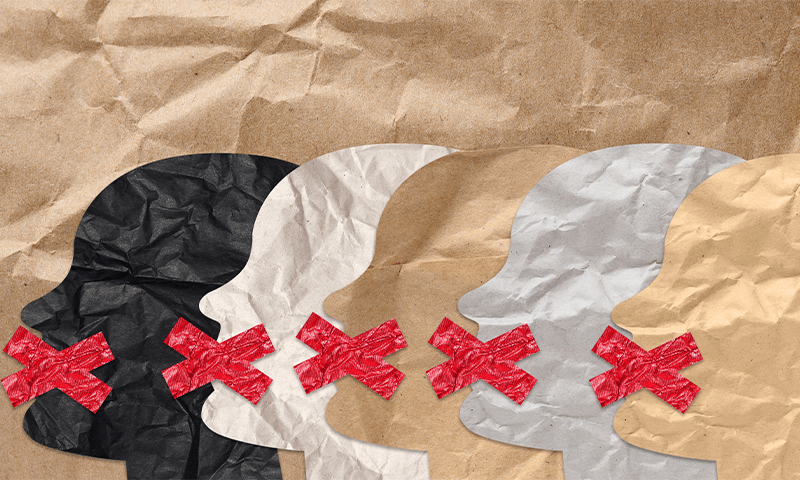
Population-level surveillance, through phones, social media, and facial recognition, is on the rise in the United States and around the world. So are punishments for dissent. The examples of politicians and protestors who have been targeted, jailed, or pursued by authorities are too many to count. When these kinds of threats to fragile democracies emerge, self-censorship becomes a real risk. So how do people decide whether to stay quiet or to speak up?
A new game might help answer this question. Researchers created a mathematical model to see how ruling powers and individual people make choices and weigh tradeoffs in authoritarian regimes. What they found suggests that self-censorship is less a simple fear response and more a strategic one: Whether someone is willing to risk speaking out is governed by the likelihood of getting caught and the severity of punishments they might face. But certain personality traits, such as boldness, that can characterize entire populations, play an important part. The researchers published their results in Proceedings of the National Academy of Sciences.
“A population's willingness to speak out early on, and suffer the negative consequences, has an outsized effect on how long it takes an authority to suppress all dissent," said study author Stephanie Forrest, a professor of computing and augmented intelligence at Arizona State University, in a statement. "This is because the cost of punishing an entire population simultaneously is too high.”
How punishments are meted out also has a big impact on how willing people are to speak out, Forrest and her colleagues found. When the consequences for dissent are uniform—blanket bans on certain types of speech or activity and Internet shutdowns—people readily self-censor. But when punishments are proportional to the offense, for example tougher penalties for repeat offenders, some individuals will still take small risks to speak out.
Read more: “There Are No True Rebels”
In the model the researchers created, hypothetical ruling powers were enabled to adjust the extent of their surveillance and the severity of their punishments according to their need to minimize dissent and costs. Protestors, meanwhile, had to weigh the risk of getting caught. Each responded to the other. In these simulated societies, the authorities that started out with more lax surveillance and punishments often ramped up repressive policies over time.
This is in line with how such regimes have played out historically. In 1957, Chairman Mao Zedong launched the “Hundred Flowers Campaign,” which lifted restrictions on Chinese intellectuals and writers, who were encouraged to critique the communist government. “Let a hundred flowers bloom,” said Mao in a speech announcing the new initiative, citing a line from a Chinese poem. Soon letters began to flood government offices and a “Democratic Wall” went up at Beijing University, with messages of dissent. By July, Mao had quashed his own campaign. Hundreds of thousands of critics were rounded up and sent to labor camps or executed.
The researchers’ model showed that as surveillance grows, so does self-censorship. But populations with higher levels of “boldness,” defined as a willingness to risk punishment, were able to draw out their resistance over longer periods of time. When this happened, those in power often struggled to fully repress dissent no matter how high the risk of protest. “The most powerful lever a population has for sustaining dissent is its boldness,” the authors write in their paper.
Preserving open dialogue, then, seems to depend not only on punishments and surveillance, Forrest says, “but on the courage of individuals and the collective willingness to keep speaking, even when it’s uncomfortable.” 
Enjoying Nautilus? Subscribe to our free newsletter.
Lead image: NDanko / Shutterstock