As an avatar becomes more humanlike, it looks familiar to us until it eventually triggers creepy feelings of strangeness. This “uncanny valley” effect, coined by Japanese roboticist Masahiro Mori, is increasingly salient as we strive to perfect humanoid robots (such as these Chinese “U1s”). Although they look uncannily like us, they also make our hair stand on end. Interestingly, a new study published in PLOS Biology finds that other primates also experience the uncanny valley.
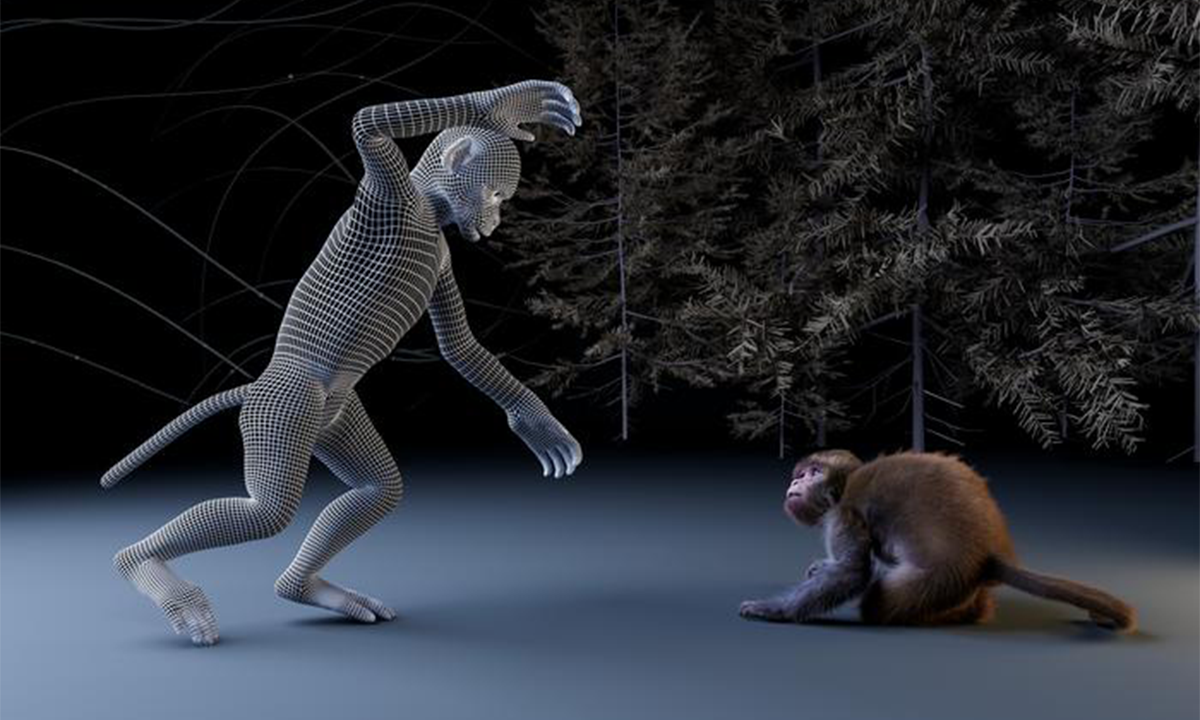
A team of brain and intelligent systems researchers in Germany and Belgium aimed to create lifelike, full-body monkey avatars that could be used to study the neural mechanisms underlying social communication. They chose macaques (Macaca mulatta) since they’re highly expressive in their communication. Because it was impractical to acquire enough movement data from markers affixed to real monkeys, the researchers relied on cameras. They identified 42 key points (elbow, wrist, tail-base, and so on), which they tracked from eight camera angles, and analyzed them using deep-learning software.
Read more: “The Uncanny Valley of Xenobots”
Eight macaques then watched variations of the 3-D moving avatar with different levels of realism offered by varying parameters like color, texture, and furriness. The researchers recorded the monkeys’ reactions and compared them to videos of real monkeys making the same movements. In terms of time spent staring at the footage, the macaques’ reactions were indistinguishable, showing that the avatars triggered a similar social perception.
But the macaques also displayed behavior that’s typical of the uncanny valley effect—namely, they paid more attention to both the unrealistic and the hyperrealistic avatars and less attention to ones that were realistic but not perfect. This kind of U-shaped attention curve is a key characteristic of the uncanny valley effect in humans. As the study authors said in a statement, “the social perception of monkeys and humans thus exhibit quite similar properties.”
It’s uncanny that, despite the sophistication of the human brain, we still experience perceptions like our close primate relatives. 
Enjoying Nautilus? Subscribe to our free newsletter.
Lead image: Lucas Martini et al.