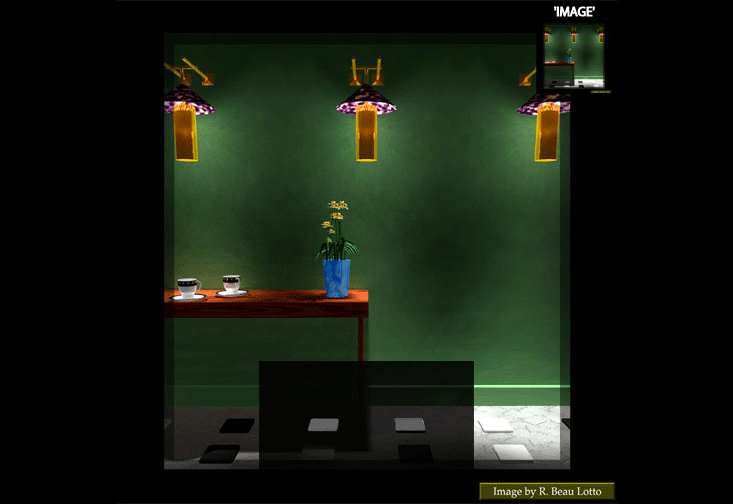
Take a close look at the floor tiles in the scene below. First, focus your attention on the tile directly below the potted plant, in the shadow of the table. Then, look at the tile to the right, outside of the table. Which of these tiles is brighter? The left one?
Wrong. In fact, as you can see in the image below, the colors of the tiles are identical. This trick is known as the brightness illusion. We perceive an object against a light background as darker than the same object against a dark background. That’s because our vision systems are attuned to contrasts, which helps us distinguish shapes (like an advancing predator). The upshot is that we don’t always see things for what they are.
As a neuroscientist who studies illusions at University College London, Beau Lotto knows all about the ways our brains can distort reality to our evolutionary advantage. I spoke to him about the deceptive nature of perception and whether it is possible to ever see anything for what it is.
What do brightness illusions teach us about how we see?
Everything we do is a kind of perception. Our experience of ourselves, of other people, the world—everything we think, believe, conceive—begins with perception. And brightness is our simplest mode of visual perception. It can’t get any more basic than that—to see the light. Illusions of brightness tell us that even at the most basic level, we can’t see everything. The brain did not evolve to see absolutes. It evolved to see relationships and to see what is behaviorally useful. If this is true with brightness, it has to be true all the way up, even to abstract conceptions.
Are you saying that we learn to navigate the world by recognizing patterns?
Yes and no. The fundamental problem that your brain evolved to deal with is uncertainty—the ambiguity of information. Information doesn’t tell you about itself; it doesn’t tell us what to do. So the first thing the brain does when you look at an image is it finds the pattern, which is nothing other than a statistical relationship. The pattern by itself is meaningless in the same way that the image you are looking at is meaningless, because you have no idea what it is, nor does it come with instructions about what to do. But then when you interact with the world, you generate either a good behavior, such as staying alive, or a bad behavior, such as dying. And your brain associates the behavioral value with the pattern. It’s the behavioral value that you see. Or it could be the behavioral value that your ancestors saw before you. As humans, we encode our cultural history as well as our evolutionary history.
Can we find evidence of this encoding in the human brain?
Unfortunately we know next to nothing about how any of this works mechanistically. We use bumblebees as a model because they have a million brain cells compared to our billions. And they see the same visual illusions that we see. While the mechanisms might be different, the principles are likely the same. If we can understand the principles, then we can understand the mechanisms and apply them to other systems, like robots.
You created a wearable device called the LumaKey that converts light to sound. Why?
What we want to do is provide a new kind of statistical experience. The physical structure of sound is very different from the physical structure of light. When we translate light into sound, the acoustic part of your brain is actually experiencing visual information, and we can see how the acoustic system makes sense of it. The question is: Can people start hearing visual illusions? That’s one reason we’re doing this. The other reason is that it’s potentially a wonderful way to compose music.
Is it possible to change our perceptions?
Yes, I think so. The beautiful thing about illusions is that they show us that everything we do is grounded in assumption. If you are looking at an illusion without knowing it is an illusion, you are having a perception of reality. But as soon as I show you that it is an illusion, your brain is doing something amazing—it is holding two realities that are mutually exclusive at the same time. The two tiles look different, but I know they are the same. Conceptually, this is no different from saying, “I am experiencing one reality today, but I can imagine another reality tomorrow.” The only way to begin the process of seeing differently is to have that awareness.
Claire Cameron is the social media and news editor at Nautilus.