Like other big cats on Earth, jaguars are getting squeezed out by humans. Assessed as Near Threatened on the IUCN Red List, jaguars (Panthera onca) are gone from almost half their historic range and are still on the decline. Because they can adapt to a wide range of habitats, jaguars used to be found all the way from Argentina to the Southwestern United States. But urbanization, agriculture, and poaching have now confined them to a much patchier distribution.
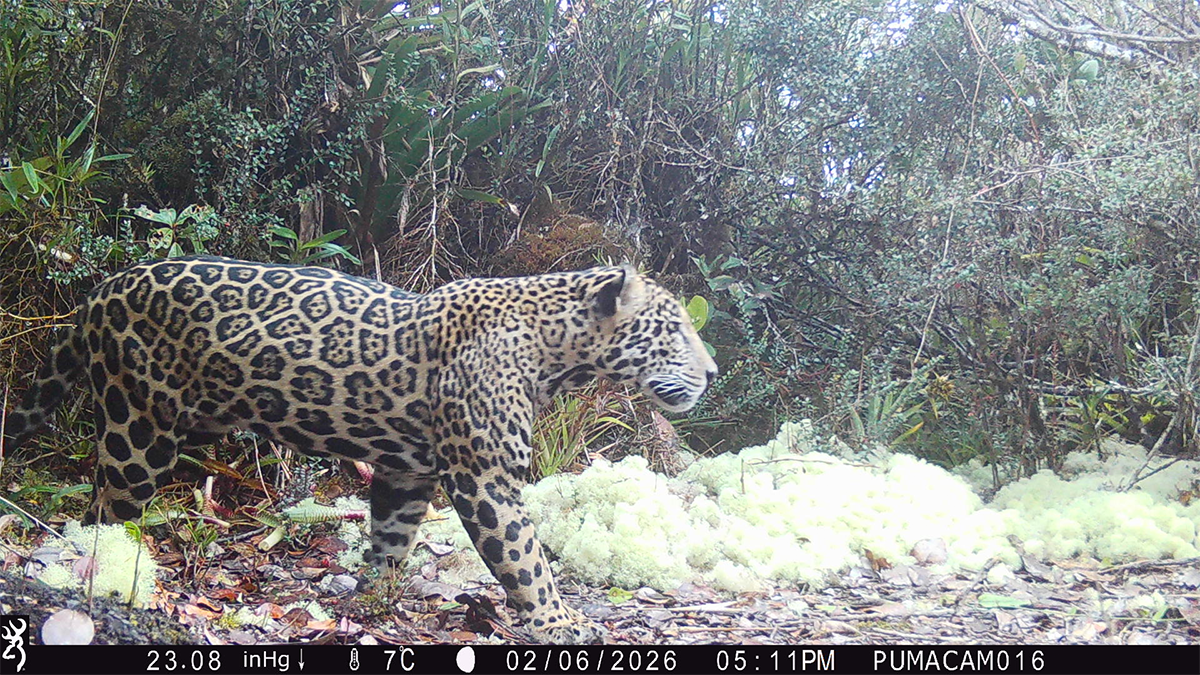
That’s why the recent sighting of a male jaguar in the cloud forests of the Merendón Mountains in Honduras is cause for optimism. On February 6, camera traps captured images of a healthy-looking male jaguar making his way through the high-elevation forest. At about 2,200 meters, the observation is the first jaguar sighting in the area in a decade—since a 2016 camera trap image of a jaguar in nearly the same spot that elicited “joyful roars, laughs, hugs, and smiles” from the field team.
This new observation has similarly thrilled biologists from the big cat conservation organization Panthera. Knowing that jaguars are naturally wide-ranging, they’ve been counting on the Merendón Mountain forests to serve as a link in the “Jaguar Corridor” from Mexico to Argentina, allowing for migration through otherwise deforested landscapes. Jaguars cover vast distances, during the course of which they disperse, find mates, set up new territories, and maintain genetic diversity.
Read more: “What Wild Animals Do in the Dark of the Night”
The locale of the two jaguars spotted on camera is a protected bridge between Honduras and Guatemala. Honduras has one of the highest deforestation rates in Latin America, but conservation measures are allowing jaguars to hang on in the remaining forests. Over the past decade, Panthera, working in collaboration with local partners, has supported ranger patrols to stem jaguar poaching; technology such as camera traps to monitor jaguar populations; and the reintroduction of iguanas and peccaries as jaguar food.
All of this, along with a recently adopted international framework for jaguar conservation and the Jaguar 2030 Conservation Roadmap for the Americas, which has been endorsed by 16 of the 18 countries within the natural range of jaguars, should strengthen the corridor even further.
So, if all goes according to plan, the recent jaguar sighting in Honduras will just be one of many. 
Enjoying Nautilus? Subscribe to our free newsletter.
Lead image: This healthy male jaguar was captured on camera in Honduras’ Sierra del Merendón mountain range. It marks the first time in a decade such a creature has been captured on camera in this area. Courtesy of Panthera