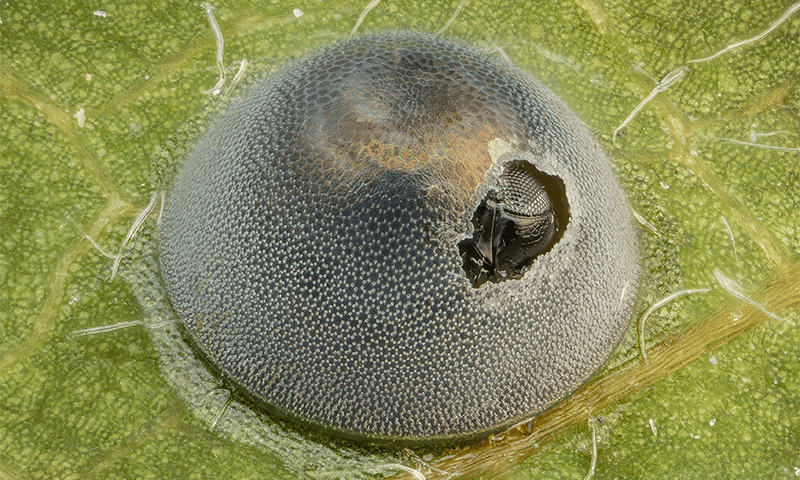
A small, scaled creature appears ready to emerge through a broken wall in an iridescent dome. Though the dome might resemble a strange spaceship, it is actually the remains of a moth egg, and the creature inside is a wasp that parasitized the egg.
Many wasp species are parasites, laying their offspring in or feeding on other insect and spider eggs. Scelionidae wasps, like the one pictured here, are “idiobiont” arthropods who, as developing larvae, feed on and grow from within their unfortunate host eggs—in this case, a sigmoid prominent moth (Clostera albosigma). Although these wasps are detrimental to the lives of their host organisms, many parasitic wasp species have formed beneficial relationships with other animals, including humans.
In the United Kingdom, where moths frequent musty closets and feast on wools and cottons, pest control teams have taken to releasing Trichogramma wasps on the unsuspecting fabric-eaters. Museums and heritage sites are particularly fond of this wasp-control method, since their ravenous parasitism is less toxic than fumigation or spraying insecticides.
Many parasitic wasp species have formed beneficial relationships with other animals.
California-based photographer Alison Pollack captured this surprising moment in her photograph, a winner in the Nikon Photomicrography Competition’s top 20 images. Though this egg was fully intact when Pollack’s colleague, Brent Haglund, first collected it from atop a poplar leaf in New Hampshire, the egg “hatched” just a few days later. It was only when Pollack inspected this specimen under a microscope that she realized she was staring at a wasp’s eye and leg through the cracked egg’s opening.
Pollack’s photograph used “focus stacking,” an editing technique that helped her display the true depth and detail of this wasp-and-egg duo. This technique is particularly useful in microphotography, where even the most powerful cameras would struggle to capture the micrometer-sized patterns of a wasp’s compound eye. To compose her shot, Pollack layered no fewer than 200 photos. By literally “stacking” a set of images that focus on different parts of a scene, photographers like Pollack can create a composite photo that keeps every detail of the subject in sharp focus, revealing some of nature’s most surprising moments.