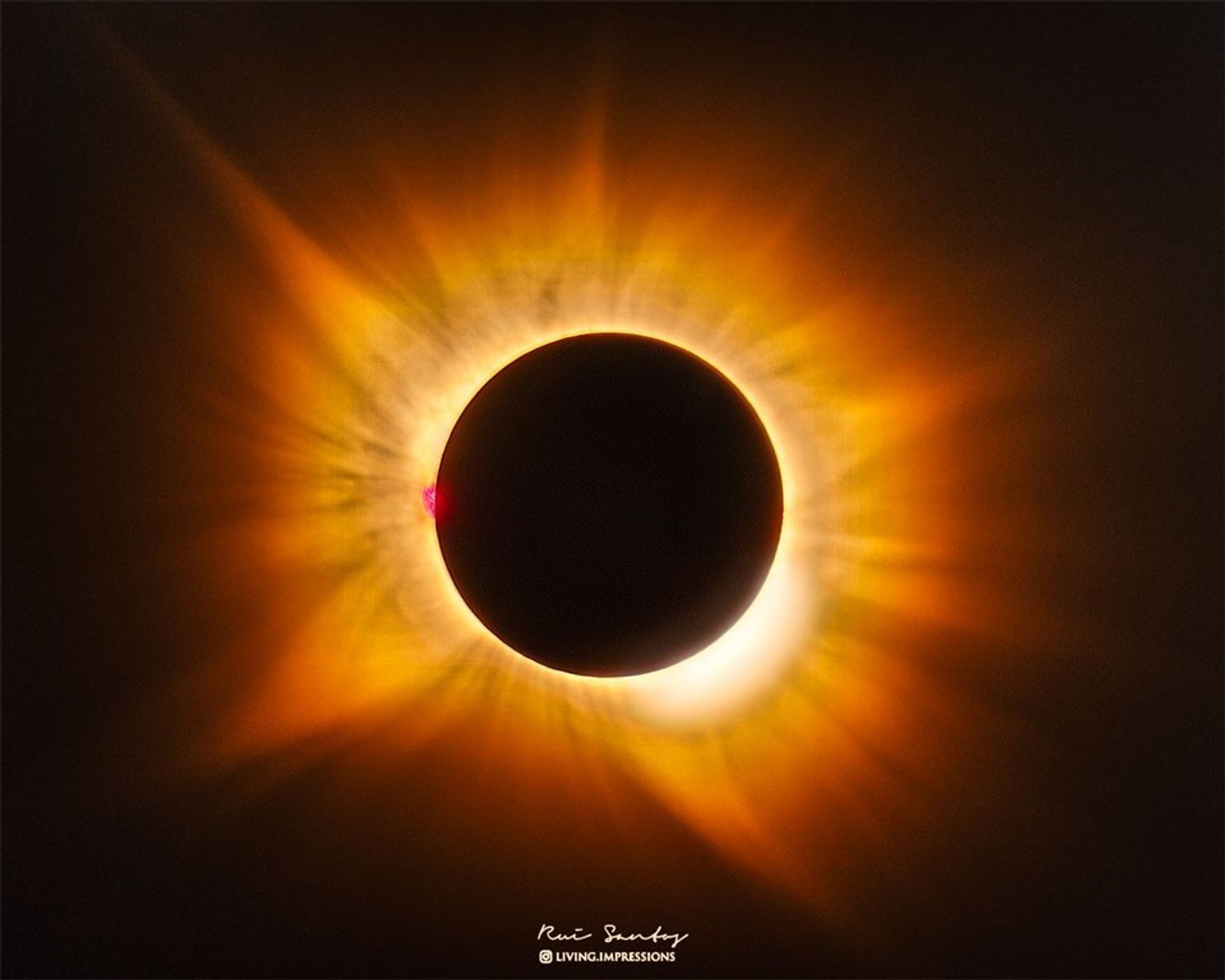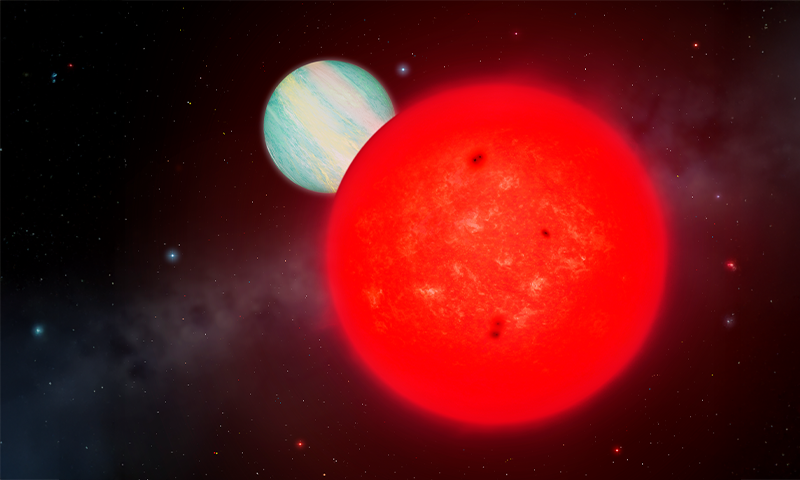
At first glance, the star TOI-6894 doesn’t appear out of the ordinary—it’s a red dwarf, like most of our galaxy’s stars. But this dwarf is different: It is orbited by a truly giant gas planet. This makes TOI-6894 the lowest mass star yet to be found anchoring a hefty planet. The discovery has astronomers scratching their heads: It defies current theories of planet formation.
The birth of the odd planet, TOI-6894b, can’t be explained by the prevailing model of gas planet formation: the core accretion theory. This claims that specks of space gas and dust swirling around a star clump up to form a core. Once the core grows big enough, its gravitational pull attracts gases that build up an atmosphere. But smaller stars like TOI-6894 likely don’t have enough dust and gas swirling around them to form a large enough core to kick things off.
The perplexing planet-star combination cropped up after researchers sifted through more than 90,000 observations of low-mass red-dwarf stars from NASA’s Transiting Exoplanet Survey Satellite, as reported recently in Nature Astronomy.
The international team of researchers offered a handful of hypotheses to explain this strange pair, such as the gravitational instability theory: Developing planets may grow unstable from the gravitational force they push onto themselves, and the collapsing gas and dust could spawn a new world—a process much quicker than the dominant theory. But simulations didn’t offer a clear winner.
For more definitive answers, the scientists want to peer into TOI-6894b’s atmosphere—the ingredients within could reveal how it came to be. For instance, a high amount of metals in the atmosphere could point to the gravitational instability theory. This analysis could happen relatively soon: Within the next year, the James Webb Space Telescope is slated to catch view of the planet, which is 241 light-years from us. By better understanding the weirdness of worlds like TOI-6894b, the team says we might get a new picture of how our own solar system formed. 
Lead image: University of Warwick/Mark Garlick