There are many stories to tell about GW170817.
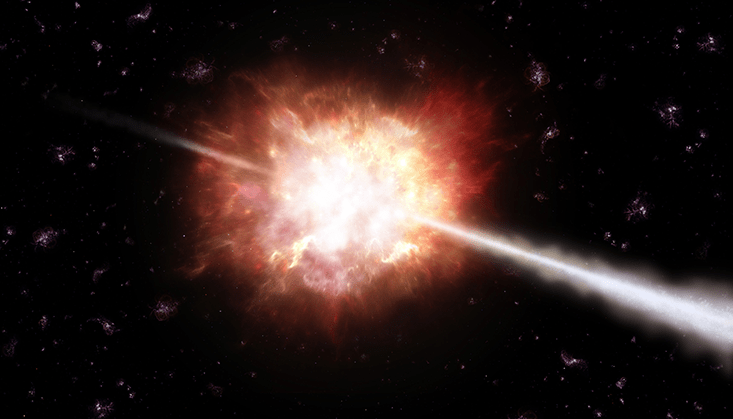
There are stories of a binary neutron star inspiral, two dead stars locked in a deadly dance that culminated in a collision. There are accounts of a worldwide collaboration of scientists, all working to discover what happened 130 million light-years away in NGC 4993. There are even tales of treasure—of gold and uranium, whose true origin may be the cosmic anvil of neutron star mergers.
Many of these have been covered by excellent reporting of yesterday’s news.
In some ways, the biggest story is that there are so many stories to tell. And the reason that there are so many is because GW170817 is not just another discovery, but the advent of an age of multi-messenger astronomy.
New ways of perceiving and detecting reality do not come about so frequently.
LIGO (Laser-Interferometric Gravitational Wave Observatory) first detected gravitational waves two years ago, ripples in spacetime from a collision between two black holes, each about 30 times the mass of our sun. Imperceptible to all but the most sensitive of devices, these waves passed through the Earth, distorting spacetime by a fraction the diameter of a proton.
Since this landmark discovery, LIGO has seen three other black hole binary mergers, including one with its European counterpart, Virgo. No light escapes these events, and while there is much to learn from the gravitational waves they emit, pointing an optical telescope their way would reveal … nothing.
Earlier this month, the Nobel Prize in Physics went to Rainer Weiss, Kip Thorne, and Barry Barish, for their role in LIGO’s direct observations of gravitational waves.
Important as they are, the Nobels are awarded every year. New ways of perceiving and detecting reality do not come about so frequently.
People in early civilizations used their eyes to look at the night sky. Even Galileo Galilei’s miraculous new invention—the “telescope”—was limited to visible light. It would not be until the 1800s that other tools for peering into the cosmos became available. Infrared astronomers observed our moon and other stars in literally, a new light.
The early to mid 20th century saw an expansion of the range of the electromagnetic spectrum through which we saw our universe—radio waves, X-rays, UV waves, microwaves, and gamma rays all become new avenues. Each new spectral band brought revelations: the story of the big bang, the massive energies present in solar flares, beauty hidden from the visible spectrum.
In 1987, another form of astronomy debuted when neutrino detectors picked up the signal of a supernova in the Tarantula Nebula. Ethereal neutrinos arrived at Earth hours earlier than any light from the supernova. Able to pass through and escape from the core of the imploding star thanks to their ghostly nature, neutrinos got the jump on light itself.
Ultimately, these different methods have more in common with each other than they do with gravitational waves.
To describe detection of gravitational waves to a lay audience, scientists and science writers have often used the analogy of “hearing,” and written about “listening to the cosmos.” This has created the misconception that scientists are actually listening for a sound passing through space.
“There’s been a mystique about that, that we’re now ‘listening’ to the universe,” said Weiss at his Nobel Press conference. “I heard that over and over again in the press, and I think we were partly to blame for that ourselves.”
Sound does not travel through space—the chirp you can listen to is an artifact of the interferometer readout frequency coincidentally falling in the audible range. That said, the notion of gravitational waves as a different sense is incredibly apt.
Gravitational waves are to electromagnetic radiation what hearing is to vision. They are fundamentally different ways of perception. Unlike electromagnetic radiation, gravitational waves are not composed of particles; they are omnidirectional and unstoppable undulations of spacetime.
GW170817 is not just another discovery, but the advent of an age of multi-messenger astronomy.
Multi-messenger astronomy is tantalizing for the same reason that the departure from silent films was celebrated. The addition of sound—or in this case, gravitational waves, adds a new dimension to what scientists can learn about the cosmos.
“We all knew it was coming, but this is the first time that we’ve seen it all together,” said Reshmi Mukherjee, an astrophysicist on the VERITAS experiment. “It’s really exciting.”
VERITAS, which looks for high-energy gamma rays, is located in the northern hemisphere, so it was blind to the events other telescopes could see in the skies from places like Chile.
Mukherhjee is not deterred—there will be more events like GW170817, and when they happen in the skies of the northern hemisphere, VERITAS will be looking.
Even though scientists expected to see an event like GW170817 at some point, the details themselves were a surprise.
“One of the most striking surprises for me is how ‘close’ this event was,” said David Radice, a postdoctoral researcher at Princeton University who works with simulations of neutron star mergers. By “close,” Radice means 130 million light-years, as opposed to 230 million light-years.
“The relative proximity to the source enabled a follow up campaign of observations with a level of coverage that goes beyond my wildest hopes,” he said.
Measurements of GW170817 seem to confirm that a possible source for short gamma ray bursts is the collision of neutron stars. Precise calculations of these events will also allow scientists to look at gravity itself.
“The very long signal as these neutron stars merged lets one put really tight constraints on possible deviations from general relativity,” said Robert McNees, a professor of physics at Loyola University Chicago.
One paper, published in Nature, used GW170817 to independently calculate the Hubble constant, which describes the expansion of the universe.
But as with any good discovery, GW170817 raises questions even as it answers others. For example, we don’t know if the merger formed a back hole, or what the mechanism behind the gamma ray burst is. Closer looks at the data over the next few months will hopefully yield answers to these and other questions.
Today’s haul yielded an unprecedented 30 papers across at least five major journals. The breadth and importance of their findings illustrates just how powerful multi-messenger astronomy will be.
“The big picture here is that we’ve entered the age of gravitational wave multi-messenger astronomy, and that is going to open up all sorts of new ways of understanding the universe,” McNees said.
“Multi-messenger science could be the new norm,” Mukherjee said. “It’s a very profound way to look into nature and how matter behaves.”
Dan Garisto is an editorial intern at Nautilus.