Some science is borne out of genuine curiosity, some comes from the desire to meet a pressing need, and some comes from goofing off with your coworkers. A new study published in the journal Ecology is the latter.
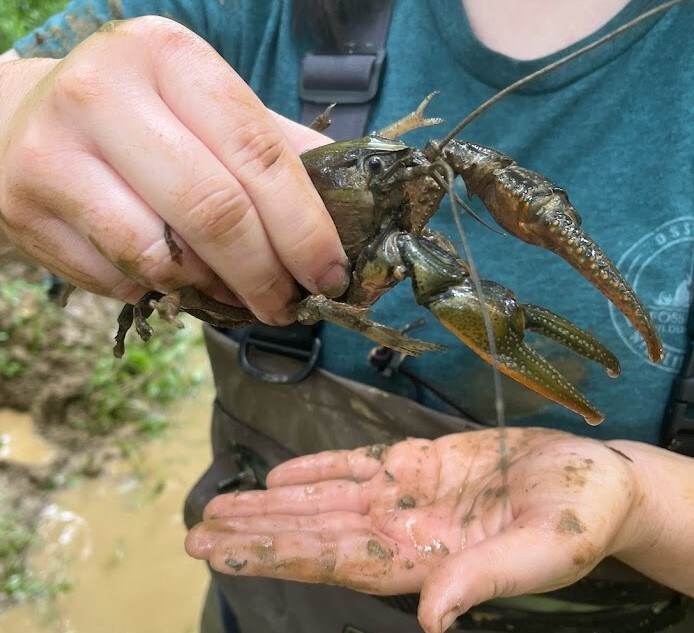
Caitlin Bloomer, an environmental scientist at the University of Illinois Urbana-Champaign, found a crayfish so huge, she felt like it might be a record-setter. “I thought, ‘There’s no doubt I have caught the biggest crayfish anyone’s ever seen!’” she said in a statement. “I brought it back to campus to show my colleague, naturally bragging about having caught the biggest-ever crayfish. But, as all biologists and sport fisherman do, he took one look and said, ‘No way, I’ve caught bigger.’”
Read more: “When Pigs Fly, Crayfish Whistle, and It Snows Red Snowflakes”
And that’s how the quest to find the largest crayfish in North America started. Bloomer’s crayfish was a member of the species Lacunicambarus chimera, commonly known as the crawzilla crawdad, and measured 77.5 millimeters from the tip of its head to the bottom of its thorax (just a hair over three inches). To find out how it stacked up, Bloomer and her colleagues asked museum curators and fellow scientists to measure their biggest specimens and send the numbers in.
They found around 20 specimens in contention for the beefiest crawdad on the continent, but Bloomer’s didn’t earn the top spot. “Mine wasn’t the biggest, but it did make the top 20, so I’m super proud of it,” Bloomer said. “And it was also the only burrowing crayfish to make the list, so I’ll take the win.”
Instead, the crown went to a Tennessee bottlebrush crayfish housed at West Virginia’s West Liberty University that measured a whopping 86.6 millimeters (around three and a half inches).
Of course, scientific journals don’t just publish the results of fishing competitions, the team also used the dataset to conduct some sophisticated analyses. They discovered that in general, 80 millimeters seems to represent the upper limit of how large North American crayfish can get. This struck them as a little odd considering they never stop growing over the course of their lives.
To investigate further, they looked at what factors might be holding these freshwater decapods under that 80 millimeter ceiling. They started by considering Bergmann’s rule, which states that animals within a certain group tend to grow larger in colder environments. Some of their largest specimens came from warm southern ecosystems, so that explanation seemed unlikely. Next, they moved on to Cope’s rule, the idea that animals grow larger over evolutionary time. Unfortunately, large specimens came from both early and late-branching lineages, so no luck there. They also ruled out oxygen availability as a factor, as the biggest specimens were from both free-swimming and burrowing species.
So what keeps North American crayfish from becoming the kaiju of the creeks?
According to the team, it’s possible there are physiological constraints restricting growth. Activities like walking and burrowing may become more difficult at larger sizes. Furthermore, crayfish need to molt to grow larger. After ditching their old shells, they’re left sporting thin, fragile shells for a period.
But the researchers say there’s likely more to the story. Other ecological factors like predation and competition could play a role. They also note that while 80 millimeters seems to be the North American size limit, there are larger crayfish in the Southern Hemisphere. The worldwide heavyweight champion is the Tasmanian giant freshwater crayfish, which can grow to be an eye-popping 120 millimeters (over four and a half inches).
There’s always a bigger (cray)fish in the pond. 
Enjoying Nautilus? Subscribe to our free newsletter.
Lead Image: Caitlin Bloomer, University of Illinois Urbana-Champaign