The more we get to know bees, the more we discover mental capabilities rivaling our own. A century ago, when ethologist Karl von Frisch recognized honeybee dancing as a way to direct other bees to nectar sources, it was the first of what would become many known facets of their remarkable cognition. Since then, according to a 2024 review study, research has demonstrated that honeybees can categorize visual stimuli, learn abstract rules, and grasp rudimentary arithmetic. Now, a recent study published in Science Advances adds human-like decision-making to the list.
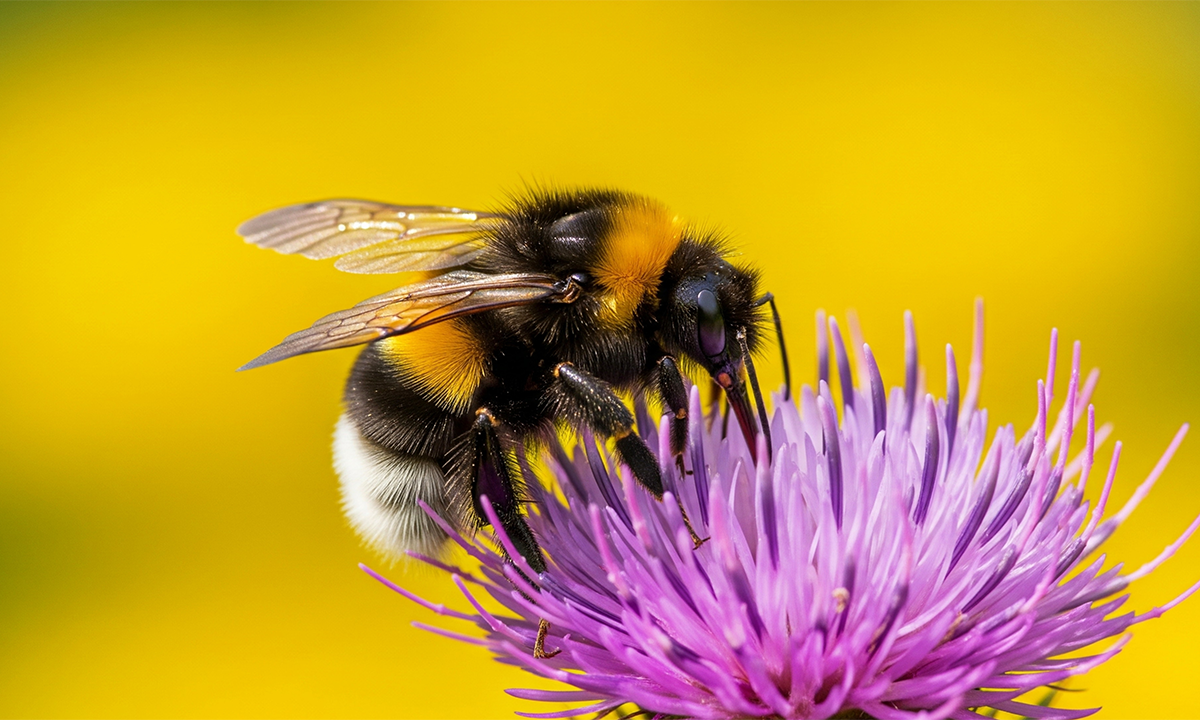
Researchers in Germany conducted experiments to determine how bumblebees (Bombus terrestris) adjust their learning and decision-making to context. A bumblebee visits hundreds of flowers per day, requiring myriad decisions about which are likely to offer nectar rewards.
“As they make so many decisions in very short periods, bumblebees are particularly well suited for studying decision-making processes,” said study author Anna Stöckl, neuroethologist at the University of Konstanz in Germany, in a press release.
Read more: “The Dreams of a Bumblebee in Autumn”
The researchers first trained bees to associate a combination of color and either pattern or shape with a nectar reward, and another combination with a less rewarding drop of water. For example, a blue, star-shaped flower might contain a sugar solution, while a yellow, round flower contains just water. Then, by swapping out color, shape, or pattern, they determined with cue(s) what the bees relied on to decide where to forage.
When the cues were mixed up, the bees kept choosing flowers based on color, rather than shape or pattern. For example, a blue, round flower was favored over a yellow, star-shaped flower. However, when bees were trained on flowers with only subtle distinctions in color (like orange-red hues), they focused on the shape and pattern. During the trials, they gravitated to flowers with the shapes that had contained rewards.
“In this way, the insects consistently achieve the best possible outcome by following the principle of ‘as much as necessary, as little as possible,’” said Stöckl.
Or put more plainly: Where possible, bumblebees take the shortcut of just learning color, an easier task for them than learning complex spatial cues. If color’s not available as a cue, bumblebees spend additional time learning shape and pattern.
Humans use a similar strategy of decision-making based on the most salient cues. If you’re choosing peaches at a market, you’ll grab the ones that have a pinkish-orange color rather than green. If they all have the pinkish-orange color, you might take a moment to smell them or feel them, using additional cues of scent and texture to determine ripeness.
It’s the same thing with bees—it’s just that their favorite piece of produce is a flower. 
Enjoying Nautilus? Subscribe to our free newsletter.
Lead image: SILVIA MAQQ / Shutterstock