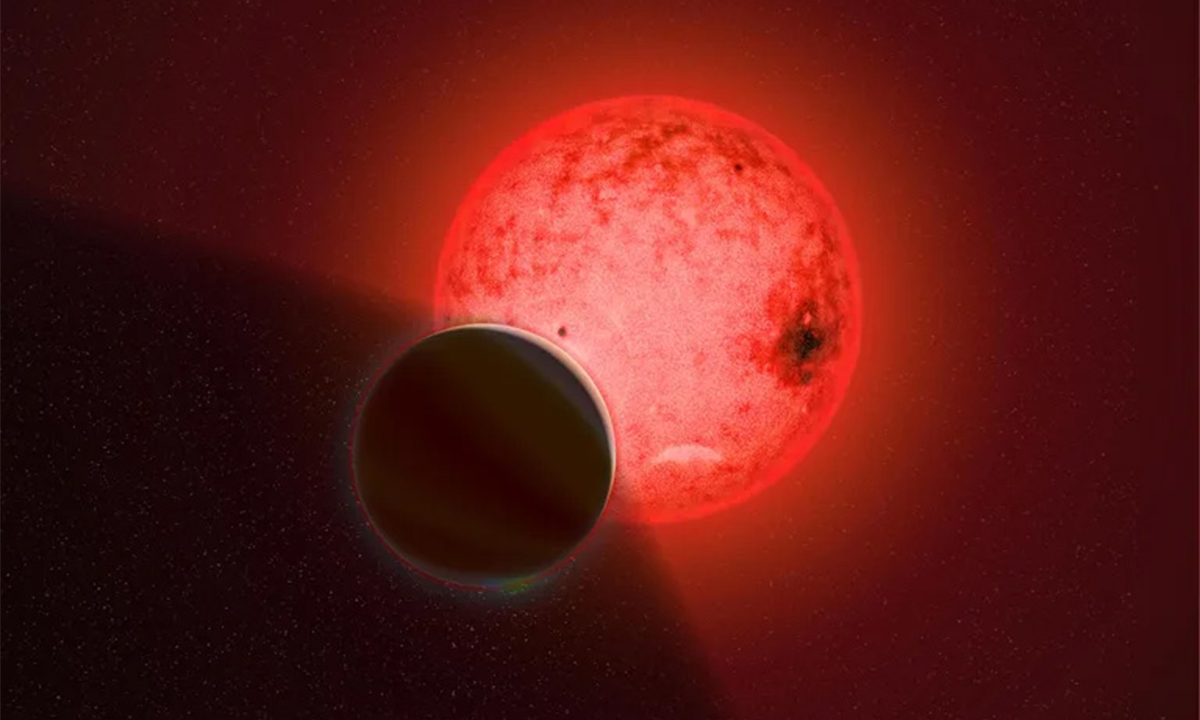
In 2023, a team of astronomers led by Shubham Kanodia of the Carnegie Institute of Science discovered an extraordinarily peculiar exoplanet. 282 light-years from Earth, a red dwarf star, TOI-5205, appeared to be harboring a planet that seemed much too big—a gas giant the size of Jupiter called TOI-5205b.
“The host star, TOI-5205, is just about four times the size of Jupiter, yet it has somehow managed to form a Jupiter-sized planet, which is quite surprising!” Kanodia, co-author of a 2023 study of the system, said in a statement at the time. “Based on our nominal current understanding of planet formation, TOI-5205b should not exist; it is a ‘forbidden’ planet.”
It might seem like a dramatic thing to say, but TOI-5205 and its forbidden planet appeared to be breaking the rules of planetary development. Planets are formed from the protoplanetary disk of cosmic dust that swirls around stars. Making a gas giant first requires accumulating enough dust to form a rocky core, which then attracts gas. A red dwarf star like TOI-5205, cooler and smaller than our sun, shouldn’t have been able to accumulate enough material to make a gas giant like TOI-5205b.
Read more: “How Pebbles Form Planets”
And yet, the forbidden planet is there, closely orbiting a star only four times its size. Today, Kanodia published a follow-up study in The Astronomical Journal. Using data from NASA’s Transiting Exoplanet Survey Satellite, which caught the mysterious celestial body making three trips in front of the red dwarf, the team was able to get a glimpse at the chemical composition of its atmosphere.
Surprisingly, the forbidden planet’s atmosphere has a lower concentration of heavy elements than a gas giant in our own solar system, like Jupiter. Unlike any other gas giant, its metallicity—the abundance of elements heavier than hydrogen and helium—is even lower than its host star.
Using models of planetary interiors the team estimated that TOI5205b’s overall composition is about 100 times more metal-rich than its atmosphere. “We observed much lower metallicity than our models predicted for the planet’s bulk composition, which is calculated from measurements of a planet’s mass and radius,” Kanodia explained in a statement. “This suggests that its heavy elements migrated inward during formation and now its interior and atmosphere are not mixing.”
While it’s proven to be a frustratingly tough nut to crack, unraveling the enigma of the forbidden planet’s existence could shed light on the evolution of all planets—even the “normal” ones. 
Enjoying Nautilus? Subscribe to our free newsletter.
Lead image: Katherine Cain, Carnegie Science