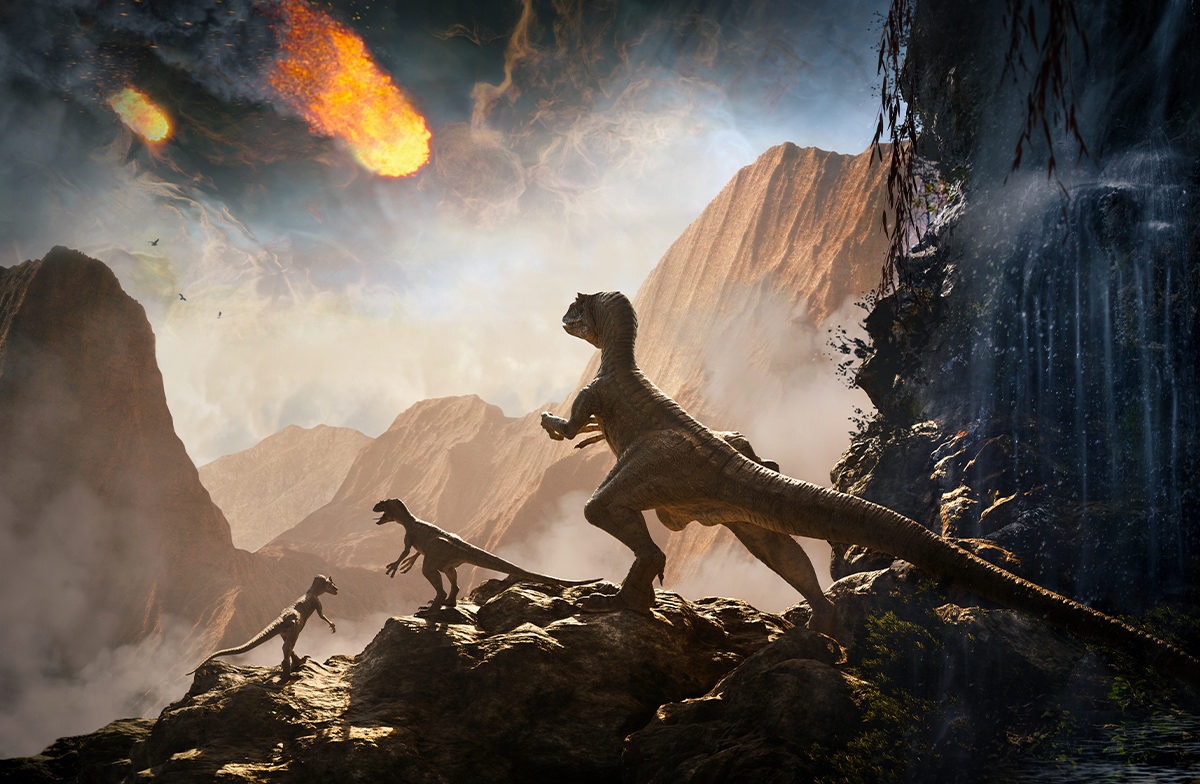
We know why the dinosaurs died—a massive asteroid hit the Yucatan Peninsula forming the Chicxulub crater—but how they died is still the subject of debate. To paraphrase Robert Frost, some say it happened with fire, and some say with ice. The “ice” version of events is that a cloud of dust from the impact blotted out the sun enough to cause a drop in global temperatures (similar to a nuclear winter).
The “fire” scenario is much more violent: As material ejected from the impact rained down from the atmosphere, it ignited a global firestorm, essentially cooking almost everything alive. While Team Ice has seemed to have an edge in recent years, Team Fire is coming in hot with a new study published in the Journal of Geophysical Research: Biogeosciences.
When the Mt. Everest-sized asteroid responsible for the Chicxulub crater hit, it displaced an enormous plume of vaporized material that spread into the upper atmosphere. It’s the physical characteristics of that plume and immediate aftermath that planetary scientists from Purdue University were focused on modeling in this latest study.
Read more: “The Day the Mesozoic Died”
According to the team, when that vaporized rock, soil, and living matter (R.I.P.) reached the upper atmosphere, it condensed into tiny spherules, beads of matter that then fell back to Earth, heating up again as they rained down. These spherules have in fact been found all over the world—even in the gills of fossilized fish that likely died soon after the impact.
The material from the asteroid, on the other hand, became a cloud of uncondensed vapor (or fine dust), and it’s this dust cloud that turned a bad day into a mass extinction event. It prevented any heat generated by the falling spherules from escaping into space, similar to a lid on a pot.
“Without fine dust, this still wouldn’t have been a good day for dinosaurs. It would have killed some off, but it probably wasn’t enough to start many wildfires,” study author Brandon C. Johnson said in a statement. “With the fine dust, the Cretaceous animals received 17 times the dose of thermal radiation that is 100 percent lethal to humans. It was enough to ignite grass, pine needles, lichen, and maybe even directly ignite wood.”
Basically, it was hell on Earth. 
Enjoying Nautilus? Subscribe to our free newsletter.
Lead image: Mikael Damkier / Adobe Stock