Is it better to cooperate or to cheat?
This is the question at the heart of the so-called prisoner’s dilemma, one of the most famous ideas in game theory. Suppose that two suspects are arrested for the same crime, and then separated and offered a plea deal. They can either “cooperate” by staying silent, or “cheat”—betraying the other and taking the deal. If both of them stay silent, they both get short sentences. If one stays silent and the other rats him out, one gets the maximum sentence and the other walks free. But what often happens is that they both cheat instead. Fearing betrayal, each suspect acts in their own self-interest, takes the plea, and spends years rotting in prison. (This outcome is known as the Nash equilibrium, for Nobel-prize winning mathematician John Nash, and was dramatized in the film A Beautiful Mind.)
The prisoner’s dilemma has long been used to understand everything from the behavior of competing microbes in a petri dish to human societies seeking to head off nuclear war. But the model has always confounded scientists: Cooperation is essential for the survival of biological life, but how can cooperation emerge if cheating always offers the biggest payoff?
Now, a new study led by Rutgers University physicist Alexandre Morozov suggests cooperation can emerge naturally as long as we assume people are neither heroes nor villains, but something in between: They cooperate with some individuals and cheat with others, and they change their behavior based on who their opponents are. The new findings, published in the Proceedings of the National Academy of Sciences, suggest that cooperation doesn’t have to rely on any special rules or even genetic ties. It just requires a certain amount of recognition, knowing who you’re dealing with, and having preferences.
I spoke with Morozov about how he and his collaborator Alexander Feigel from the Hebrew University of Jerusalem broke the shackles of the prisoner’s dilemma, where the model breaks down, and what if anything it has to say about modern politics.
Read more: “People Really Want to Be Good”
What inspired you to take up this question of the prisoner’s dilemma, or why cooperation exists in a world where natural selection seems to reward selfishness?
I’m a biological physicist, so for a long time, I was interested in modeling evolution. But I only learned about game theory more recently, in 2021, when I got a fellowship to study in the department of physics at Hebrew University with my old friend, and coauthor on this paper, the physicist Alex Hagel. He had been working on evolutionary game theory for a while and had developed these small digital populations of neural networks. When he tried to evolve them, they always became cooperative, and he had no idea why. We started thinking about it, and the rest of the work is just trying to extract effects or ideas that would bring about such behavior.
It was an observation first and the theory later. That’s how it is in physics. You see something, and you try to explain it with a very simple system, which captures something essential about it.
What is wrong with the prisoner’s dilemma?
The prisoner’s dilemma was formulated in the 1960s by researchers from the RAND Corporation, a policy think tank, to model human conflicts in the context of the Cold War. Only later did scientists begin to apply it to evolution—and to animals, as opposed to people. That’s why it’s kind of weird. It’s about prison sentences. But the way people use it now, it’s about payoffs and about cheaters and cooperators.
In the standard prisoner’s dilemma model, if person one cooperates and person two cooperates, they both get plus 10 points. But if the first person cooperates and the other one now defects, it’s actually minus 10 for the first person who foolishly cooperates, but plus 20 for the person who defects. The first guy is screwed, right? If both people defect, you get zero payoffs. So now you’re stuck in a very bad place. If you had just both cooperated, you’d each get plus 10 per round.
In evolutionary simulations, if you implement this exact model, you collapse to zero payoffs in like 500 generations. Everyone defects. It’s very fast. People were always puzzled by this because life is cooperative. Without cooperation, nothing works. Even organisms are multicellular cooperatives. If our cells went their own way, they wouldn’t build something like a human. They had to give up something. Maybe you’ve heard the phrase “tragedy of the commons.” Imagine a village or just a population of cells. Everybody contributes to some shared resource. It would be very tempting to be a cell that uses that resource but doesn’t contribute to it because it takes energy to replenish the source. But then you can imagine what happens if the cheaters take over. No one is replenishing this anymore and everybody dies.
People have developed a lot of workarounds, such as reputation scores, tags that people carry around that tell others whether you’re an honest person. There’s a spectrum of values on the tag. There’s nothing wrong with all these workaround models, it’s just that they required extra assumptions. In the old models, you had to assign one number, a probability of cooperation, to every person. This probability applied equally to everybody no matter who they met. Unless we modify the payoff according to a person’s reputation score, the simulation collapses. Everyone becomes a cheater, and then the population dies off.
How is your model different?
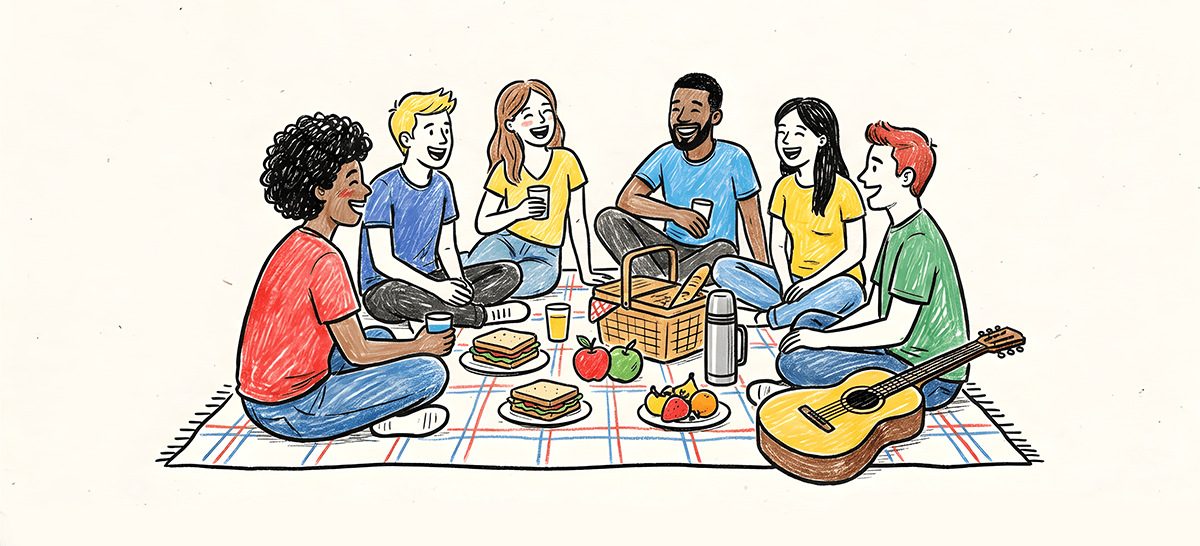
What we did is really one thing: You don’t have to be an absolute cheater or an absolute cooperator. You can be nice to some people, and less nice to others. This is very natural, in hindsight, because it’s true even with people, probably true with animals as well. I’m a physicist, not an evolutionary biologist, but evolutionary biologists write a lot about animal encounters. How an animal behaves depends very much on its opponent. If the opponent is big and strong, then maybe the animal will cooperate. It would be a fairly silly strategy to just fight all the time. But if you relax that assumption, make cheating and cooperating relational, that’s enough to have cooperation all over the place.
My understanding is that recognition is fundamental to how this operates. Can you explain why?
To act like this, to cooperate with some and cheat with others, you need to know who you’re dealing with. In our model, you recognize your opponent and say, “Oh, they’re a member of group two. So I will cheat.” But toward my own group, I might act not as a cheater at all. I can be a very nice person toward members of my own group. Let’s say I’m also nice toward group three, but I’m just nasty toward group two. It emerges in the dynamic. It shows up by itself without any extra mechanism. You don’t have to modify the model.
Is there anywhere the model breaks down?
Yes, if you have a very popular individual who is supported by different swaths of the population. Everybody likes him. We could see some examples in politics. I don’t want to speculate too much. Because people like him are well supported, this person’s group proliferates like fire in the population. It’s very fast. Now the question is, because they’re all the same, how much do the members of this group like one another?
If they like one another, everybody’s happy. And if there are no new mutants, or changes in the environment, this is basically a paradise. Everybody looks the same, and they all like one another. But if the members of the dominant group don’t like each other, this society eventually collapses. Even if they all like each other, the system doesn’t stay stable forever. What you see is a repeating pattern. First a dominant group takes over, leading to a plateau. Then a new mutant arises and begins to outcompete the dominant group, leading to a chaotic transition. Someone wins, and that group becomes dominant, leading to a new plateau, until the cycle begins again.
Read more: “Cooperation Is What Makes Us Human”
What does “liking” someone mean exactly in this context?
It’s just a proxy for the probability that an individual will cooperate with another individual. This is something that you decide based on appearance, but also on a history of interactions. It’s not easy to capture it in people. But as a physicist, I’m trained to create simple models. You could imagine up to five features that would be presented to your opponents, but you might also try to deceive your opponents—hiding or maybe adding noise around these recognizable features—and then maybe you’ll win this way. This kind of behavior is for future research.
How would you sum up the breakthrough you made?
The main thing is that we broke the shackles, if you will, of the prisoner’s dilemma. Because regardless of mutation rates or population sizes, when you model the prisoner’s dilemma, cheaters always win. That’s the only outcome. You always end up with the collapse of the society or population. There’s just not enough flexibility in the model. It’s not a realistic model. But it’s one that people use in all kinds of scenarios. So our paradigm takes it one step further: You’re no longer an absolute cheater, an absolute cooperator. You have the freedom to adjust your reaction depending on the nature of your opponent. So that’s the new idea.
The prisoner’s dilemma has been the foundation for so many different kinds of modeling over the years. What needs to be revised now in light of what you found?
Evolutionary game theory was imported into biology and economics in the 1970s and 1980s, and the prisoner’s dilemma became foundational to both. A lot of this work now needs to be revisited with the added assumption that cooperation probabilities can be opponent-dependent.
Does your model have any specific implications for today’s very politically polarized environment?
This is a simple model, and it’s a stretch to apply it to modern politics or modern human societies even. I try to stay on the biological side of things. But there are some analogies, because even with the simple model, if everything works, you hit that stability plateau, and people may become a little bit antsy, dissatisfied, want change, and suddenly change comes. Other people come to power, and it’s not the old order of things anymore. The change is very fast. One cannot really apply this detail to modern politics, but look at history. There’s some empire, and it works, and then suddenly nothing works anymore.
Still, your finding feels like good news for the human species, at a time when things otherwise look pretty grim.
Exactly. If you allow people to change their behavior, depending on who they encounter, cooperation becomes possible. 
Enjoying Nautilus? Subscribe to our free newsletter.
Lead image: Rob Goebel / Adobe Stock