The old adage that “an elephant never forgets” holds some truth. Between excellent spatial memory and ability to remember individual elephants’ and humans’ faces, elephants merit the long-held respect for their powers of recollection. And researchers working with wild elephants have found that this noteworthy memory capacity could be pivotal to the endangered animals’ conservation.
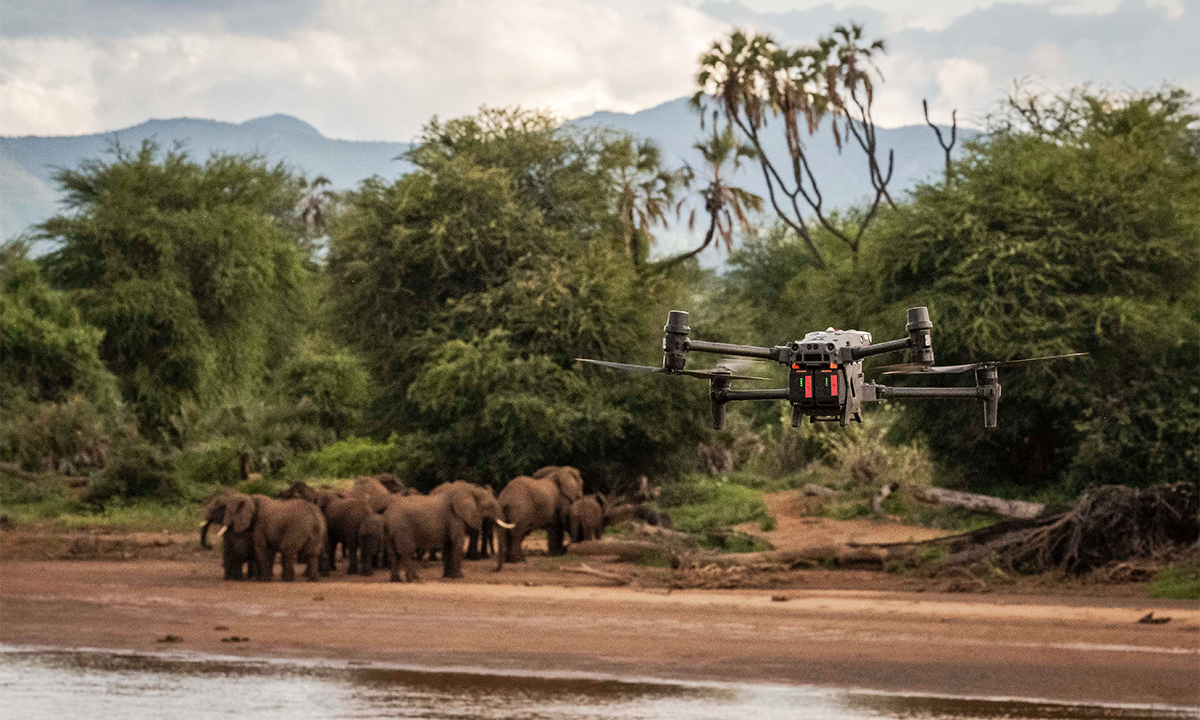
African elephants, the world’s largest terrestrial animals, may tap their memories to become habituated to the presence of drones that could collect crucial data to help their imperiled populations, suggests a team comprising scientists from the nonprofit conservation group Save the Elephants. The scientists published their findings recently in Scientific Reports.
African savannah elephants (Loxodonta africana) had initially encountered drones (i.e., unmanned aerial vehicles) as a method for farmers to drive herds away from their crops. Elephant crop raiding is a significant issue in parts of Africa, and the noise and flashing lights of drones flown within 50 meters of elephants disturbed them enough to send them fleeing. So, while drones have been used to monitor other animals, they weren’t thought suitable for elephants.
So, scientists from Save the Elephants, the University of Oxford, Sussex University, and the University of Colorado, Boulder, conducted 35 trials of using quadcopter drones to monitor elephants in two northern Kenyan reserves. The researchers conducted flights and recorded elephant behaviors to determine whether the animals could habituate to drones in single trials and with repeated monitoring. Drones were deployed using protocols less likely to disturb the elephants, such as launching from at least 1,600 feet away and always on the downwind side to dampen noise.
The drones evoked disturbance reactions in elephants about half the time. These behaviors included elephants pausing their feeding with trunks up or showing agitation through head shaking. The reactions, however, were mostly confined to the first minute of drone arrival, after which the animals learned to ignore them, returning to their typical behaviors. Furthermore, some elephants were less reactive in repeat drone trials relative to their first drone exposure, even after an interval of as long as 355 days.
“Our results suggest that these habituation effects may last over many months if not years, demonstrating the capacity for learning and adaptability for which elephants are already well known,” said co-author Angus Carey-Douglas, a scientist with Save the Elephants, in a statement.
Read more: “The Natural World Is an Elephant World”
Elephants’ tolerance of drones opens the possibility of a minimally invasive, affordable way to keep tabs on herds. Because elephants are large and travel in groups, they are in some ways ideal candidates for drone-based research. The aerial vehicles carry cameras and sensors that can collect data on previously unseen aspects of elephant individual and social behavior.
“This research demonstrates the power of a new and rapidly evolving technology that allows us to probe ever deeper into the secret lives of elephants,” said University of Oxford evolutionary biologist and co-author Fritz Vollrath. 
Enjoying Nautilus? Subscribe to our free newsletter.
Lead image: © Jane Wynyard / Save the Elephants