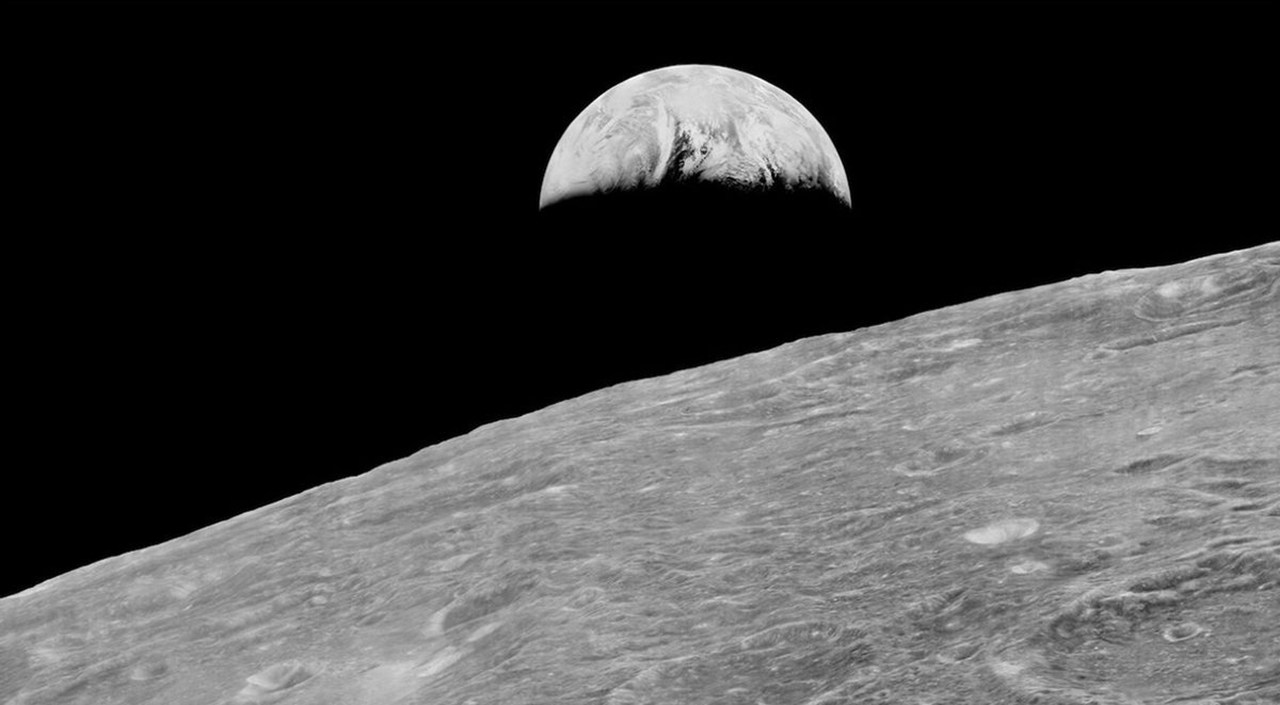
An Earthside sunrise is one of life’s most spectacular vistas. Sixty years ago, the Lunar Orbiter 1 captured a similar, yet infinitely rarer-to-behold wonder: our home planet “rising” above the lunar surface.
On August 23, 1966, NASA’s first lunar orbiter snapped the header photo above, a few weeks after it launched from Cape Canaveral on August 10th. After taking a couple of hundred more images of the moon over the course of a year, the orbiter met its demise when it dived into the lunar surface.
Read more: “The Best Photos of the Artemis II Mission”
Thankfully, it wasn’t the last time such an image was captured. In fact, perhaps the most famous Earthrise photo was taken by astronaut William Anders during the Apollo 8 mission—the first crewed spaceflight to travel to the moon and back successfully. Nature photographer Galen Rowell described it as “the most influential environmental photograph ever taken.”
Fast-forward to the 21st century—April 6, 2008 to be exact—when the Selene (or Kaguya) lunar orbiter developed by the Japan Aerospace Exploration Agency (JAXA) snapped the first photo to capture the entire Earth, in full color, in high definition.
Then there’s “Earthrise 2.0,” taken by the Lunar Reconnaissance Orbiter (LRO) that launched in 2009 and is still circling the moon today. It’s actually a composite of several different black-and-white and color photos, taken by two different cameras.
All of which brings us to the recent Artemis II mission, which sent astronauts Reid Wiseman, Victor Glover, Christina Koch, and Jeremy Hansen around the moon. They were able to capture their own version of Earthrise on April 6, 2026—the part of Earth you can see shows clouds swirling above Australia and Oceania—just a few minutes before temporarily losing touch with Earth as they disappeared around the far side of the moon.
Six decades on, the view has lost none of its impact. 
Enjoying Nautilus? Subscribe to our free newsletter.
Lead image: NASA