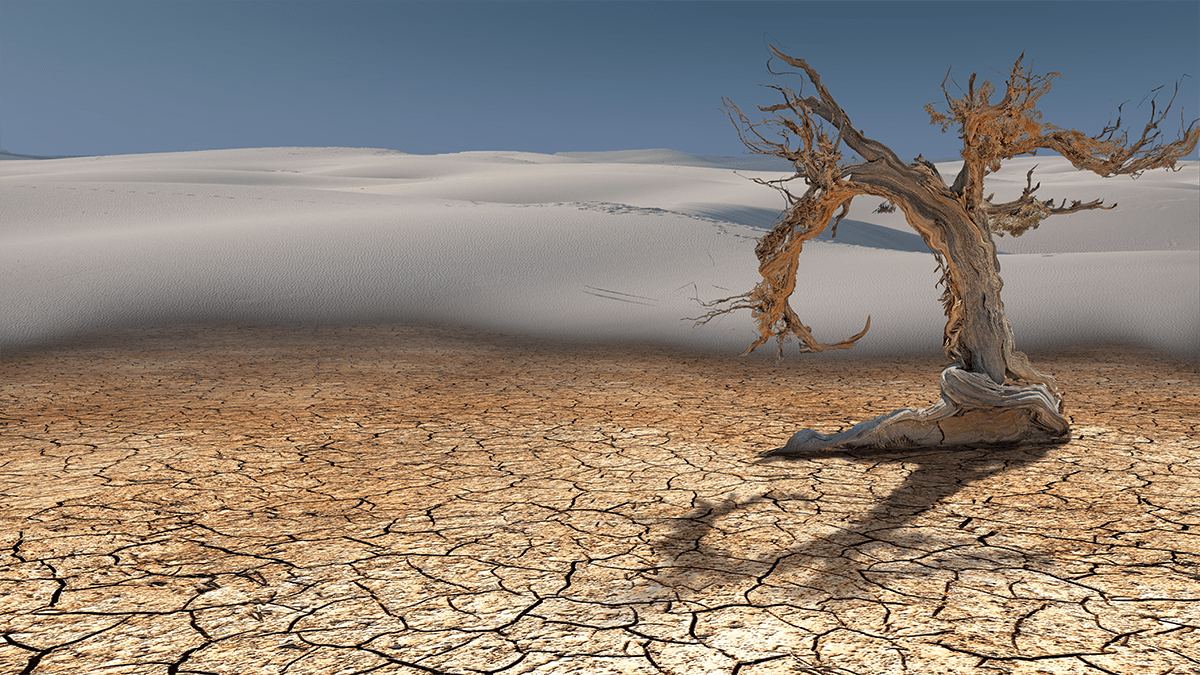
All good things must come to an end, and that includes Earth’s ability to support plant life—and thus, the rest of the biosphere. Of course, when that will happen is up for debate. Thanks to a new study published in the Journal of Geophysical Research: Atmospheres, we’ve at least got a ballpark figure, and it’s longer than we previously thought.
At some point in the distant future, our sun will expand into a red giant star, either engulfing or displacing our planet. But billions of years before that, our star is going to get around 20 percent brighter, which means the Earth will get hotter. The heat is also going to affect how much carbon dioxide, which plants need to live, is present in the atmosphere via the carbon-silicate cycle.
This geological cycle works over vast stretches of time (around 500,000 to 1 million years). At the beginning, volcanic activity vents CO2 into the atmosphere, where it rains back to Earth. The CO2 then gets deposited on the seafloor and eventually incorporated into carbonate rocks. These carbonate rocks are subducted into the mantle where heat and pressure convert them to silicate rocks, releasing the CO2 so it can once again be vented into the atmosphere, beginning the cycle anew.
Read more: “A Step-by-Step Guide to Our Solar System’s Demise”
To find out how long Earth can support plant life, planetary scientists from the Blue Marble research institute in Seattle created two different computational models of this cycle: a strong weathering model and a weak weathering model. In the strong model, Earth’s temperature stays relatively constant, but the amount of CO2 declines precipitously, starving all plant life in around 1.84 billion years. Under the weak model, the CO2 levels remain stable but the temperature increases to around 150 degrees Fahrenheit, cooking all plant life in 1.87 billion years.
But that doesn’t necessarily mean plant life is doomed. These models, the researchers stress, don’t take into account evolution or technological interventions that could forestall either of these fates. So plants (and humans) have quite some time to figure things out.
“Life on Earth is resilient, and limits posed by thermal stress or CO2 starvation may only reflect our observations of the biosphere today rather than hard limits on how the biosphere may evolve,” the researchers write. “We suggest that the default story for our planet’s future is that life will survive at least as long as Earth.”
Fingers crossed. 
Enjoying Nautilus? Subscribe to our free newsletter.
Lead image: rolffimages / Adobe Stock