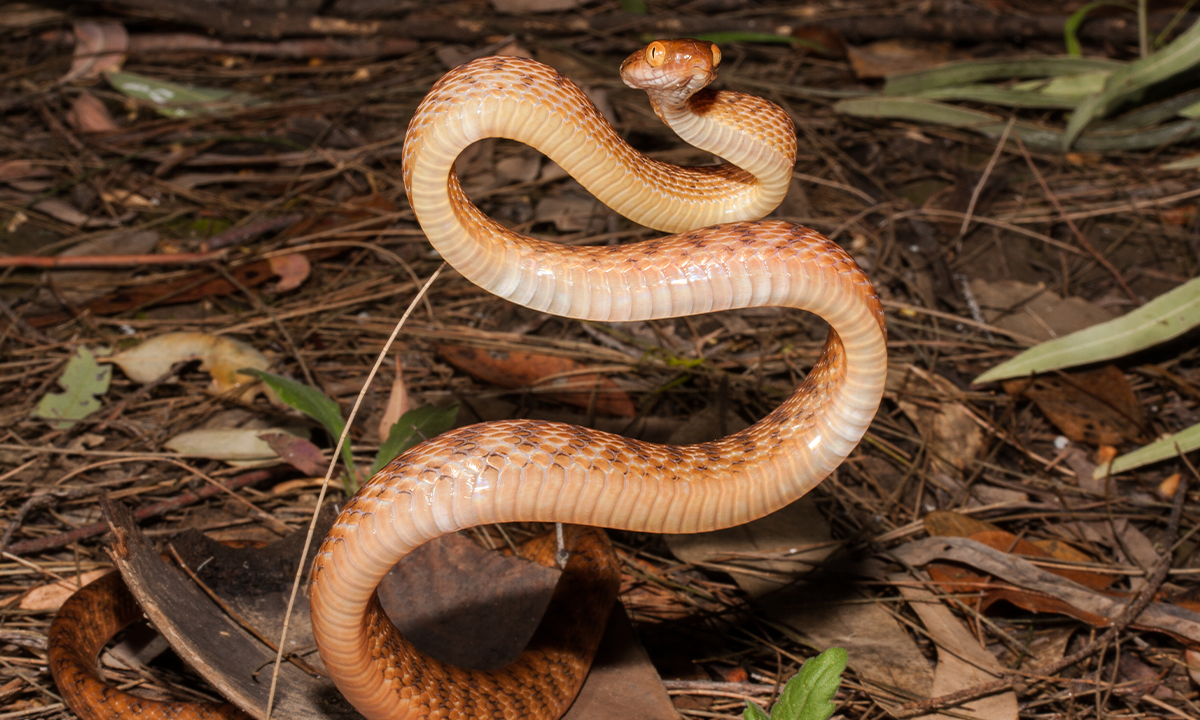
Snakes are depicted as slithering around on the ground. But the snake behavior that humans find even more alarming is when they raise body parts off the ground in strike poses or climbing stances. A recent study in Journal of the Royal Society Interface examines how snakes can stand nearly upright, wielding up to 70 percent of their body length into the air, a feat made all the more remarkable by their flexible bodies and absence of limbs.
A team of Harvard University engineers, along with a University of Cincinnati biologist, quantified experimental observations of two tree-climbing species: brown tree snakes (Boiga irregularis) and juvenile scrub pythons (Simalia amesthistina), and then modeled the forces behind their vertical movements.
“For some it may be the stuff of nightmares, but we’ve now analyzed, mathematically and physically, the hidden physics and control strategies that allow snakes to defy gravity,” said study author L. Mahadevan in a press release.
Read more: “Snakes Break All the Rules”
In each trial, a snake was placed on a lower perch and filmed as it extended its body to reach a higher perch. The distance between the two perches was incrementally increased from 11.8 to 31.5 inches—or until the snake could no longer reach the upper perch.
In lieu of directly measuring the muscles used in climbing, the researchers used data from a prior study coupled with their video observations to model the snake as an active elastic filament controlled by muscular forces. They discovered that targeted muscle contractions in a short “boundary layer” near the base of a snake’s tail allow it to effectively stand up. Rather than stiffening its whole body, a snake leverages itself up from the base, remaining so perfectly vertical as to escape any pulls of gravity.
And so, their biggest challenge turns out to be maintaining the perfect upright posture, which the study authors equate with “balancing an inverted pendulum.”
To that end, imagine stacking Jenga blocks; as long as each layer is directly over the other, the tower stays erect. It may sway a bit, which upright snakes also do, but it remains intact. As soon as one block is a bit off, however, the Jenga tower—or in this case, snake—crumples. 
Enjoying Nautilus? Subscribe to our free newsletter.
Lead image: Ken Griffiths / Shutterstock