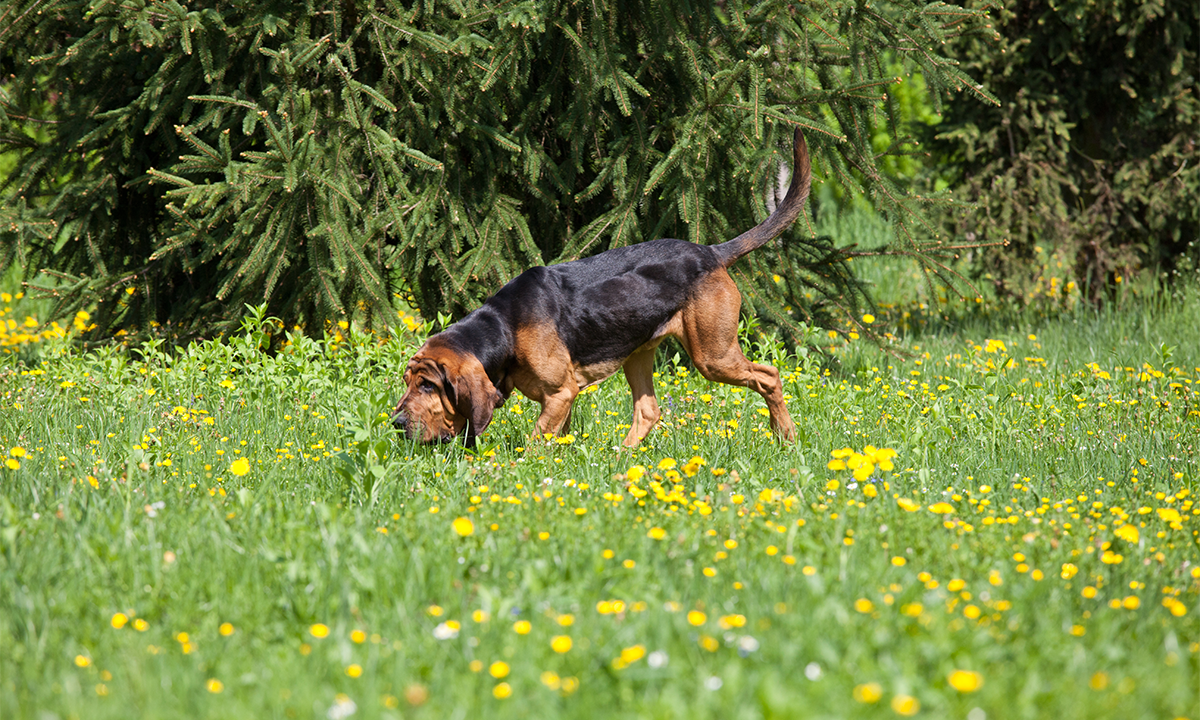
Today, our canine companions help support people with disabilities, conduct search and rescue operations, and sniff out narcotics. The personality characteristics that affect dogs’ suitability for such tasks have life-and-death implications. But, with the myriad modern breeds, what makes for the best scent-detection dog?
A new study published in PLOS One figured out the ideal dog characteristics for scent detection, based on structured interviews with experts. Veterinary researchers from Utrecht University in the Netherlands interviewed 87 professional Dutch scent dog handlers and trainers, along with a control group of 23 civilian dog owners. The participants were asked to imagine that they could create their “ideal scent detection dog, as if it were a robot created in a laboratory.” They then scored their imaginary ideal dogs on 24 dog characteristics on a scale of zero (preferably not present in the dog) to 100 (preferably present).
Most dog handlers and trainers concurred that the ideal scent detection dog is confident, persistent, and resilient, with little neuroticism or insecurity. Confidence gives a scent dog the courage to deal with new environments; persistence keeps the dog on task until a scent is identified; and resilience confers an ability to rebound from unexpected stressors that may surface in the types of settings scent dogs face (for example, war zones, loud airports, and disaster sites).
Read more: “The Doctor Will Sniff You Now”
Handlers were also queried about how much deviation was acceptable from their idealized scent dog’s characteristics. Which characteristics could they concede on, and which were deal breakers?
The favored characteristics of “confidence,” “persistence,” and “resilience” were deemed deal-breakers for which the imaginary dog could deviate little or none. Most of the professional participants also refused to make concessions on “scent-oriented,” “independent,” and “imperturbable.”
“These characteristics [for which no concessions were made] are regarded as part of a dog’s personality and thus not easily influenced by training and/or management,” wrote the study authors. Even the characteristic of “scent-oriented behavior” arguably stems from a desire to seek out and investigate odors that is innately heightened in some dogs.
Professional handlers and trainers, on the other hand, were more willing to concede on the characteristic “precise” for their ideal dogs than civilians. The research hypothesized, from informal interview data, that professionals believed they could improve a dog’s precision through training, while civilians didn’t. Professionals also ranked “possessiveness” as a positive and required characteristic. In contrast, civilians tended to view “possessiveness” as negative, and assessed “impulsiveness” and “excitability” as less desirable characteristics.
So, while anyone handling a dog would like to see confidence, persistence, and resilience, the ideal scent dog to be handled by professionals should also be scent-oriented, independent, and basically unflappable. 
Enjoying Nautilus? Subscribe to our free newsletter.
Lead image: olginaa84 / Pixabay