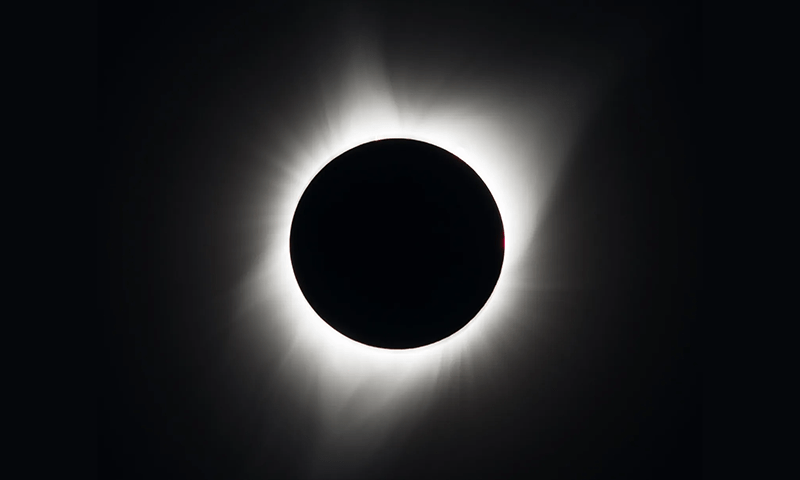
Millions of people are preparing to bathe in the dramatic midday darkness of the total solar eclipse on April 8. We experience the cosmic rhythm of light and dark, the spinning and whirling of celestial bodies to their own beat, on a daily basis. Why are humans so awed by an eclipse, that seemingly rare, brief dip of the daytime sun behind the moon?
Solar eclipses have played a powerful role in human history: They have inspired numerous religious myths, and in at least one case, according to the ancient historian Herodotus, even stopped a war. Many who have watched one report shadows growing sharper, the air temperature dropping, and animals behaving strangely, even before the sun has vanished. And during totality—when the moon covers the full disc of the sun—the visual spectacle is mind-bending: A crimson sunset-like band looms over the horizon in every direction, bright stars dot the midday sky, and the sun’s glowing white corona, its outermost atmosphere, reveals itself.
The corona itself springs prong-shaped streamers, resembling devil’s horns.
Most people will never behold a total eclipse. The moon is indifferent to where she casts her shadow. Since 2000, less than 10 percent of the world’s current population has passed through the shadow or “umbra” that the moon creates during totality. Were it not for an eclipse that passed over densely populated India and China in July 2009, that number would be closer to 2 percent. Even when the umbra passes over towns and cities, not everyone gets to witness the event. Work and weather don’t stop.
But a few years ago, in 2017, I was one of the lucky ones. When I embarked on my eclipse-viewing trip to Idaho, I thought I was prepared. I had read about the corona and seen countless photos of it beforehand. But while I knew what it was supposed to look like, there’s no substitute for the real thing. The corona itself springs prong-shaped streamers, resembling devil’s horns, that are both beautiful and utterly terrifying. As I watched, I was reminded of some lines written by the Austrian poet Rainer Maria Rilke, “For beauty is nothing but the beginning of terror which we are barely able to endure, and it amazes us so, because it serenely disdains to destroy us.”
Watching this terrifying beauty, I felt uncomfortably small and insignificant. It underscored for me how ephemeral we Earthlings are. In Earth’s many eons, solar eclipses are neither rare nor random—they are as routine as sunsets, occurring hundreds of millions of times, again and again. If eclipses are the chimes of a cosmic clock, humans scarcely live long enough to notice an entire cycle.
Such shifts in perspective are common among people who witness a total eclipse, according to the findings of a 2022 study, “The Social Effects of an Awesome Solar Eclipse,” from researchers at the University of California, Irvine. The authors analyzed millions of tweets posted during the 2017 solar eclipse and found that those sent from the path of totality were more likely to express not only awe but also prosocial language. This year, my colleagues from the Santa Monica-based Institute for Advanced Consciousness Studies (IACS) are preparing to build on that research.
Many report shadows growing sharper, the air temperature dropping, and animals behaving strangely.
Cognitive neuroscientist Nicco Reggente, principal investigator of IACS, says he is particularly interested in how an eclipse might impact prosociality, as well as how one’s individual personality might affect the likelihood that viewing such an event will inspire self-transcendence. He and his colleagues define self-transcendence as a positive altered state of consciousness associated with ego-dissolution, connectedness, and an elevated sense of morality, which impacts one’s well-being, sense of meaning, and pro-social attitudes.
On April 8, Reggente and Leo Christov-Moore, a senior research scientist at IACS, will visit an eclipse festival in Burnet, Texas. In collaboration with Sensoria, another consciousness research organization, they will collect data on self-reported experiences of self-awareness, connectedness, awe, and perceptual distortions from more than 1,000 eclipse witnesses just after the cosmic event. The data will be an important test of the scientists’ hypothesis that extraordinary experiences can promote belief change and prosocial feelings. In previous work, they found that experiences of self-transcendence are strongly associated with “aesthetic chills,” pleasurable goosebump-like sensations. The researchers will also collect data on these experiences, which they expect to see in their participants.
According to legend, King Louis the Pious died of fright after witnessing a total solar eclipse 1,200 years ago. While such stories are likely often exaggerated, it’s true that no one can be fully prepared for a psychologically transformative experience. But you can prepare for the physical risks. These are easily avoidable: Never look directly at the sun without proper eye protection, such as ISO-certified eclipse glasses. Indeed, nearly all of us have been conditioned (for good reason) to never stare at the sun. As a result, looking straight at it can feel weird, even with protective glasses.
In Idaho, I felt I was staring up at a powerful god who might smite me. Even knowing this wasn’t so, I was certainly communing with something far more powerful than myself. I’m looking forward to doing it all over again on April 8. Feeling so small and insignificant can be a reminder of the stunning drama that governs the cosmos of which we are a part. 
Lead image: NASA/Aubrey Gemignani
Prefer to listen?