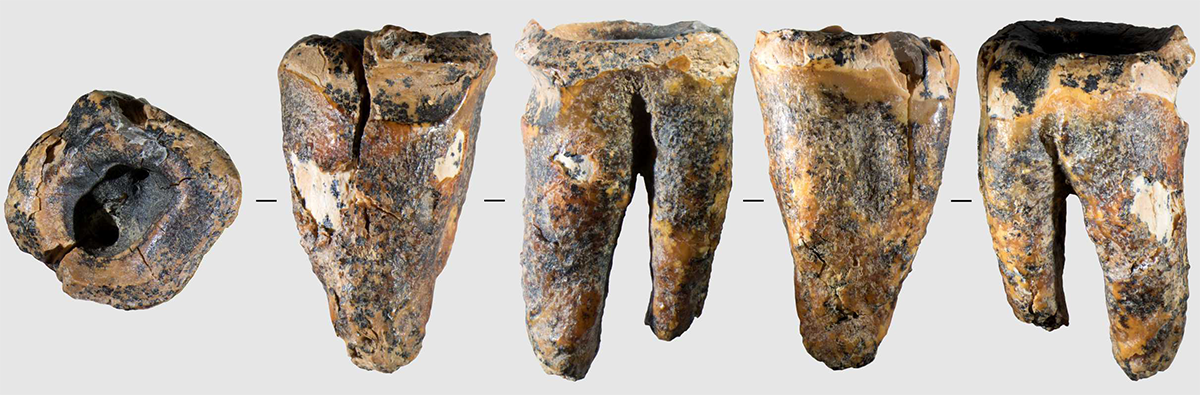
If you’ve ever had the misfortune of getting a cavity drilled, you know it’s not an experience you subject yourself to on a whim. That’s why paleontologists were surprised to find a Neanderthal molar with drill holes among the approximately 59,000-year-old remains unearthed in the Altai region of Russia. An analysis of the tooth revealed a hole drilled through the top enamel into the pulp—exactly the kind of opening you’d expect from a dentist excavating a cavity.
“We were intrigued by the unusual shape of the concavity on the tooth’s chewing surface,” Alisa Zubova of the Russian Academy of Sciences and co-author of a study on the tooth published today in PLOS One said in a statement. “It differed from the normal morphology of the pulp chamber and did not match the typical pattern of carious lesions seen in Homo sapiens. Moreover, distinctly visible scratches suggested that the concavity was not the result of natural damage but of intentional actions.”
But did Neanderthals really have dentists?
Our archaic cousins were already known to care for the sick and elderly and use toothpicks, so dentistry isn’t too far of a leap. To find out for sure, the researchers decided to perform an experiment. Using simulated Neanderthal stone tools comparable to those found at the Altai site, they attempted to drill into two teeth from Stone Age humans and one modern tooth (donated by one of the study authors).
Read more: “Our Neanderthal Complex”
Remarkably, they were able to complete the task, and a close examination of the human teeth and the original Neanderthal molar under an electron microscope revealed the grooves along the hole were similar. “Comparison of the microscopic traces on the original Neanderthal specimen with those produced experimentally revealed a clear match,” study co-author Lydia Zotkina explained. “The findings demonstrate that drilling a carious lesion using a sharp, thin stone tool is entirely effective, permitting the rapid removal of damaged dental tissue.”
It’s not just the first evidence of Neanderthal dentistry either—it’s the “world’s oldest evidence of successful dental treatment,” the authors wrote. And the implications of this finding on Neanderthal life are staggering. Not only could they correctly identify the cause of the pain, they developed both the treatment and the tools to ameliorate it. Perhaps even more impressive, it demonstrates that Neanderthals were capable of goal-directed behavior that involved an incredible amount of pain. The researchers say wear marks on the tooth indicate its owner lived to eat for quite a while after the surgery.
And with no evidence of dental insurance found, maybe our distant relatives were more advanced than us after all. 
Lead image from Zubova, A. et al. PLOS One (2026).