Humans have remarkably large brains for our bodies (no offense), but why?
One theory, the social brain hypothesis, says we owe our massive noggins in part to the evolutionary pressure exerted by the demands of large social groups. Because we needed to keep a running tally of friends and foes to navigate thorny hierarchies and shifting alliances, we had to have brains that were up to the task (which is why this theory is also known as the Machiavellian intelligence hypothesis).
In many animals, especially mammals, there does seem to be a correlation between social group size and brain size. But there’s at least one big exception to this rule: cephalopods.
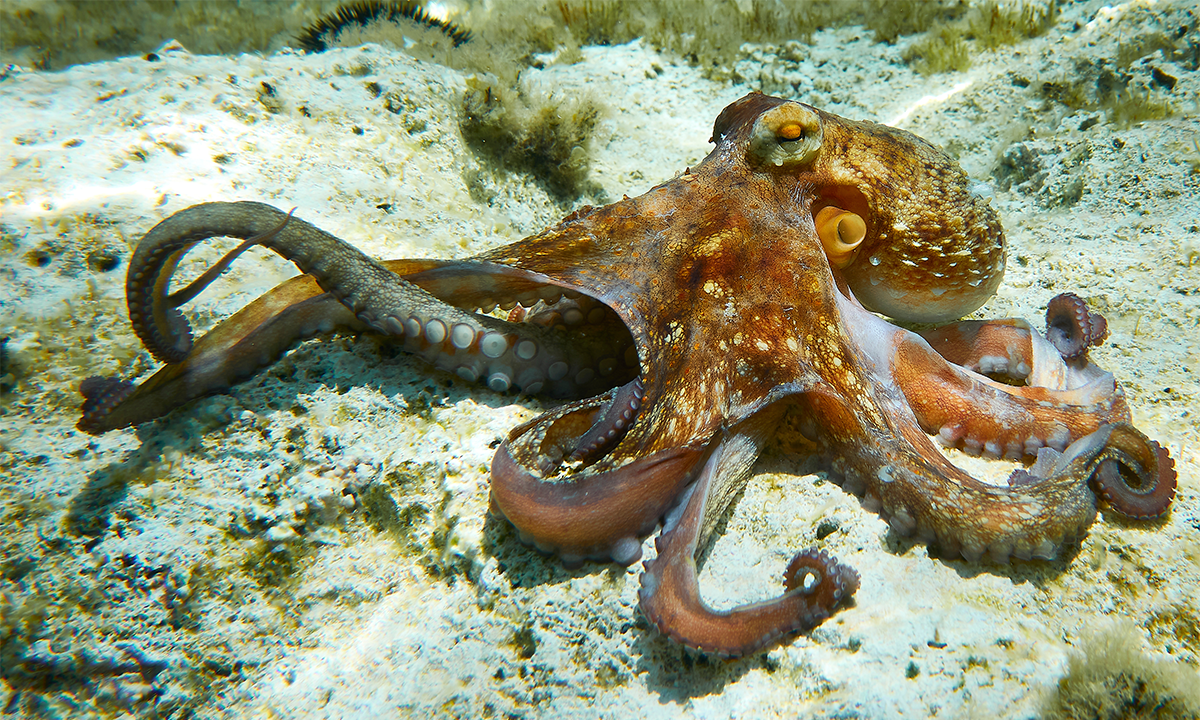
Cephalopods like octopuses have huge brains but aren’t really known for their gregarious behavior. They tend to live solitary lives, mating without forming pair bonds and reproducing without parenting their young. In fact, their behavior can stray into the downright anti-social—many species are territorial, aggressive, and cannibalistic. Still, they’re incredibly intelligent. Octopuses use tools, solve problems, and even like to play.
Read more: “The Octopus Teacher’s Student”
So if sociality can’t explain big cephalopod brains, what can?
In a new paper published in iScience, an international team of researchers proposed a new version of the cultural brain hypothesis. This hypothesis—first advanced by one of the authors of the current study—states that big brains evolved to handle mountains of information that are learned both socially and asocially. In this latest research, the team focuses solely on the asocial pathway to brain evolution.
To test their asocial brain hypothesis, the team compiled data on cephalopod brain size as well as ecological, behavioral, and social factors from 79 cephalopod species. They found that several ecological factors seemed to correlate with big cephalopod brains, especially the complexity of their habitats. Cephalopods that lived on the ocean floor and in shallow pools—where cleverness can be rewarded with calorie-rich prey—tended to have larger brains. Sociality, on the other hand, showed no such correlation.
“For decades the main story of why brains got big has been a social one where bigger brains evolve to manage bigger, more complex groups,” study author Michael Muthukrishna of the London School of Economics and Political Science said in a statement. “Cephalopods reveal that there’s another path to bigger brains.”
Let’s hear it for the intelligent, moody loners of the sea. 
Enjoying Nautilus? Subscribe to our free newsletter.
Lead image: gennaro / Adobe Stock