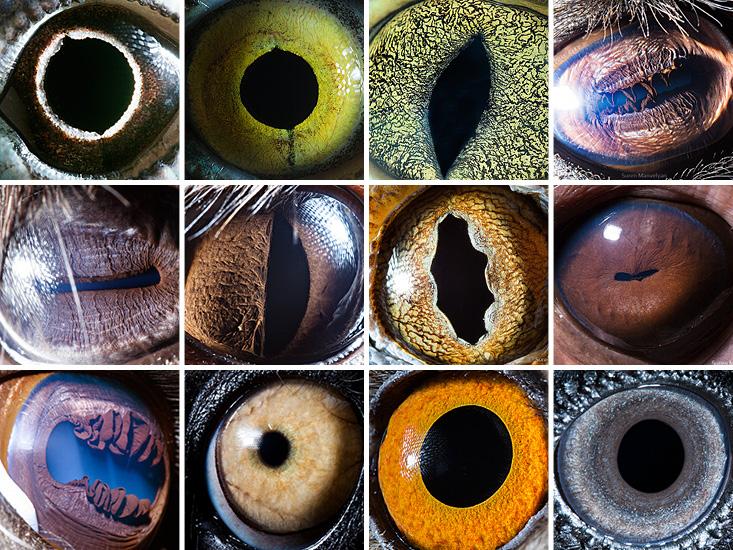
Last week, we asked you to pick out human eyes from animal eyes that look similar. It was probably harder than you expected. This week’s eyeball challenge, again courtesy of some great photographs by Suren Manvelyan, might be even harder. Can you tell which very inhuman-looking eyes (bigger images below) belong to which animals?
Here’s a list of animals to choose from: anole lizard, caiman (an alligator-like reptile), camel, common basilisk lizard, cow, fennec fox, hippopotamus, lemur, llama, long-eared owl, raven, and tokay gecko. Now try to match them up with these eccentric eyes. The answers are at the bottom of this post.
So why do these eyes look so different from ours?
The first thing you might notice is that some of these animals have strangely shaped pupils. While (most) humans and birds have round pupils, lizards, snakes and cats have ones shaped like slits. (Some people are born with “cat’s eye” or coloboma—where the pupil is not round. You can see an example of that in our earlier post on human eyes.)
For a long time, scientists thought that the slit-shaped pupil was to help enhance their night vision, but recent research suggests that’s no the case at all. Instead, it seems some species have tall, skinny pupils because the lenses of their eyes have different concentric zones, each of which focuses specific wavelengths of light onto the retina. Having a long, linear slit allows them to contract their pupils without entirely blocking out any of the focal zones and associated wavelengths. “A contracted round pupil will mask some of these concentric areas, rendering them useless” says François Brischoux, a researcher at the University of Sydney who studies snake eyes. Since humans don’t have these different zones, a round pupil is just fine for us.
Possibly because of these multiple focal zones, some geckos have a quite strange pupil shape. Instead of a slit or a single circular hole, their pupils close up to form four tiny, separate holes. You can see the beginnings of this in the Tokay gecko photograph above; when the scallop shape closes up, it leaves open just the four pinholes. “The reasons for this are not really known,” says Almut Kelber, a biologist in the vision group at the University of Lund. “But it may be just easier to achieve a very small pupil this way.”
Geckos aren’t the only ones with strangely shaped pupils, either. Look at the llama—the one with the nudibranch-like structure protruding from the flat part of its iris, the colored part of the eye. That thing is called a corpora nigra, or black body. It only comes out in bright sunlight, and seems to protect the animal’s eyes. “Basically they’re a baseball cap built into the eye,” Kelber explained. What remains a mystery, however, is why their pupils are neither round nor slit shaped, but instead a strange irregular oval.
As for the reasons behind the colors of various animals’ irises, that’s relatively unknown as well. Some suggest that the coloration of the eyes helps camouflage an animal, so caimans have caiman-colored eyes and ravens have raven-colored eyes. But other species have bright, distinct eyes that don’t blend in at all. The great Horned Owl has bright orange eyes due to some unusual pigment cells. These cells are full of little lipid droplets and surrounded by crystalline granules which together give the owl’s eye its color.
But science has not yet explained exactly why different lizards and snakes have the iris colors they do. “There is definitely an interesting field of research there, and it seems that nobody is paying attention to it” says Brischoux.
If eyes are the window to the soul, we still have much to learn about the lives of these animals.
Answer key:
Lemur | Raven
Caiman | Llama
Fennec Fox | Tokay gecko
Hippo | Long-eared owl
Camel | Cow
Anole | Basilicus Lizard