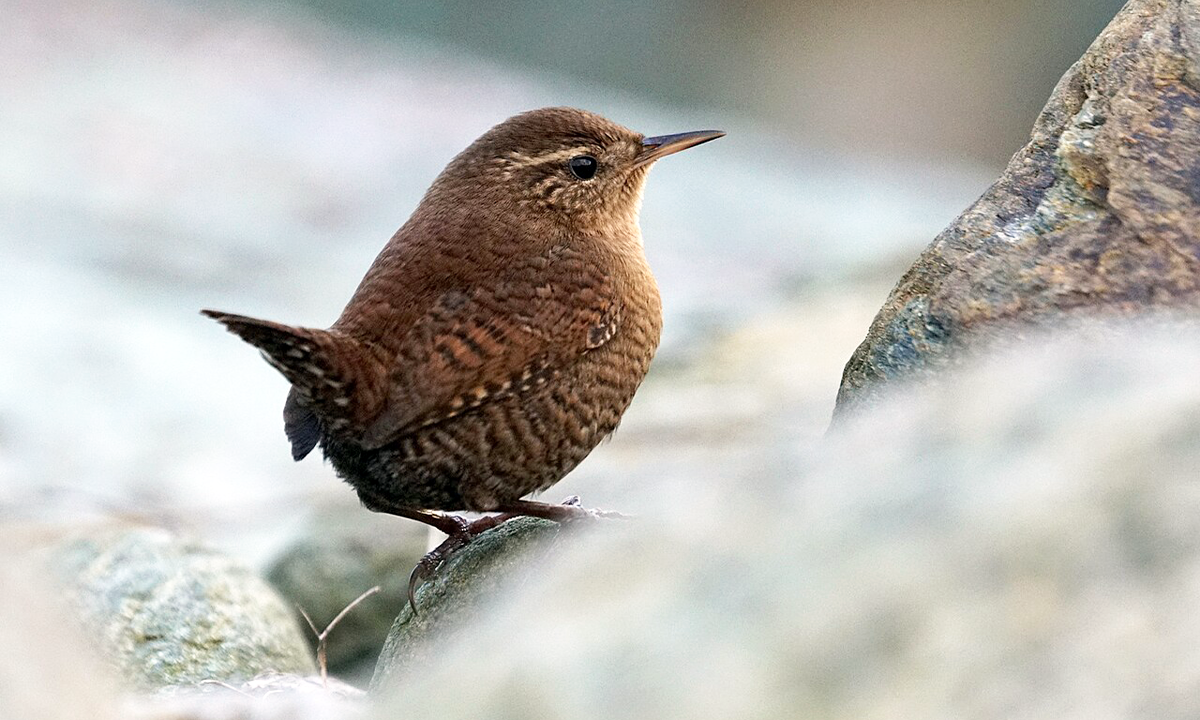
Some island animals are notably bigger than their mainland relatives. Witness the giant tortoises on the Galápagos, the 300-pound Komodo dragons on Indonesian islands, and the colossal hissing cockroaches of Madagascar. This “island gigantism” has been considered a case of convergent evolution, where similar selective pressures on islands lead to similar responses of species, something that’s exemplified in a new study in the Evolutionary Journal of the Linnean Society about British wrens on islands around Scotland.
Led by the University of Birmingham, researchers compared wrens (Troglodytes troglodytes) across four Scottish islands: Shetland, Fair Isle, the Outer Hebrides, and St Kilda. They captured and released wrens, collecting body measurements and blood samples from 62 adult birds as well as recording 55 wren songs in the field.
Three of the subspecies were found to be significantly heavier than mainland wrens. The largest individuals of the Shetland (T. t. zetlandicus) and St Kilda (T. t. hirtensis) wrens were up to twice as heavy as their smallest mainland counterparts. They look similar, but their genomes proved genetically distinct, showing that they haven’t been breeding recently with their mainland cousins.
Read more: “The Most Charming Villain in the Sky”
“Their island gigantism is a case of ‘parallel evolution,’ where a similar original population (probably colonists from the British mainland) made it to each island archipelago,” explained study author Michał Jezierski, a biogeographer at the University of Birmingham, in a press release, “then independently evolved to become island giants.”
Furthermore, the wren populations on different islands have unique traits that evolved after isolation from their mainland ancestors. There’s variation in their plumage colors, body proportions, and songs, with more extreme features in the wrens of Shetland and St Kilda. Wrens from Fair Isle and the Outer Hebrides aren’t as far diverged from the British mainland wrens.
Essentially, the islands’ wren populations have assumed their own character during geographic isolation from mainland populations—and each other. All islands obviously offer distinct ecological conditions, such as limitations on resources and lower predation and competition, absent species present on continents. “Their genetic distinctiveness [of Shetland and St Kilda] is so high that it’s likely they’re on their way to becoming new species,” explained Jezierski.
These new species might not be better, but chances are they’ll be bigger. 
Enjoying Nautilus? Subscribe to our free newsletter.
Lead image: Mike Pennington / Wikimedia Commons