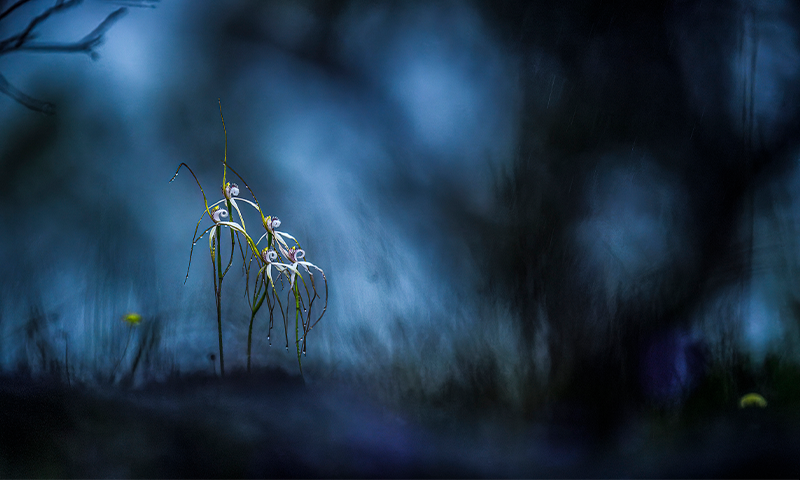
Against the moody, rain-soaked backdrop of Western Australia’s southern coast, flowers from a lone white spider orchid emerge from the brush and unfurl their spindly arms.
Photographer Georgina Steytler captured the illusory, spectral essence of these plants, which tempt pollinators with scents and flowering bodies that resemble those of the pollinators’ mates. The image was a finalist in this year’s California Academy of Sciences’ BigPicture Photography Competition.
The orchids inspire male wasps to try to copulate with the flower.
Several spider orchid species, including the white spider orchid, are what scientists call “sexually deceptive,” producing so-called pseudopheromones that mimic the scents of female wasps. Paired with the orchid’s unique color and shape, these adaptations lure male wasps from afar and inspire them to try to copulate with the flower, covering the wasps with pollen in the process. The insects then deliver this pollen to other plants they visit.
Spider orchids tend to live as loners, rather than in colonies, and thrive in the biodiverse forests of Western Australia. Depending on which taxonomist you ask, the spider orchid genus includes a staggering number of plants endemic to the region: Scientists estimate there are roughly 380 species of spider orchids, with more than 185 in Western Australia alone.
And yet, many spider orchids are found only along Western Australia’s southern coast, and some species are critically endangered, such as the elegant spider orchid, or Caladenia elegans. Local government officials have promoted recovery plans to protect these endangered species, whose populations have been devastated by wildfire, humans, invasive weeds, chemical fertilizers, and animals, such as hungry feral pigs and kangaroos.
The endangered orchids need whatever help they can get—whether from lovesick wasps or from conservationists. 
This image originally appeared on bioGraphic, an online magazine about nature and regeneration and the official media sponsor for the California Academy of Sciences’ BigPicture Natural World Photography Competition.