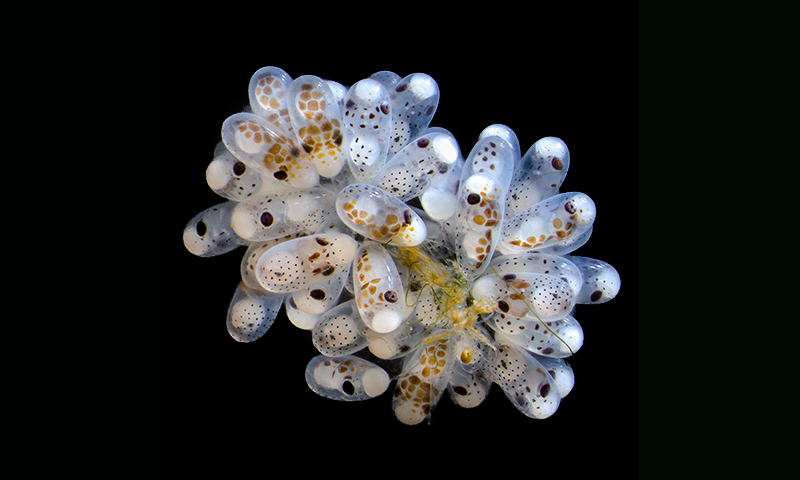
Like tiny grapes tethered together by a vine, a clump of Caribbean two-spot octopus eggs (Octopus hummelincki) huddles under the watchful gaze of a magnified camera lens. The cluster, which measures just under 1 centimeter in diameter, holds the lives of dozens of fragile, weeks-old embryos.
The Caribbean two-spot octopus tends to shelter in the shallow costal shelves of the Caribbean Sea and the Gulf of Mexico. Very little is known about the species' reproduction and development, but like most octopus species, it lays clusters of eggs that are knotted together by translucent strings and guarded in their nests. Mother octopods generally tend to and clean their offspring for weeks at a time—a period dependent upon the species and the surrounding water temperature—until the eggs hatch and start their life cycles as miniscule, planktonic larvae.
Each egg is speckled with pigment sacs colored a brown hue that is reflective of their environment.
Like many other cephalopods, two-spot octopuses are masters of disguise. Observations from almost a century ago detail this octopus’ effective camouflaging practice, with one 1937 observation remarking on a wild two-spot octopus’ ability to rapidly alternate between mottled patterns and solid colors. Their colorful “flashing” is enabled by a complex web of chromatophores: These color-changing organs have a distinct pigment sac that sits beneath the surface of their skin and expands and contracts to reveal different hues.
Such chromatophores are a subject of fascination for Thomas Barlow and Connor Gibbons, who took this photograph, the fifth place winner in Nikon’s Photomicrography Competition. Barlow and Gibbons are also researchers at Axel Lab, a neuroscience lab at Columbia University that is investigating the neural basis of camouflage in cuttlefish and other model cephalopods—including the adult mother of this egg cluster.
Even the 20-day-old eggs pictured here reveal the early development of chromatophores: Each egg is speckled with pigment sacs colored a brown hue that is reflective of their environment and smaller than a millimeter. When the eggs eventually mature into adults, the cephalopods will use their developed chromatophores to transform visual information into neural signals, projecting an approximation of what they see on their skin.
By studying this complex system in cephalopods, neurobiologists hope to better understand how brains process and project visual information. The Axel Lab has already mapped a “brain atlas” for dwarf cuttlefish (Sepia bandensis), displaying the neuroanatomical mechanisms that enable its changing pigments and patterns. And because cephalopods use camouflage for several different behaviors—ranging from courtship to signaling social cues like hunger, aggression, and fear—researchers ultimately seek to understand how neural visual processing is intertwined with other forms of social activity.