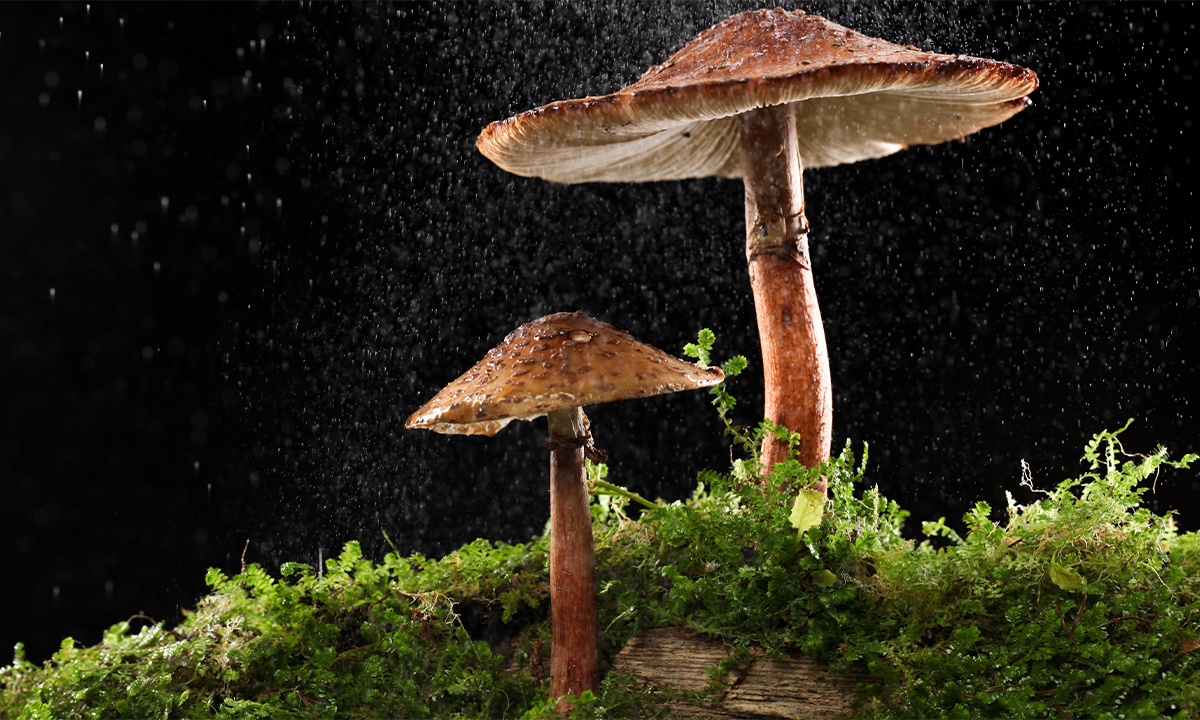
Mushrooms typically pop up after a rainstorm, but what if they could cause them, as well? According to research recently published in Science Advances, some fungi might be able to do so, and they got this ability from an unlikely source.
In clouds that are below freezing, rain begins as ice, melting as it falls to Earth through warmer air. But water doesn’t just automatically make the transition to ice when temperatures dip below freezing. Instead, it needs something to grab a hold of to start forming ice crystals. This process, known as ice nucleation, can be triggered by any number of nonliving substances, like dust. It can also be triggered by living things like the bacterium Pseudomonas syringae.
P. syringae, commonly found on plants, expresses a protein in its cell wall that speeds the process of ice crystal formation. Unfortunately, this particular feature of the bacteria can have disastrous consequences for crops. Because these proteins make ice form at higher temperatures, plants that would otherwise survive a cold snap instead get damaged by frost.
According to biologists from Virginia Tech University, fungus from the family Mortierellaceae co-opted these bacterial genes at some point and gained the ability to produce a very similar protein. “It is known that fungi can acquire genes from bacteria, but it’s not something that is common,” study co-author Boris A. Vinatzer explained in a statement. “So I never expected that this fungal gene had a bacterial origin.”
Read more: “A Wild Idea to Protect the Great Barrier Reef”
While it’s unclear what benefit the fungi get from producing such an ice-nucleating protein, the researchers said that evolutionary improvements to the protein over generations indicate there’s likely some utility. For example, unlike the bacterial version, the fungal protein is smaller, water soluble, and isn't bound to any membranes.
But could the fungi be using this purloined protein to make it rain?
Because they’re active in low concentrations and under harsh conditions, researchers say it’s possible that their effects on atmospheric ice nucleation are underestimated. Still, they say more research is needed to reach any definitive conclusions.
In the meantime, the novel characteristics of the fungal protein make it an ideal candidate for cloud seeding (as opposed to the toxic chemicals like silver iodide that are typically used). “If we learn how to cheaply produce enough of this fungal protein, then we could put that into clouds and make cloud seeding much safer,” Vinatzer said.
There’s nothing natural about manufacturing rain, but these fungal proteins could at least make it a little more organic. 
Enjoying Nautilus? Subscribe to our free newsletter.
Lead image: Leigh Prather / Adobe Stock