In 1900, the French tire company Michelin took a seemingly circuitous route to sell more tires: They started reviewing restaurants. Alerting the French people to distant fine-dining opportunities, the theory went, would increase demand for cars which would in turn increase demand for tires. Fast forward to today and a Michelin star is one of the most sought-after honors for any chef seeking to make their mark on the culinary world. It’s also the inspiration for the name of a newly discovered Japanese jellyfish.
Found floating in the shallow waters off the coast of Nagasaki and Yamaguchi Prefectures, researchers from Fukuyama University collected samples of the jellyfish and hauled them back to the aquarium. There, they fed them brine shrimp, allowed them to breed, and watched as they produced offspring in order to study the jellyfish’s life cycle in full.
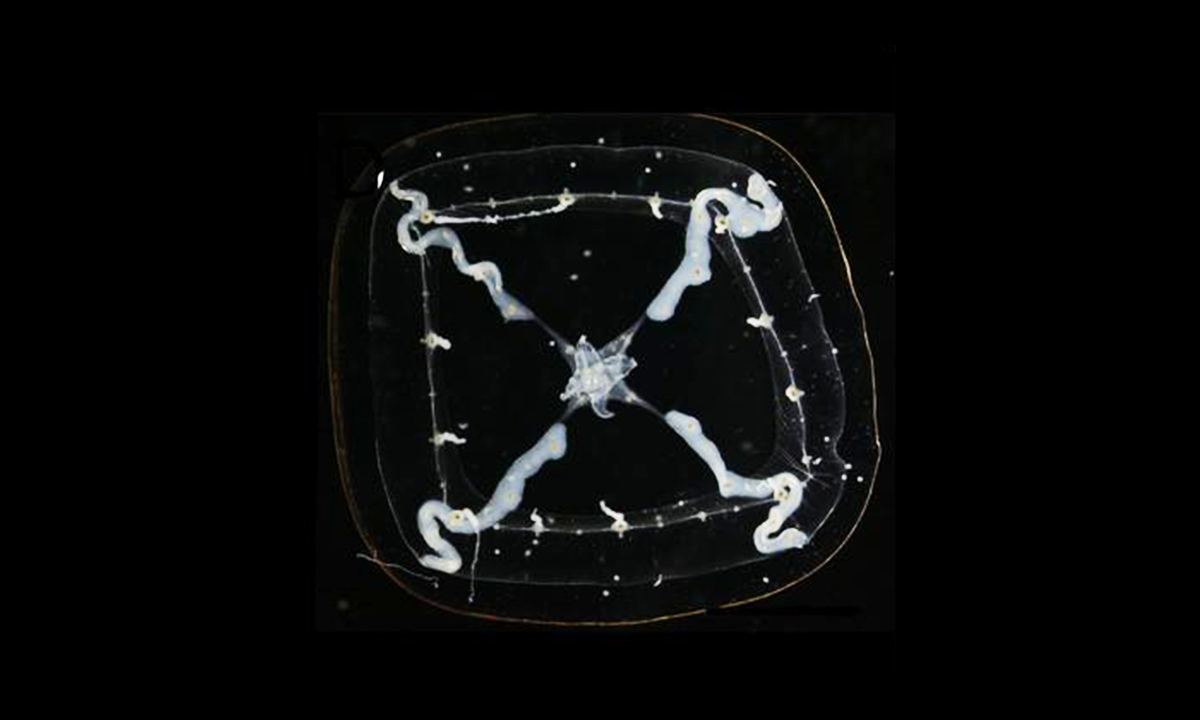
The species had four linear gonads and four “lips” at the end of its manubrium—the tube-like stalk that serves as the creature’s mouth. Taken together, the features placed it in the family Malagazziidae. But what set it apart from other members of the family were the mysterious small brown spots peppered across its stomach and reproductive organs.
Read more: “How to Learn Without a Brain”
Because they resembled stars, these spots led the researchers to give it the name Malagazzia michelin. As it grew, they noticed, it accumulated more spots, just like restaurants can earn more Michelin stars for better quality food.
The discovery also called attention to a vexing problem with jellyfish names in Japan. Because they’re typically given common names based on their appearance, they can go mislabeled for years. Malagazzia michelin, for example, already had the incorrect common name “tsubuiri-sujiko-yawara-kurage,” which translates to “salmon-roe laodicean jellyfish.”
The name was problematic because it wasn’t a member of distantly related family Laodiceidae at all, rather it was a member of the family Malagazziidae. In keeping with the celestial theme, researchers gave this new species the common name “ama-no-gawa-kurage,” or “Milky Way jellyfish.”
Just don’t look for it on any Michelin star menus anytime soon. At only half an inch in size, it wouldn’t make for a very filling meal. 
Enjoying Nautilus? Subscribe to our free newsletter.
Lead image: From Izumi, T., et al. ZooKeys (2026)