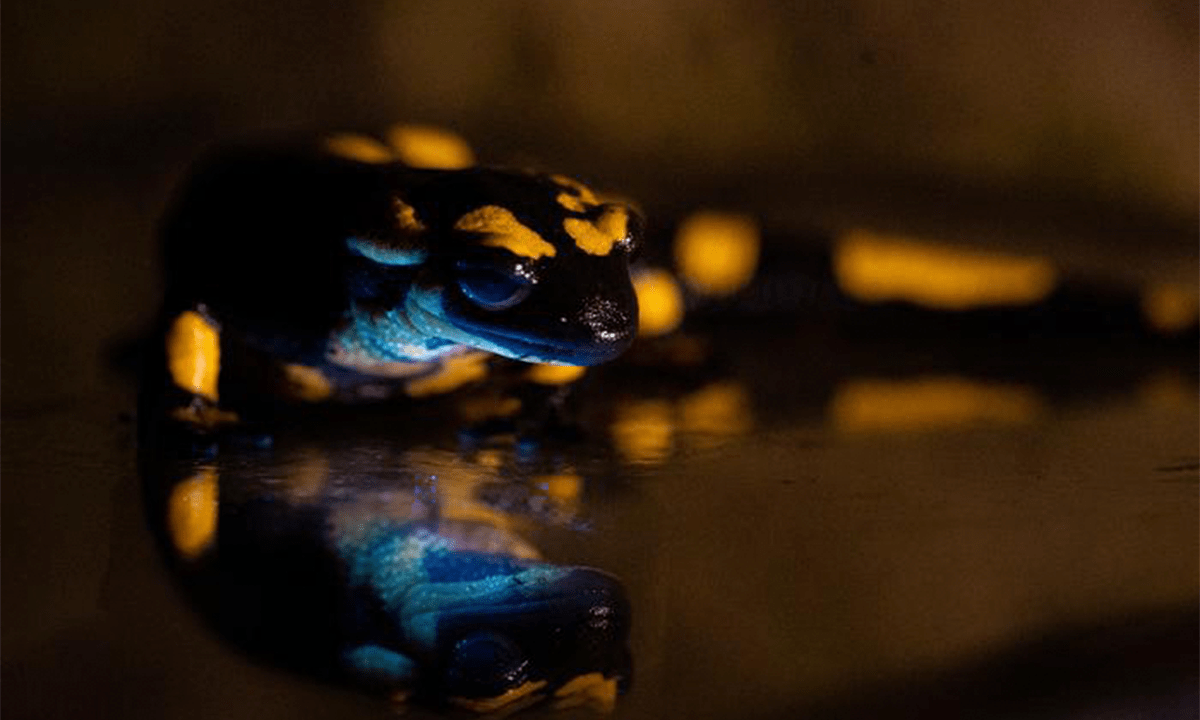
You’d think that a salamander well-known to science, the fire salamander (Salamandra salamandra), would harbor no secrets. Decades of research have focused on its bright yellow and black coloration as a warning signal to predators about its toxic skin secretions. Now, though, a recent paper in Royal Society Open Science reports (surprise!) that fire salamanders are fluorescent.
“It reminds us that even the most familiar organisms can hide secrets that are only revealed when they’re observed with new tools,” said first author Bernat Burriel, an evolutionary biologist at the Museum of Natural Sciences in Barcelona, in a press release.
An international group of scientists from Spain and Germany examined fire salamanders under 365-nanometer UV flashlights and saw bright, fluorescent sparkles, mostly amassed like blue-green twinkling stars over areas of yellow coloration. The sparkles occurred all the way down the salamanders’ legs to their toes.
In other amphibians, fluorescence is known to be produced in one of three ways: skin properties; skeleton features; or special “fluorophores” (chemical compounds that fluoresce) in body fluids.
Read more: “Why Do Jellyfish Glow?”
To determine whether defensive glandular secretions were the source, the researchers swabbed salamanders around the parotid glands on the neck and shoulders to prompt a defensive toxin release. The fluorescence pattern matched where the secretions were emitted, implicating the glands. Juveniles didn’t fluoresce, likely because their glands hadn’t yet fully matured.
A deeper look at the secretions revealed fluorophores in the parotid glands and even circulating in the bloodstream. Although the chemical identity of the fluorophores is still undetermined, they’re thought to be novel compounds, since the main ingredient in fire salamander secretions is steroidal alkaloids that don’t fluoresce.
“Fluorescence meets several criteria that suggest a communicative function,” explained study coauthor Martin Kaltenpoth, chemical ecologist at the Max Planck Institute in Germany. “It could help salamanders detect each other in nocturnal or particularly dense environments, or act as an additional defense signal.”
It could also be part of courtship communication or a defense to warn predators away under moonlight, which contains UV wavelengths.
Bright lights, small amphibians. 
Enjoying Nautilus? Subscribe to our free newsletter.
Lead image: Bernat Burriel-Carranza, Museu de Ciències Naturals de Barcelona, Spain